
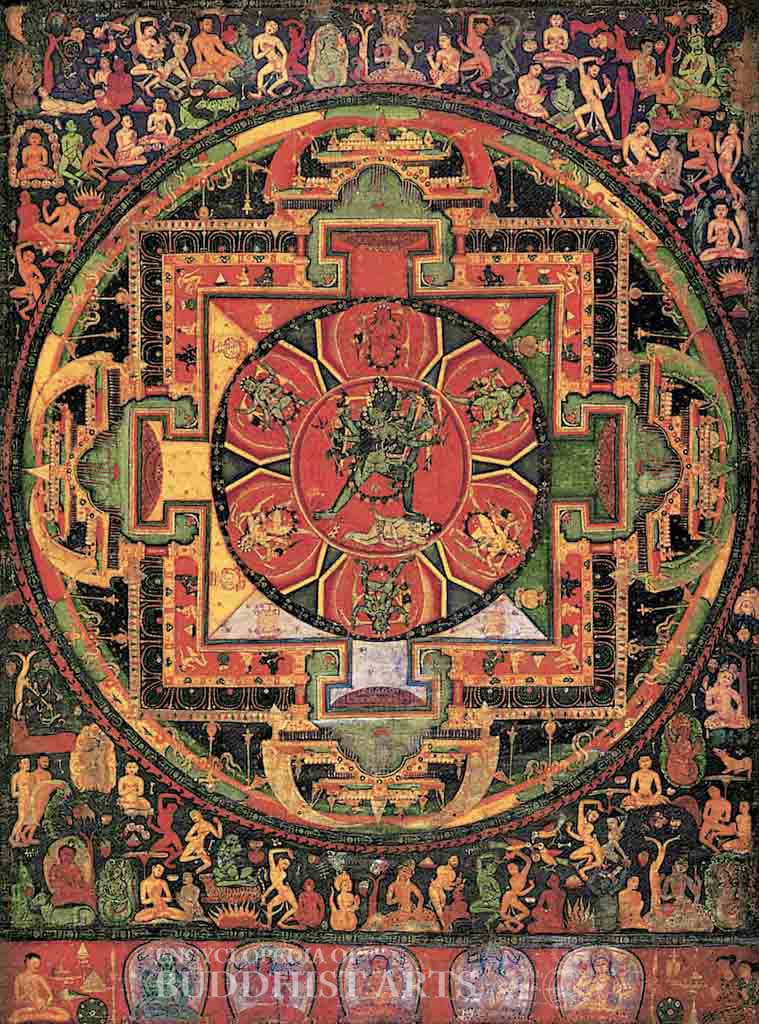
Paramasukha-Cakrasamvara Mandala
Color on cloth
Paramasukha-Cakrasamvara Mandala
NEPAL
Based on scientific research and style analysis, this mandala is thought to have been painted in 1100, making it the oldest known Nepalese paubha (painting on cloth).
The central figure, Four-Headed, Six-Armed Cakrasamvara, wears a crown and a long garland adorned with skulls. The hands form mudras, hold Dharma instruments, and embrace his consort, Vajravarahi, who is colored in blue instead of the usual red. The two figures stand within the center of a lotus flower. Six female Dharma protectors, each with four arms, are depicted within the petals. They are surrounded by a ring of patterned vajras. Moving outwards, a square palace with a tall gate in each of the walls is contained within the thin outer ring of the mandala. Outside the ring, there are colorful depictions of the eight charnel grounds. The deity of each charnel ground is seated beneath a tree, surrounded by dancing practitioners, corpses, and wild dogs. At the bottom of the painting, there are images of five deities including Tara, Kurukulla, and Vasudhara Bodhisattva. The slender, dynamically posed figures are characteristic of Nepalese art.
For more details, go to the Encyclopedia of Buddhist Arts: Painting P-Z, page 735.
Cite this article:
author = Hsingyun and Youheng and Youlu and Wilson, Graham and Manho and Mankuang and Huntington, Susan,
booktitle = {Encyclopedia of Buddhist Arts: Painting P-Z},
pages = 735,
title = {{Paramasukha-Cakrasamvara Mandala}},
volume = 16,
year = {2016}}