
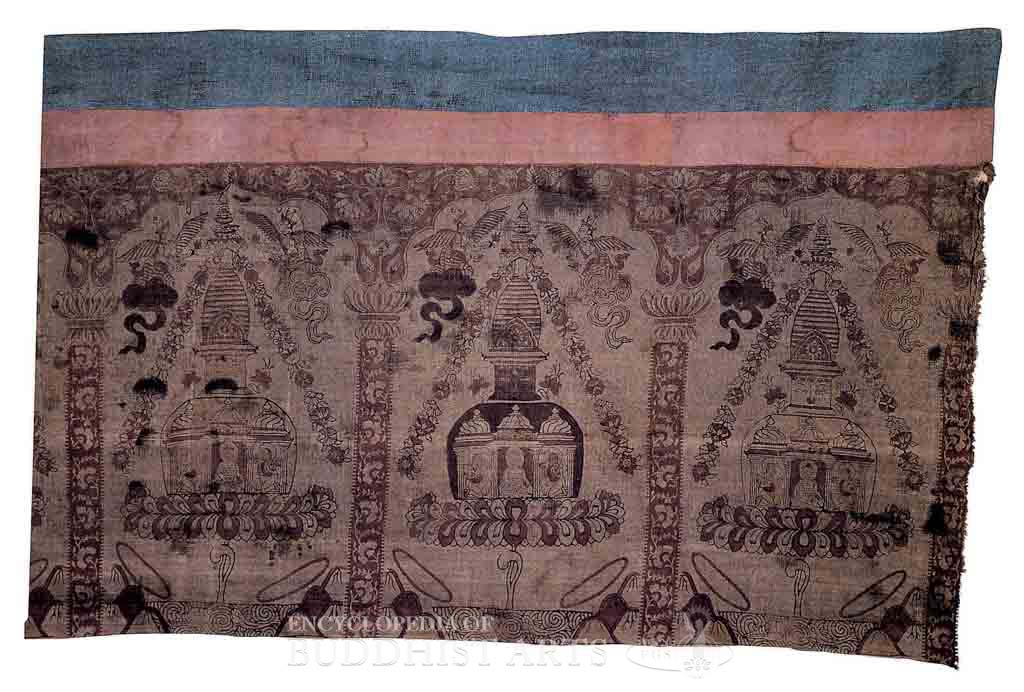
Stupas (detail)
Print on cotton
Stupas
INDIA
This long scroll decorated with printed images was produced in India for use in Nepal. Scrolls like this are stored in temples and are displayed outside on important religious occasions. Adverse weather conditions speeds up the process of discoloration. The length of the scrolls makes them unwieldy to handle and difficult to preserve.
A woodblock was used to print the repetitive pattern, resulting in three near identical images positioned side by side. The stupa in the middle of each image is based on the great Swayambhunath Stupa in Kathmandu, Nepal. In the lower register, there are two hills separated by a pool of water. A long-stemmed lotus rises from the water and serves as the base of the stupa. There are three niches in the body of the stupa. A seated Buddha is in the central niche, flanked by two kneeling disciples. Buddha eyes, a distinctive feature of Swayambhunath Stupa, can be seen on the base of the spire. Above, there is a decorative lotus flower and 13 stacked rings, which represent the 13 steps to attaining Buddhahood. Garlands are attached to the top of the spire and hang down in symmetrical lines. Beside the garlands, two winged apsaras sit on clouds and offer flowers. The floral patterns on the arch, columns, and architrave surrounding the stupa reflect the scroll’s Indian origins.
For more details, go to the Encyclopedia of Buddhist Arts: Painting P-Z, page 874.
Cite this article:
author = Hsingyun and Youheng and Youlu and Wilson, Graham and Manho and Mankuang and Huntington, Susan,
booktitle = {Encyclopedia of Buddhist Arts: Painting P-Z},
pages = 874,
title = {{Stupas}},
volume = 16,
year = {2016}}