
Buddha Teaching the Dharma
Ink and color on cotton
Buddha Teaching the Dharma
NEPAL; Malla dynasty
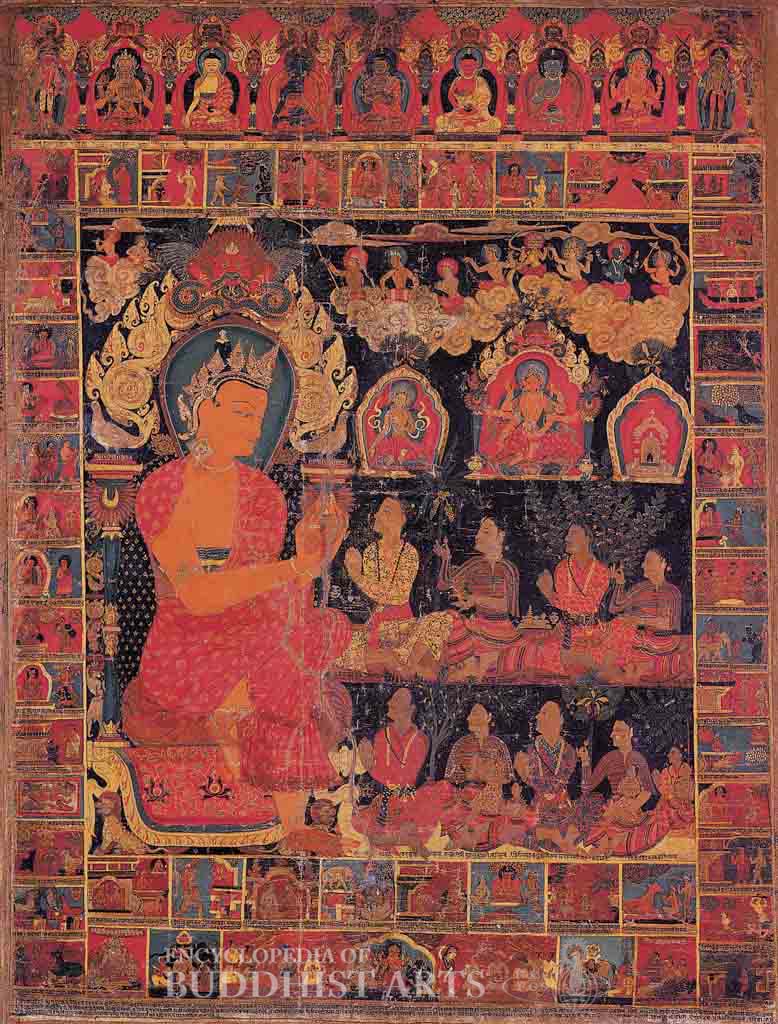
Dated to 1648, this Nepalese painting was sponsored by the Kansakar clan of Kathmandu. The central image is Sakyamuni Buddha teaching the Dharma to the Kansakar clan. The border of the painting is decorated with scenes from the Life of the Buddha and the Jataka tales.
The central figure differs from the typical centrally positioned Buddha seated in full lotus position. Instead, the Buddha is shown in profile, positioned to the left of center. Seated in a relaxed pose on an elaborate throne, the Buddha faces a group of seated figures. Sakyamuni Buddha has a nimbus surrounded by golden patterns, and wears a crown. Dressed in rich brocaded robes, he probably forms the Dharmacakra (Dharma wheel) mudra.
The figures representing the Kansakar clan are arranged in two rows. The names and titles of the ten adults and three children are neatly inscribed in Newar script. The nobly dressed figures join their palms or hold flowers, incense, or other offerings as they piously listen to the Buddha. There are three gold niches above the Kansakar clan. Tara is shown within the niche on the left, Six-Armed Vasudhara is in the middle, and on the right there is an empty throne representing the emptiness of all phenomenon. Above the niches, ten heavenly beings are shown standing on clouds and either playing musical instruments or making offerings.
The small squares on the four sides have alternating red or green backgrounds and contain illustrations of forty scenes from the Jataka tales and six events from the Life of the Buddha. The stories are identified by short inscriptions. Some of the tales depicted include the King Sibi Jataka, the Jataka of the Lion King, the Mahakapi Jataka, the Jataka of Rabbit King’s Self-Sacrifice, and the King Maitribala Jataka. The events from the Life of the Buddha include the Defeat of Mara and Enlightenment, and the First Turning of the Dharma Wheel. At the top of the picture, there are images of the Five Dhyani Buddhas and other deities.
For more details, go to the Encyclopedia of Buddhist Arts: Painting A-H, page 124.
Cite this article:
author = Hsingyun and Youheng and Youlu and Wilson, Graham and Manho and Mankuang and Huntington, Susan,
booktitle = {Encyclopedia of Buddhist Arts: Painting A-H},
pages = 124,
title = {{Buddha Teaching the Dharma}},
volume = 14,
year = {2016}}