
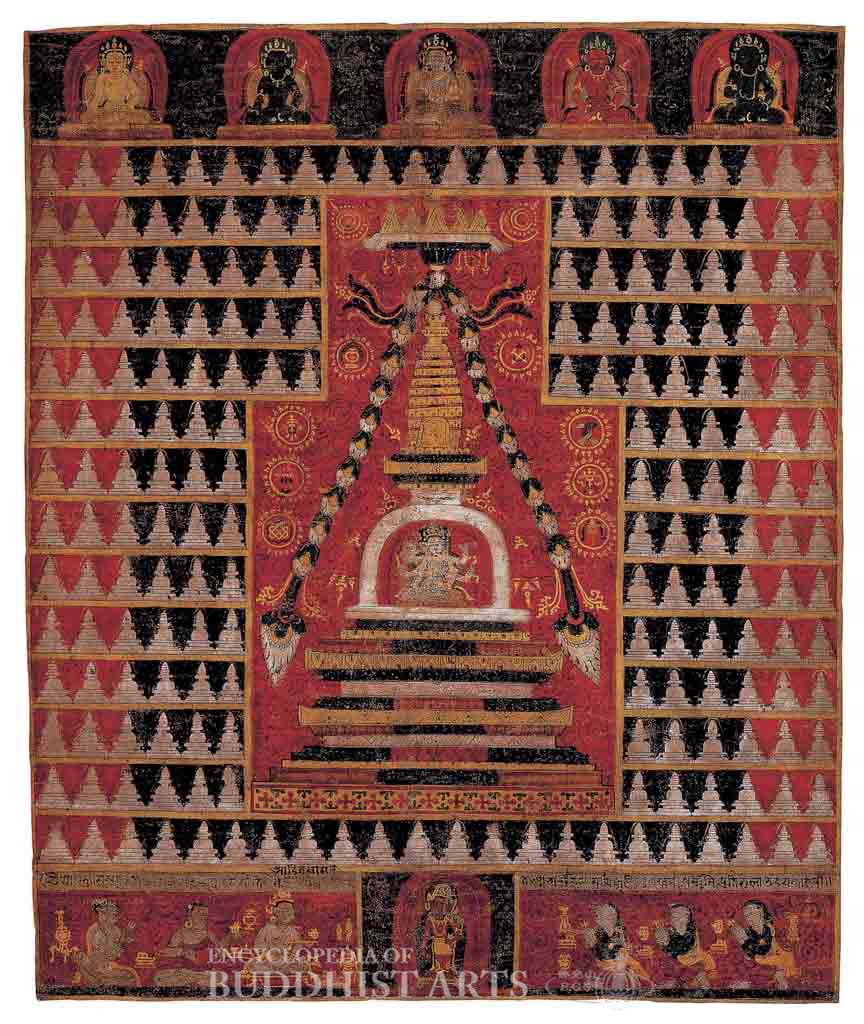
Laksa Caitya
Ink and color on cotton
Laksa Caitya
NEPAL; Malla dynasty
An inscription at the bottom of this Malla dynasty artwork states that it was commissioned in 1553 by the monk Mayikundi and others as a prayer for longevity in their current life and merit in their future lives. The central figure, Usnisavijaya, is a goddess of longevity in Nepal. The worship of Usnisavijaya was often associated with the Laksa Caitya ritual.
There is a large stupa in the center of the painting. Usnisavijaya, with three heads and eight arms, is depicted within the dome in the middle of the stupa. Above the dome, there are faint “Buddha Eyes” painted on the base of the spire, which is composed of golden stacked rings topped with a jewel. Long pennants hang from a canopy above the stupa, and circles on either side contain the eight auspicious symbols. The central stupa is surrounded by myriad smaller white stupas painted against a red and blue background.
In the upper register, the Five Dhyani Buddhas are shown seated on lotus thrones. On the bottom right of the image, a guru performs a consecration ritual. Figures making offerings are painted on the left.
For more details, go to the Encyclopedia of Buddhist Arts: Painting I-O, page 469.
Cite this article:
author = Hsingyun and Youheng and Youlu and Wilson, Graham and Manho and Mankuang and Huntington, Susan,
booktitle = {Encyclopedia of Buddhist Arts: Painting I-O},
pages = 469,
title = {{Laksa Caitya}},
volume = 15,
year = {2016}}