
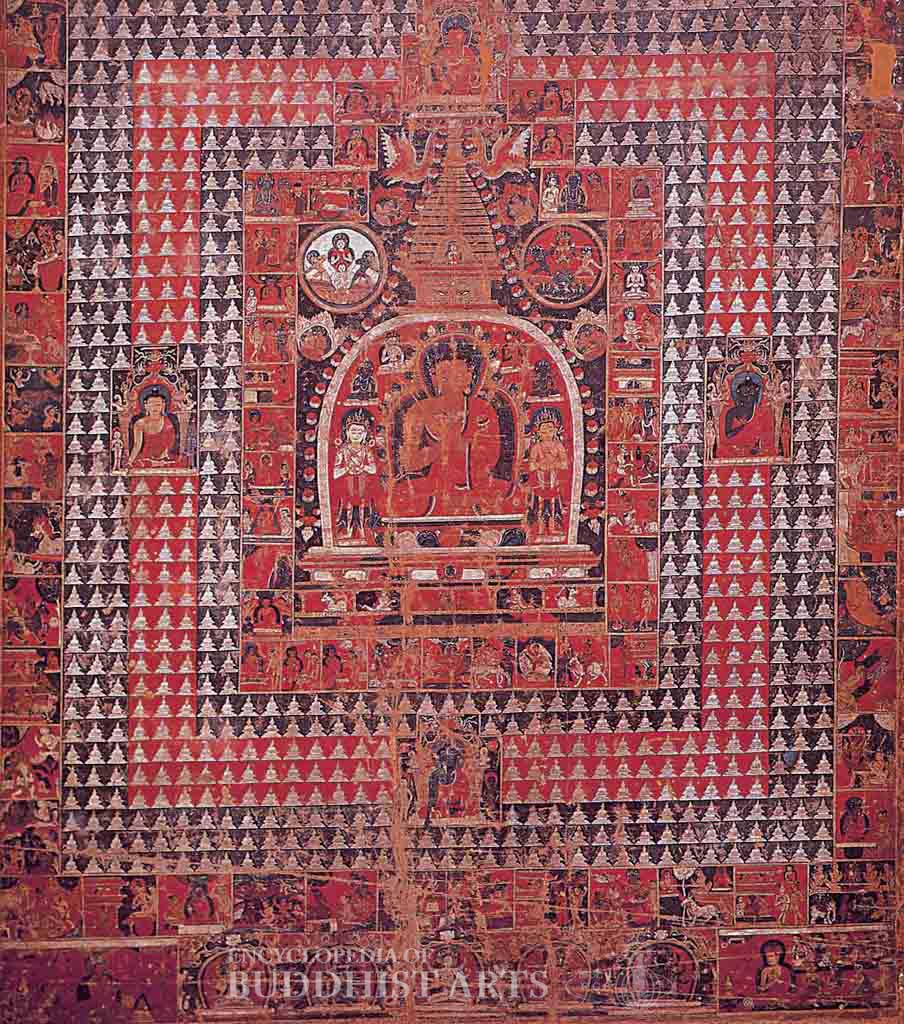
Laksa Caitya
Color on cloth
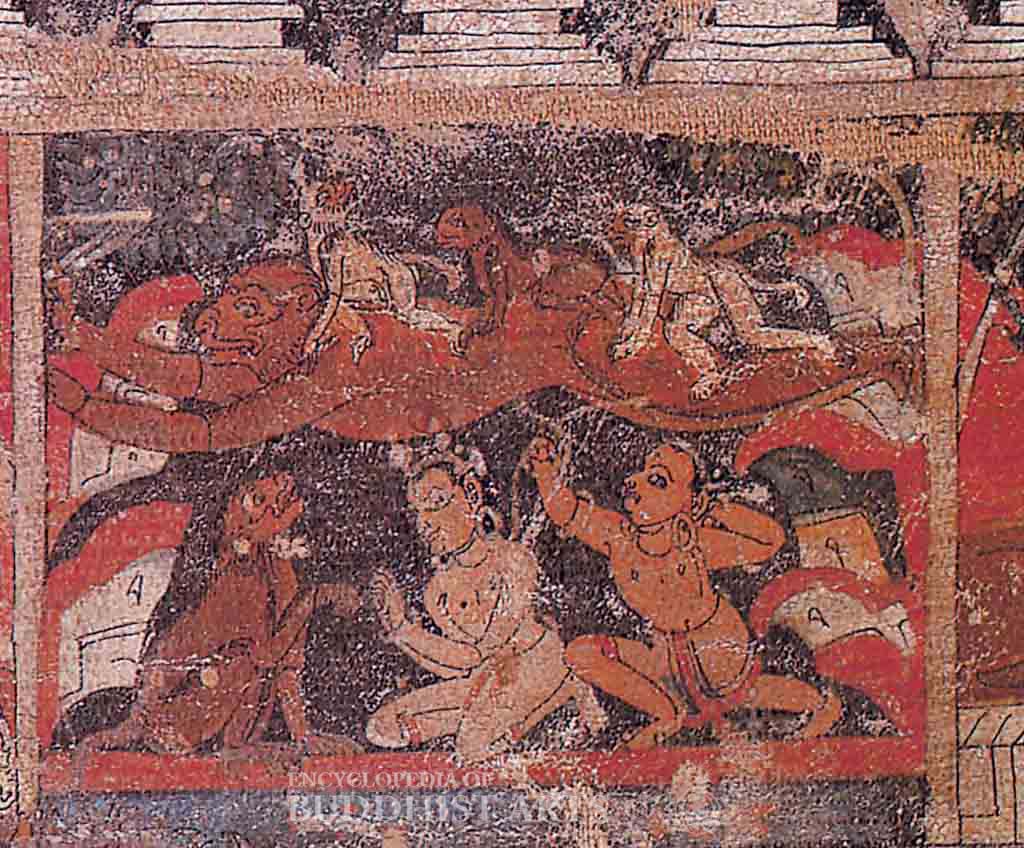
Laksa Caitya - Kapi Jataka
Laksa Caitya
NEPAL; Malla dynasty
This Nepalese paubha features “Laksa Caitya,” the grand annual Buddhist ritual in Kathmandu, where offerings of a hundred thousand stupas are made to the Buddhas. Vairocana Buddha sits in full lotus position in the center, probably forming the Dharmacakra (Dharma wheel) mudra. The Buddha is flanked by the white Avalokitesvara Bodhisattva and the yellow Maitreya Bodhisattva. Yellow, blue, green, and red Tara figures are painted on both sides of the Buddha’s nimbus. Above Vairocana, there is a large golden stupa with “Buddha’s Eyes” typically found on Nepalese stupas. On both sides of the stupa, there are the sun and the moon discs depicted with carts driven by seven horses and seven geese respectively. Scenes from the Life of the Buddha are painted within small squares that surround the central images.
Moving outwards, the next section of the painting is covered with numerous small white stupas organized in rows and columns. Within the mass of stupas, there are four rectangles containing Buddha images. The blue Aksobhya Buddha is at the bottom, yellow Ratnasambhava Buddha is on the left, red Amitabha Buddha is at the top, and green Amoghasiddhi Buddha is shown on the right. Around the border of the painting there are depictions of Jataka tales, including the Kapi and Hamsa Jatakas. At the bottom, the Pancaraksa deities of the Pancaraksa Sutra are pictured. The sponsor of this artwork is painted in the right corner, while in the left corner, a vajracharya performs a sacrifice.
Primarily colored in red and blue, this painting is a good example of the transitional phase of Buddhist art when traditional styles were modified with the inclusion of local features. The scenes from the Life of the Buddha and Jataka tales are similar to those seen on palm leaf manuscripts from the same time period.
For more details, go to the Encyclopedia of Buddhist Arts: Painting I-O, page 468.
Cite this article:
author = Hsingyun and Youheng and Youlu and Wilson, Graham and Manho and Mankuang and Huntington, Susan,
booktitle = {Encyclopedia of Buddhist Arts: Painting I-O},
pages = 468,
title = {{Laksa Caitya}},
volume = 15,
year = {2016}}