
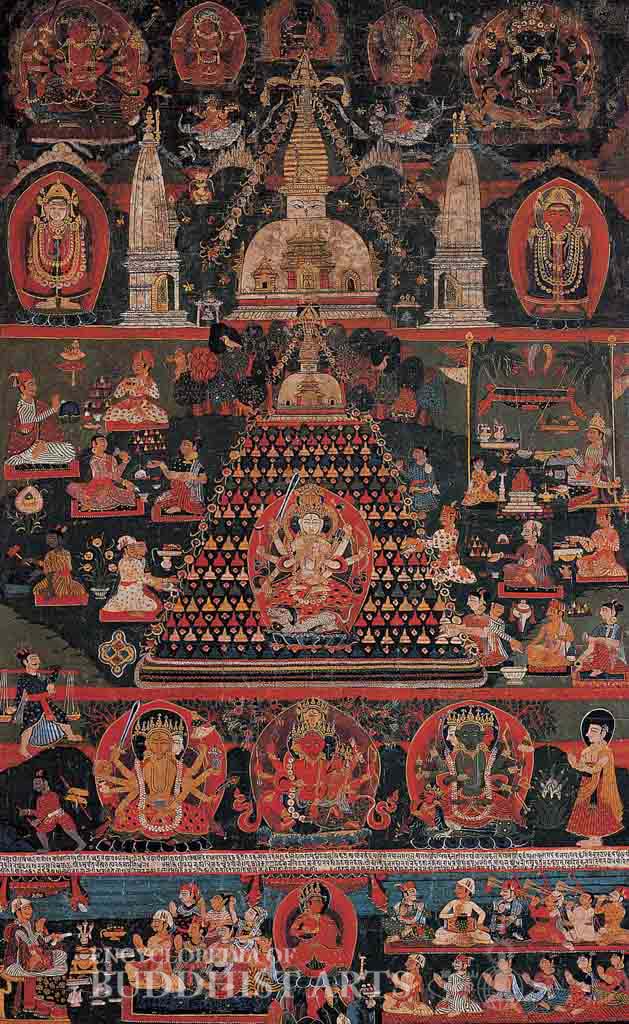
Laksa Caitya
Ink and color on cotton
Laksa Caitya
NEPAL
This Nepalese painting is divided into four distinct sections. The top section contains depictions of the large Swayambhunath Stupa, the Vajrayana shrines Pratappur and Anantapur, Aksobhya Buddha, Avalokitesvara, and Prajnaparamita, as well as unusual eight-armed figures of Amitabha and Aksobhya Buddhas. The second section shows the Laksa Caitya, represented as a pyramid composed of small stupas with Manjusri in the center. Beside the pyramid, there are scenes that illustrate the production of the small stupas. Lokesvararaja, an important figure in Newar Buddhism, is the central figure in the third section. He is flanked by Ratnasambhava and Amoghasiddhi Buddhas. At the bottom, a Buddha sits between benefactors and lay devotees.
For more details, go to the Encyclopedia of Buddhist Arts: Painting I-O, page 470.
Cite this article:
author = Hsingyun and Youheng and Youlu and Wilson, Graham and Manho and Mankuang and Huntington, Susan,
booktitle = {Encyclopedia of Buddhist Arts: Painting I-O},
pages = 470,
title = {{Laksa Caitya}},
volume = 15,
year = {2016}}