
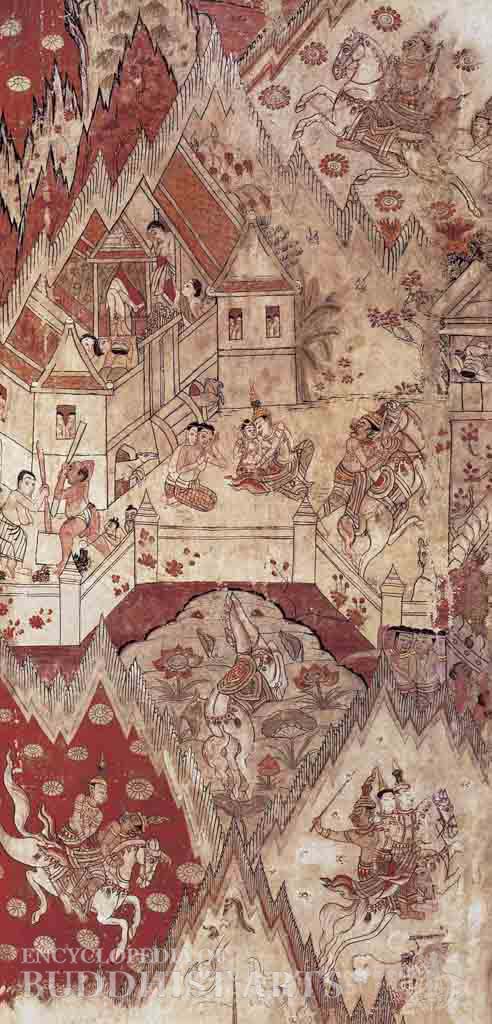
Wat Chong Nonsi Ordination Hall: Vidhurapandita Jataka

Wat Chong Nonsi Ordination Hall: Vidhurapandita Jataka (detail)
Wat Chong Nonsi Ordination Hall: Vidhurapandita Jataka
THAILAND, Bangkok; Ayutthaya Kingdom
The Vidhurapandita Jataka, Pali Jataka No. 545, is one of the Ten Great Jatakas in Thailand. It tells of the Buddha’s previous life as Vidhurapandita, a minister to King Dhananjaya, widely praised for his wisdom. During a meeting of the four great kings of the time, Vidhurapandita impressed the Naga King so much that he gave him a precious jewel as a token of his esteem. The Naga King’s wife later became jealous of this lavish gift, pretended to be sick, and told the king that she would not recover unless she received Vidhurapandita’s heart. The king sent the yaksa Purnaka to acquire the heart, promising to reward him with his beautiful daughter as his bride. Purnaka traveled to the court of King Dhananjaya, challenged him to a game of dice, and convinced him to wager his minister Vidhurapandita. After winning the game, Purnaka journeyed back to the court of the Naga King with Vidhurapandita, planning to kill him along the way. However, his attempts to harm Vidhurapandita failed and he became awed by the minister’s virtue. When they reached the palace, Vidhurapandita taught the Dharma to the Naga King and his wife.
Jagged bands divide the mural into sections of varying size. A large courtyard is painted in the middle register. There, after King Dhananjaya has lost him in a dice game, Vidhurapandita bids farewell to his family while Purnaka waits for him on horseback. In the upper right corner, Purnaka is shown attempting to harm Vidhurapandita by having him hold on to the horse’s tail while he rides. In the center of the lower register, the horse appears to gallop across a lotus pond without wetting his hooves, stunning the group of figures on the right. In the lower left corner, after Purnaka has realized that he cannot harm Vidhurapandita, the two ride together on horseback. The end of the tale is depicted in the lower right corner; Purnaka and his bride, the Naga Girl, escort Vidhurapandita home.
Scenes from daily life are also incorporated into the mural, a common feature of Thai art. On the left side of the middle register, a man and woman are seen pounding rice while children chase after a chicken. A horse and a goat bolt out the doors near the entrance of a building. The lively composition of both the principal and secondary scenes add energy to the piece.
For more details, go to the Encyclopedia of Buddhist Arts: Painting P-Z, page 976.
Cite this article:
author = Hsingyun and Youheng and Youlu and Wilson, Graham and Manho and Mankuang and Huntington, Susan,
booktitle = {Encyclopedia of Buddhist Arts: Painting P-Z},
pages = 976,
title = {{Wat Chong Nonsi Ordination Hall: Vidhurapandita Jataka}},
volume = 16,
year = {2016}}