
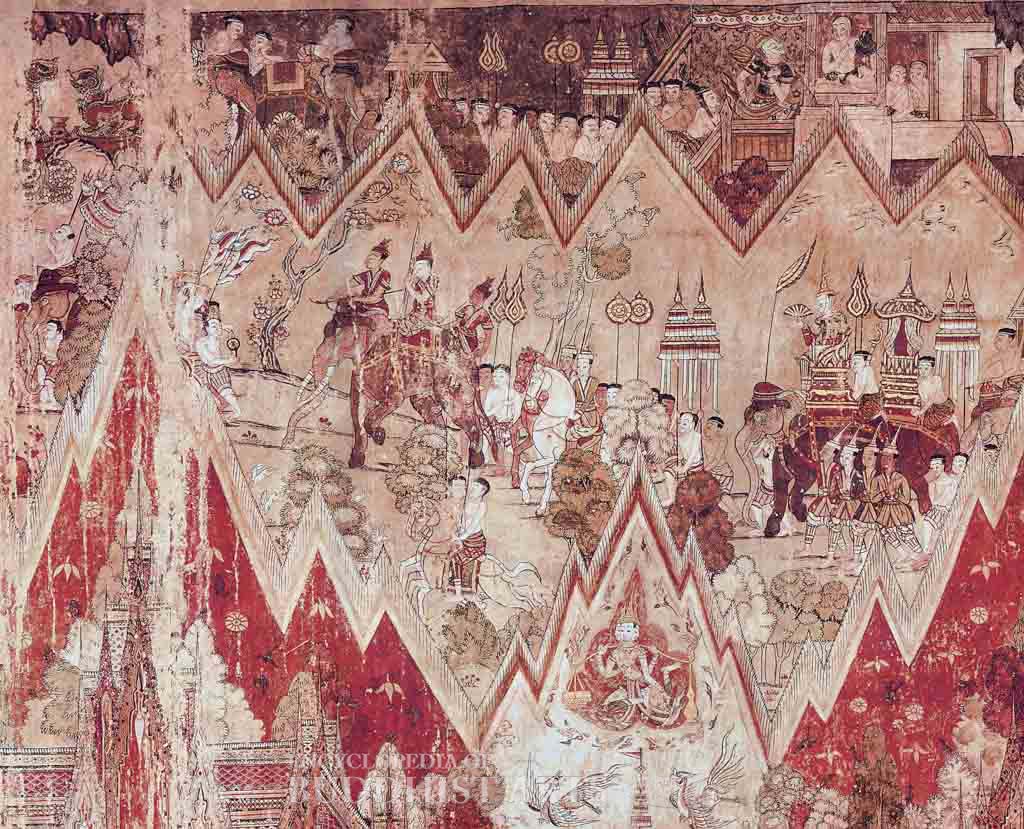
Wat Chong Nonsi Ordination Hall: Mahanarada Kasyapa Jataka
Wat Chong Nonsi Ordination Hall: Mahanarada Kasyapa Jataka
THAILAND, Bangkok; Ayutthaya Kingdom
This mural in the ordination hall of Wat Chong Nonsi is based on Pali Jataka No. 544, which tells of the Buddha’s previous life as a heavenly being named Narada. According to the story, King Angati of Mithila was a righteous man whose daughter Ruja also practiced the virtues of compassion and generosity. After a brahmin convinced the king that all events are preordained, he indulged in worldly pleasures and paid no attention to his duties. Ruja tried in vain to return her father to righteousness, and then prayed for help. Narada answered her prayers, manifested as a Buddhist practitioner, and taught the Dharma to the king.
In the upper right corner of the mural, King Angati is shown at the abode of the brahmin, seeking advice on spirituality. The brahmin sits in an elevated niche and the king is on the left, raising his head to listen to the teachings. In the middle register, the king and his entourage are depicted traveling to the palace. The king is on the far right, sitting on a throne on the back of an elephant and fanning himself. Honor guards, ministers, and attendants march towards the left side of the mural. Many of the figures wear a pointed hat and a robe, a traditional costume of the Ayutthaya Kingdom. Below the imperial procession, Four-Headed, Four-Armed Narada is depicted carrying a golden pole from which a golden pot and a crystal vase hang. Narada has a red mandorla surrounded by floral motifs and appears to fly, descending to the human world. Most of the mural is painted in earthy tones. Gilt is applied to the throne of the king, as well as the banners carried by the attendants, and the golden pot and vase carried by Narada.
For more details, go to the Encyclopedia of Buddhist Arts: Painting P-Z, page 975.
Cite this article:
author = Hsingyun and Youheng and Youlu and Wilson, Graham and Manho and Mankuang and Huntington, Susan,
booktitle = {Encyclopedia of Buddhist Arts: Painting P-Z},
pages = 975,
title = {{Wat Chong Nonsi Ordination Hall: Mahanarada Kasyapa Jataka}},
volume = 16,
year = {2016}}