
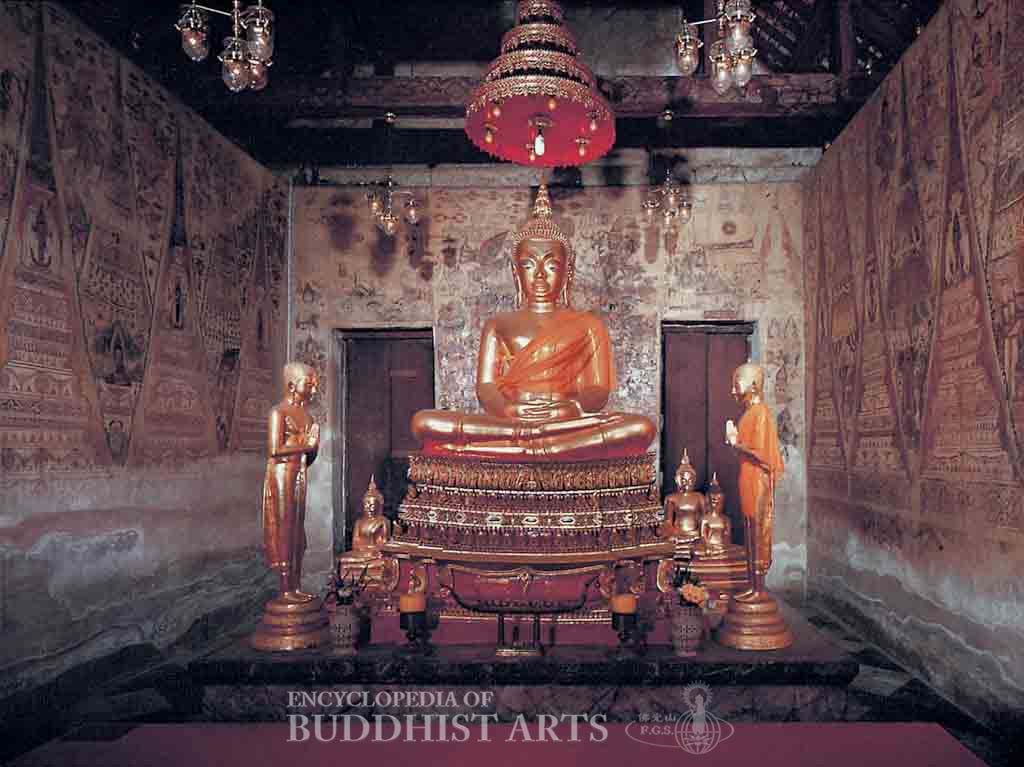
Wat Koh Kaeo Suttharam Ordination Hall Murals: Mural

Wat Koh Kaeo Suttharam Ordination Hall Murals (detail)
Wat Koh Kaeo Suttharam Ordination Hall Murals
THAILAND, Phetchaburi; Ayutthaya Kingdom
These colorful murals are painted on the walls of the ordination hall of Wat Koh Kaeo Suttharam in Phetchaburi, Thailand. The temple is one of the few sites that escaped destruction during the Burmese invasion that ended the Ayutthaya Kingdom, making these images a particularly valuable record of Buddhist mural art at the time.
Angled bands divide the murals on the north and south walls into distinct diamond and triangle-shaped sections. In the downward-pointing triangular areas with a beige background, dynamically-posed Bodhisattvas are shown making offerings of flowers or joining their palms. Within the upward-pointing triangles with a red background, there are an array of Ayutthaya-style stupas with richly decorated multi-layered Sumeru bases. The bodies of the stupas each house a standing Buddha, and they are topped with a delicate golden spire. The diamond-shaped sections between alternating triangles have elaborate canopies in the upper register, with scenes from the Life of the Buddha painted below. There are depictions of the Seven Weeks After Enlightenment, Calming the Drunken Elephant, the Miracle at Sravasti, and the Elephant and Monkey Making Offerings. Images of the Defeat of Mara and Enlightenment are painted on the east wall behind the altar. A representation of Buddhist Cosmology covers the west wall. Figures in western dress appear in the background of some murals, indicative of the diverse society that existed during the Ayutthaya Kingdom.
The use of unified tones brings coherency and balance to the composition of the diverse murals. A red-brown color is used to bring attention to the stupas, while the beige behind the Bodhisattvas offsets their striking appearances. The same technique was adopted and developed by artists during the Bangkok period (1782–present).
For more details, go to the Encyclopedia of Buddhist Arts: Painting P-Z, page 979.
Cite this article:
author = Hsingyun and Youheng and Youlu and Wilson, Graham and Manho and Mankuang and Huntington, Susan,
booktitle = {Encyclopedia of Buddhist Arts: Painting P-Z},
pages = 979,
title = {{Wat Koh Kaeo Suttharam Ordination Hall Murals}},
volume = 16,
year = {2016}}