
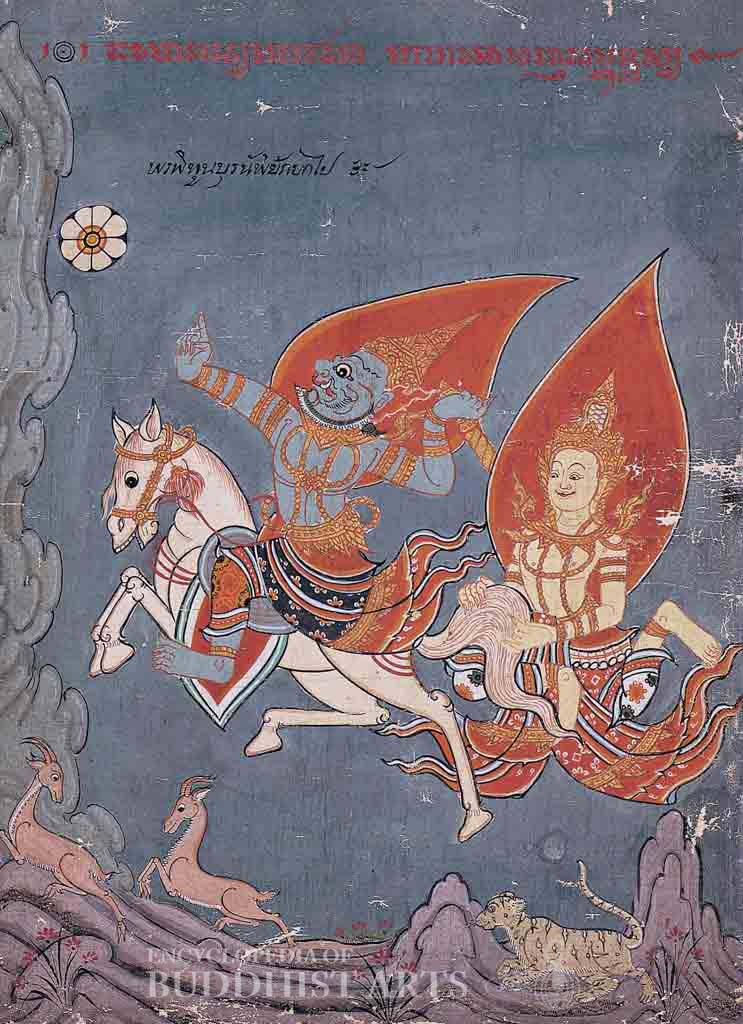
Vidhurapandita Jataka
Color on cloth
Vidhurapandita Jataka
THAILAND
This is one of the few surviving cloth paintings from the Ayutthaya Kingdom (circa 1350–1767). Based on the composition of similar artworks, it is believed that it was part of a larger painting of ten Jataka tales. The Vidhurapandita Jataka, Pali Jataka No. 545, tells of the Buddha’s previous life as the wise minister Vidhurapandita, an adviser to King Dhananjaya. Impressed by his wisdom, the Naga King Varuna gave Vidhurapandita a precious wish-fulfilling jewel. Later, the Naga King’s wife became jealous and feigned illness. She told her husband that the only thing that could cure her was the heart of Vidhurapandita. At the same time, a yaksa named Purnaka had fallen in love with a naga princess. When they asked for permission to marry, King Varuna told Purnaka to bring him the heart of Vidhurapandita in order to obtain his consent. Purnaka traveled to the court of King Dhananjaya, challenged the king to a game of dice, and convinced him to wager his prized minister. The king lost, so Purnaka took possession of Vidhurapandita and the two began the journey back to the naga kingdom. On the way, Purnaka planned to kill Vidhurapandita and remove his heart. However, all of his attempts failed, and he became awed by the minister’s virtue and wisdom. When they reached the palace of the Naga King, Vidhurapandita taught the Dharma to the royal family.
In the painting, Purnaka and Vidhurapandita are shown beginning the journey back to the naga kingdom. Both figures have red, petal shaped nimbuses and wear pointed crowns. Purnaka sits astride a flying white horse. He has a short beard, wide eyes, and pointed fangs. His right hand brandishes a weapon and his left hand is extended. The smiling Vidhurapandita holds the horse’s tail and appears to float through the air. Below, a tiger chases two antelopes. There are two inscriptions at the top of the painting. The inscription at the top, written in Pali, reads “Taking refuge in the Triple Gem.” The lower inscription in Thai states “The beginning of the journey of Vidhurapandita and Purnaka.” The dramatic poses of the figures and the striding animals lend a sense of great energy to the composition. Vivid red, gold, and white colors stand out from the light blue background.
For more details, go to the Encyclopedia of Buddhist Arts: Painting P-Z, page 962.
Cite this article:
author = Hsingyun and Youheng and Youlu and Wilson, Graham and Manho and Mankuang and Huntington, Susan,
booktitle = {Encyclopedia of Buddhist Arts: Painting P-Z},
pages = 962,
title = {{Vidhurapandita Jataka}},
volume = 16,
year = {2016}}