
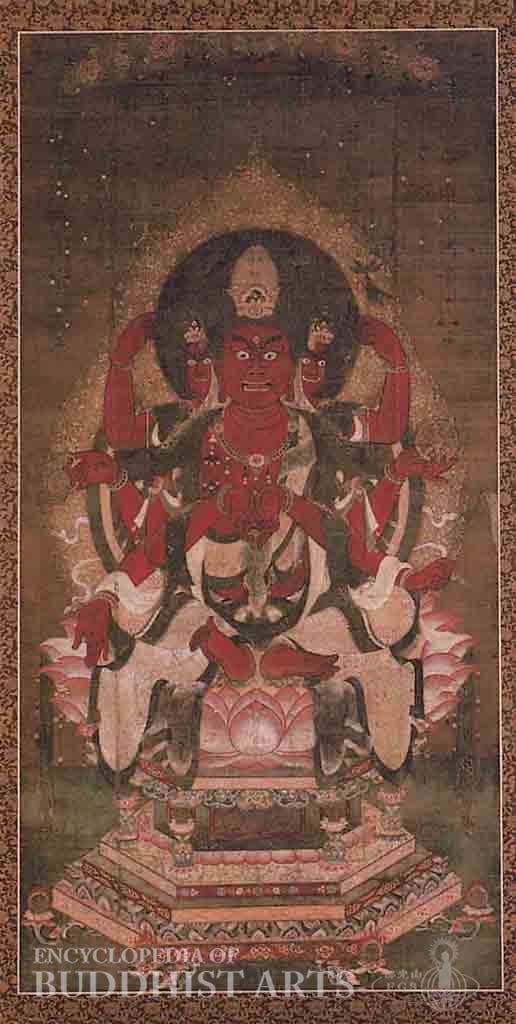
Hayagriva
Ink and color on silk
Hayagriva
JAPAN; Heian period
Painted in Kyoto, Japan in the second half of the 12th century, this work depicts a manifestation of Avalokitesvara Bodhisattva, Hayagriva, with a menacing demeanor. Images of Hayagriva, which were believed to enhance health, absolve sins, and exorcise evil spirits, originated in China during the 8th century and passed into Korea and Japan along with different forms of Vajrayana Buddhism, but it was not until the late 12th century that rituals for worshipping Hayagriva were formalized. Since the 13th century, Hayagriva has been venerated as the guardian of warriors and horses.
In this painting, Hayagriva is depicted with a red skin tone, three heads, and eight arms. Above the central head, there is a golden headdress decorated with the face of a horse. Hayagriva, sheltered by a canopy, is seated on a pink lotus atop a Sumeru throne. Of the eight hands, two form a mudra in front of the chest, the lower right hand displays a varada (wish-granting) mudra, and the remaining five hands hold a whisk, a Dharma wheel, a halberd, a sounding staff, and a vase in the shape of a bird’s head. The shape of the vase suggests that its portrayal was inspired by Tang dynasty (618–907) metalwork.
The faintly visible canopy is patterned with silver foil which has oxidized due to age, and the headdresses are decorated with gold foil. The foil and the rich colors of the painting give it a bright, shining quality.
For more details, go to the Encyclopedia of Buddhist Arts: Painting A-H, page 329.
Cite this article:
author = Hsingyun and Youheng and Youlu and Wilson, Graham and Manho and Mankuang and Huntington, Susan,
booktitle = {Encyclopedia of Buddhist Arts: Painting A-H},
pages = 329,
title = {{Hayagriva}},
volume = 14,
year = {2016}}