
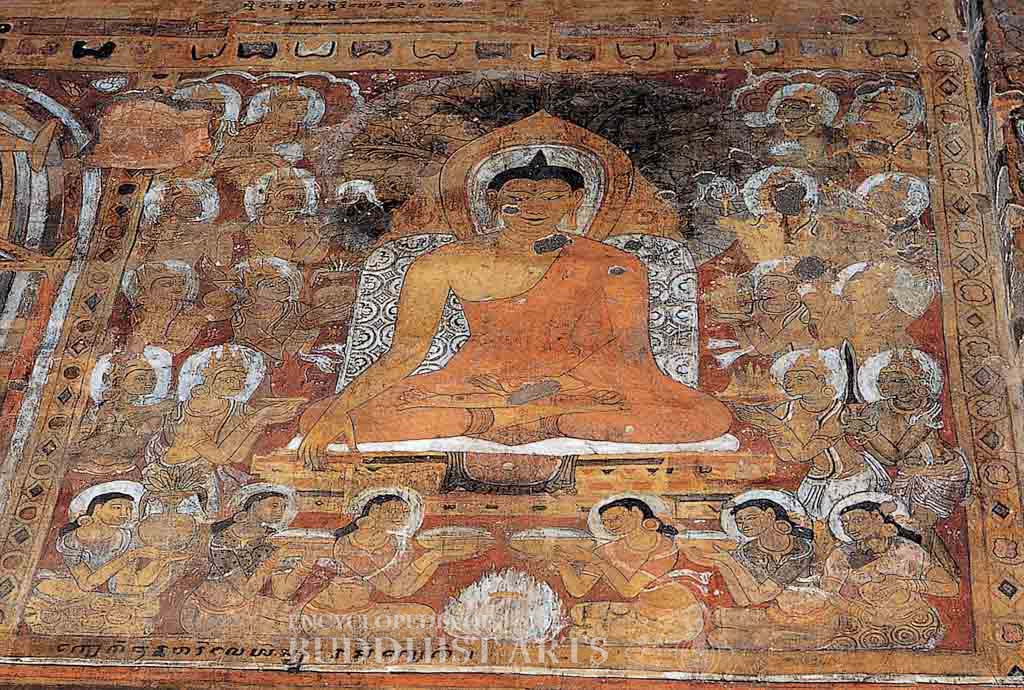
Gubyaukgyi Temple: Sakyamuni Buddha and Figures Making Offerings
Gubyaukgyi Temple: Sakyamuni Buddha and Figures Making Offerings
MYANMAR, Mandalay, Bagan
This mural is painted on right side of the west wall of the Gubyaukgyi Temple in Bagan’s Myinkaba village in Mandalay of Myanmar. Although paintings featuring Defeat of Mara and Enlightenment typically depict the dramatic encounter between the Buddha and Mara, this fresco portrays offerings made to the Buddha by various people, including village women who are rarely depicted.
In the center, the Buddha sits in full lotus position on a Sumeru throne. He has a tall usnisa, and wears an orange monastic robe draped over the left shoulder. The right hand forms the bhumisparsa (earth-touching) mudra, a common feature of Buddha images painted in Bagan Empire (circa 849–1287) temples. The white aureole is embellished with circular patterns. On both sides and below the Buddha, figures with nimbuses are shown kneeling, holding up offerings. The figures on the sides wear golden crowns, while the six women in the bottom row kneel in greeting and offer food to the Buddha.
In addition to Mara’s army and the Buddha’s bhumisparsa mudra, traditional Indian illustrations also portray Bhudevi, also known as Vasudhara, who appears from the ground and offers a full jar, a symbol of fertility. However, such representation is rarely seen in Myanmar and Southeast Asia. Scenes of Prthivi, the Earth Goddess, offering food to the Buddha is more commonly illustrated when portraying the defeat of Mara’s army and Bhudevi being called as witness.
For more details, go to the Encyclopedia of Buddhist Arts: Painting A-H, page 299.
Cite this article:
author = Hsingyun and Youheng and Youlu and Wilson, Graham and Manho and Mankuang and Huntington, Susan,
booktitle = {Encyclopedia of Buddhist Arts: Painting A-H},
pages = 299,
title = {{Gubyaukgyi Temple: Sakyamuni Buddha and Figures Making Offerings}},
volume = 14,
year = {2016}}