
Fondukistan: Two Naga Kings
Clay
Fondukistan: Two Naga Kings
AFGHANISTAN, Parwan, Fondukistan
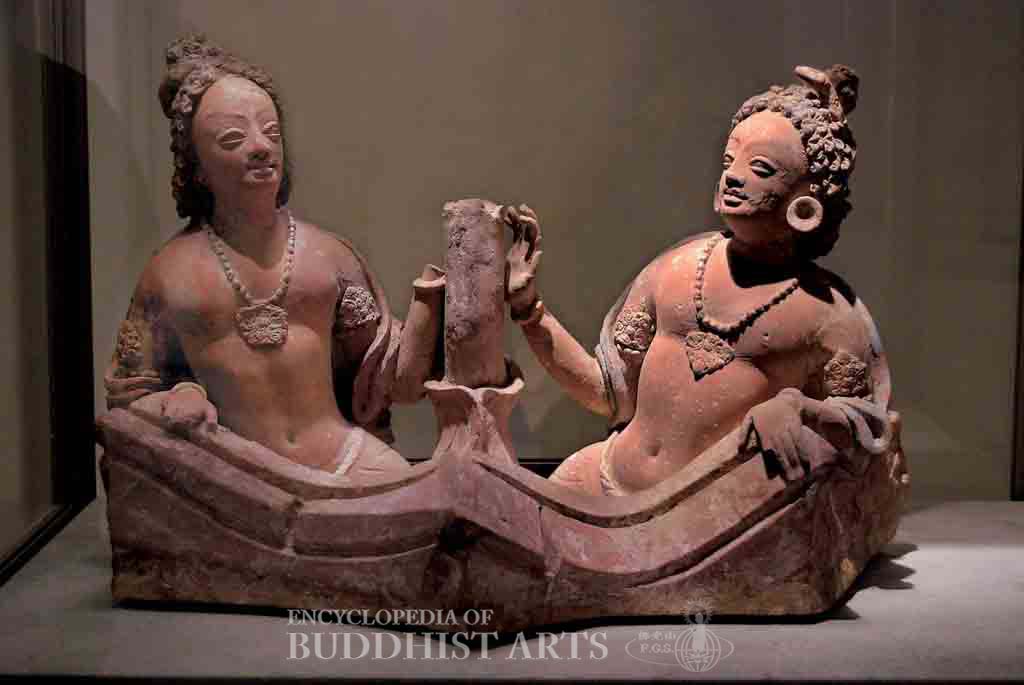
The Naga Kings, Nanda and Upananda, once portrayed as hostile to Buddhism, are generally described as being Dharma protectors in Mahayana scriptures. Only their upper bodies are depicted in this sculpture. They face each other with heads raised and bodies tilted backwards. Both have a hand placed on the thick lotus stem located in the center, signifying their rise from the waters of a pond. The naga kings have high foreheads and curly hair rolled into a topknot. One figure has horn-like earrings. Both figures wear necklaces, armlets and bracelets. The torsos are so lifelike that the softness and elasticity of the skin is almost discernible, revealing the skill achieved by clay sculpting in this area.
For more details, go to the Encyclopedia of Buddhist Arts: Sculpture A-F, page 346.
Cite this article:
author = Hsingyun and Youheng and Lovelock, Yann and Chou, Yuan and Huntington, Susan and Edson, Gary and Neather, Robert,
booktitle = {Encyclopedia of Buddhist Arts: Sculpture A-F},
pages = 346,
title = {{Fondukistan: Two Naga Kings}},
volume = 10,
year = {2016}}