
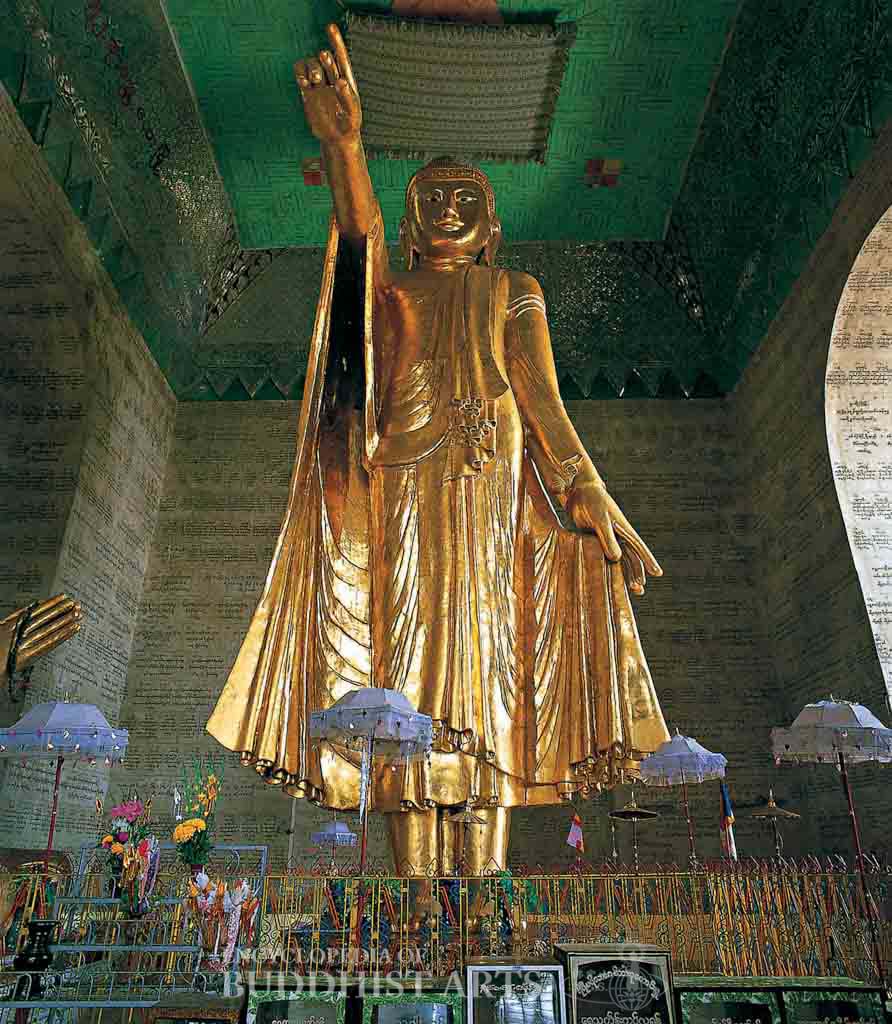
Mandalay Hill: Shweyattaw Buddha
Teak wood
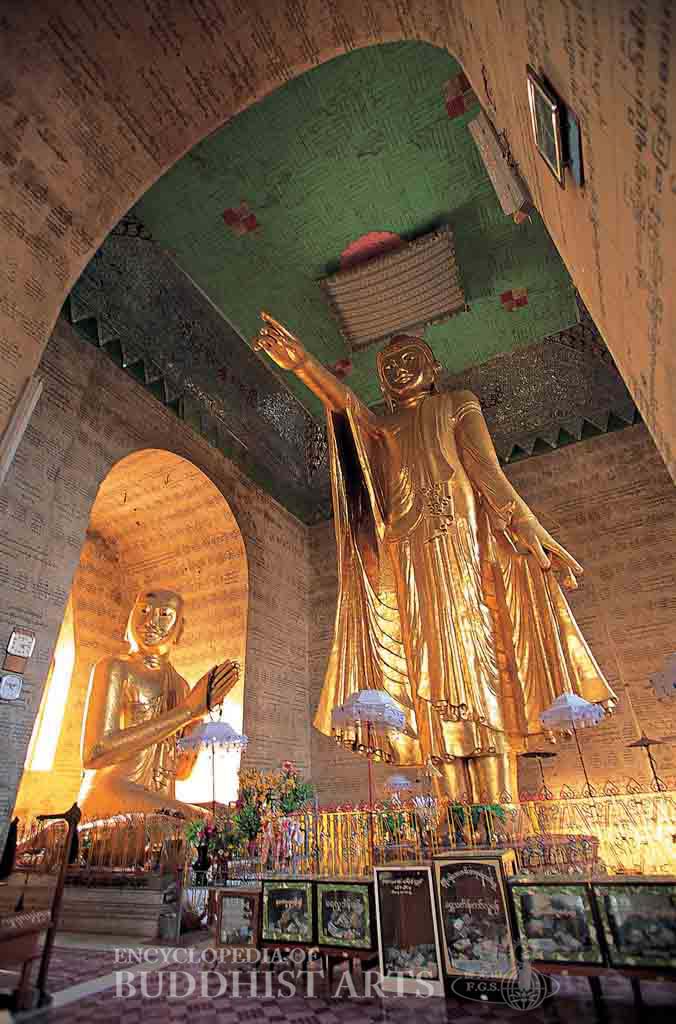
Mandalay Hill: Shweyattaw Buddha - Buddha and Ananda
Mandalay Hill: Shweyattaw Buddha
MYANMAR, Mandalay
The statue is located on Mandalay Hill. The story behind this pointing Buddha derives from the legend that Sakyamuni once traveled to Mandalay Hill and prophesized that 2,400 years later it would become a sacred place. In 1857, after King Mindon (reigned 1853–1878) became the Burmese ruler, he made Mandalay his capital and established a monastery on the neighboring peak, thus fulfilling the prophecy. The statue was placed within the monastery and is unique in its gesture.
The Buddha wears a monastic robe with its end fold pulled over the left shoulder, leaving the right bare. The ripples in the garment are realistically depicted and provide many angled facets from which the light reflects. The Buddha’s attendant, Ananda, kneels in an alcove to the left with palms joined and looks in the direction indicated by the Buddha.
For more details, go to the Encyclopedia of Buddhist Arts: Sculpture G-M, page 679.
Cite this article:
author = Hsingyun and Youheng and Lovelock, Yann and Chou, Yuan and Huntington, Susan and Edson, Gary and Neather, Robert,
booktitle = {Encyclopedia of Buddhist Arts: Sculpture G-M},
pages = 679,
title = {{Mandalay Hill: Shweyattaw Buddha}},
volume = 11,
year = {2016}}