
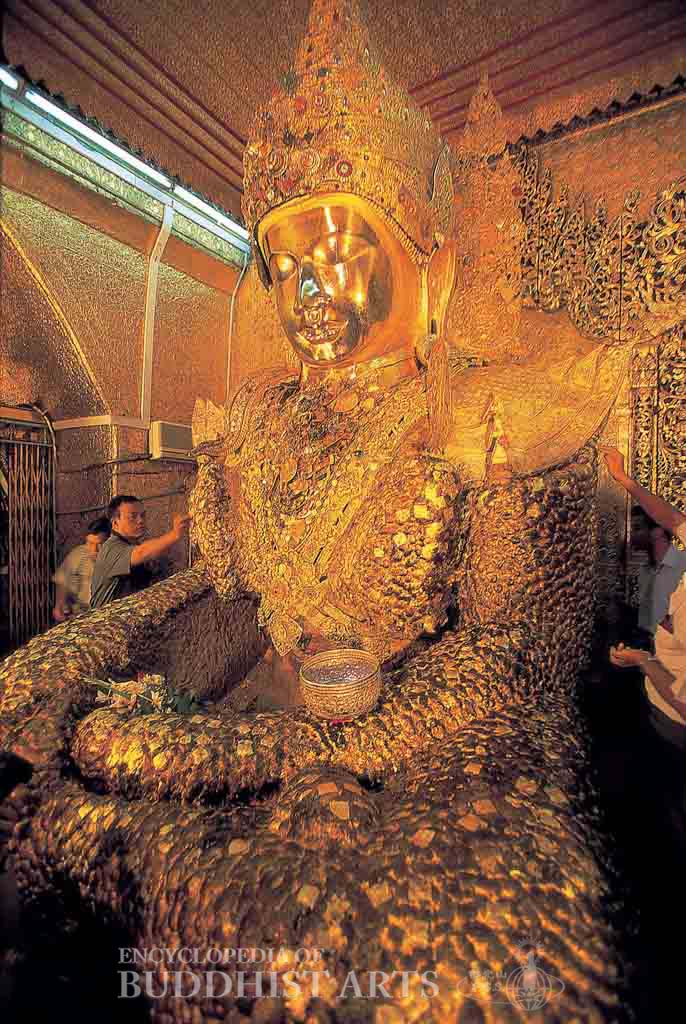
Mahamuni Pagoda: Mahamuni Buddha
Bronze
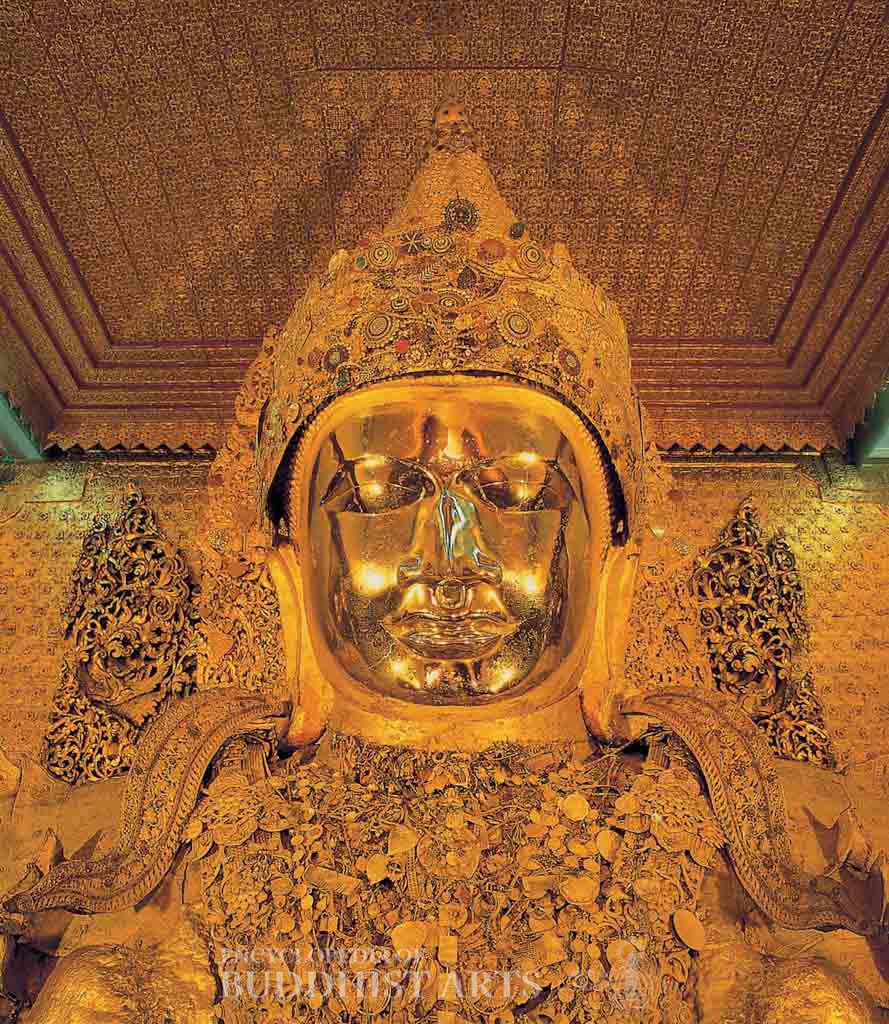
Mahamuni Pagoda: Mahamuni Buddha (detail)
Mahamuni Pagoda: Mahamuni Buddha
MYANMAR, Mandalay
Created in 150 CE, the statue was removed to Amarapura by King Bodawpaya (reigned 1782–1819) when Rakhine was annexed in 1784. Later on, the statue was moved to Mandalay. It is currently enshrined in Mahamuni Pagoda. There is a legend that suggests the statue was created in the Buddha’s likeness during a visit to Rakhine in 554 BCE, and was reportedly the only existing statue modeled on Sakyamuni.
Weighing about 6.5 t, the statue is covered in a large amount of gold and precious stones. There are small curls on the head that is covered by a crown encrusted with various types of precious stones that rises to a cone topped with a flame ornament. The head has a broad forehead and pupiless eyes that gaze downwards. The upper body is adorned with an armor-like garment that is completely covered with jewelry and the right hand is in bhumisparsa (earth-touching) mudra. The Burmese treat this statue as if it were a living Buddha, which is evident in the gold offerings. Apart from the gilding of the face and neck, the armor and crown were added later, as was the 15 cm layer of gold leaf added by devotees. Every day, the statue is washed and cleaned early in the morning by the monks, and during the rainy season it is draped with robes.
For more details, go to the Encyclopedia of Buddhist Arts: Sculpture G-M, page 655.
Cite this article:
author = Hsingyun and Youheng and Lovelock, Yann and Chou, Yuan and Huntington, Susan and Edson, Gary and Neather, Robert,
booktitle = {Encyclopedia of Buddhist Arts: Sculpture G-M},
pages = 655,
title = {{Mahamuni Pagoda: Mahamuni Buddha}},
volume = 11,
year = {2016}}