
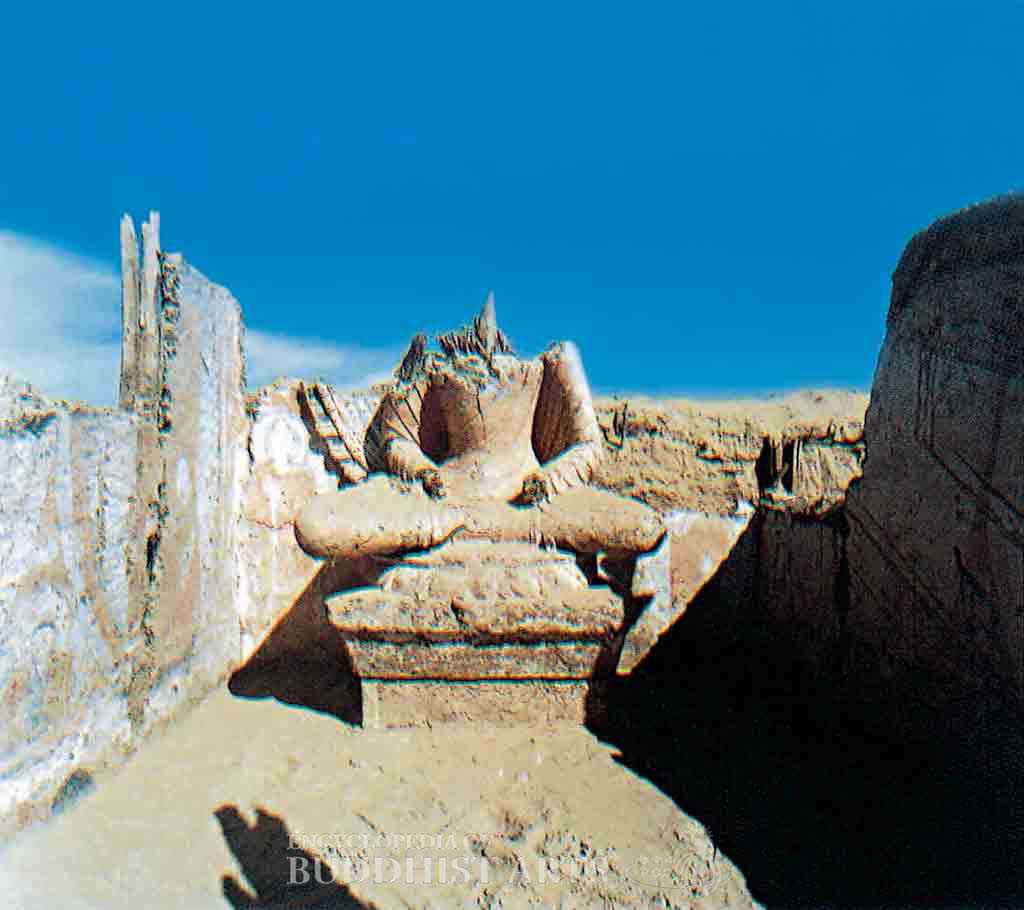
Tuopulukedun Temple 1: Seated Buddha
Clay
Tuopulukedun Temple 1: Seated Buddha
CHINA, Xinjiang, Hotan
The statue was discovered in 2000 at Tuopulukedun Temple 1, the smallest historic Buddhist temple in the world measuring 2 m by 1.7 m. Carbon-14 dating and observation of its design dates the statue to the 6th and 7th centuries. The Buddha sits in full lotus position with knees extending over a lotus throne. He wears a thin monastic robe with raised folds adapted to the shape of the body. The statue’s style is reminiscent of the Indian Gupta period (circa 320–540), while the manner in which the monastic robe and fragment of the mandorla are presented, reflect Gandharan influence. The damaged state of the statue exposes the wood and reed used as support for the trunk and limbs, which was covered with straw and clay, then molded into shape. The surface was plastered with fine wet clay and coated with white slip before painted with red ocher.
For more details, go to the Encyclopedia of Buddhist Arts: Sculpture St-Z, page 1267.
Cite this article:
author = Hsingyun and Youheng and Lovelock, Yann and Chou, Yuan and Huntington, Susan and Edson, Gary and Neather, Robert,
booktitle = {Encyclopedia of Buddhist Arts: Sculpture St-Z},
pages = 1267,
title = {{Tuopulukedun Temple 1: Seated Buddha}},
volume = 13,
year = {2016}}