
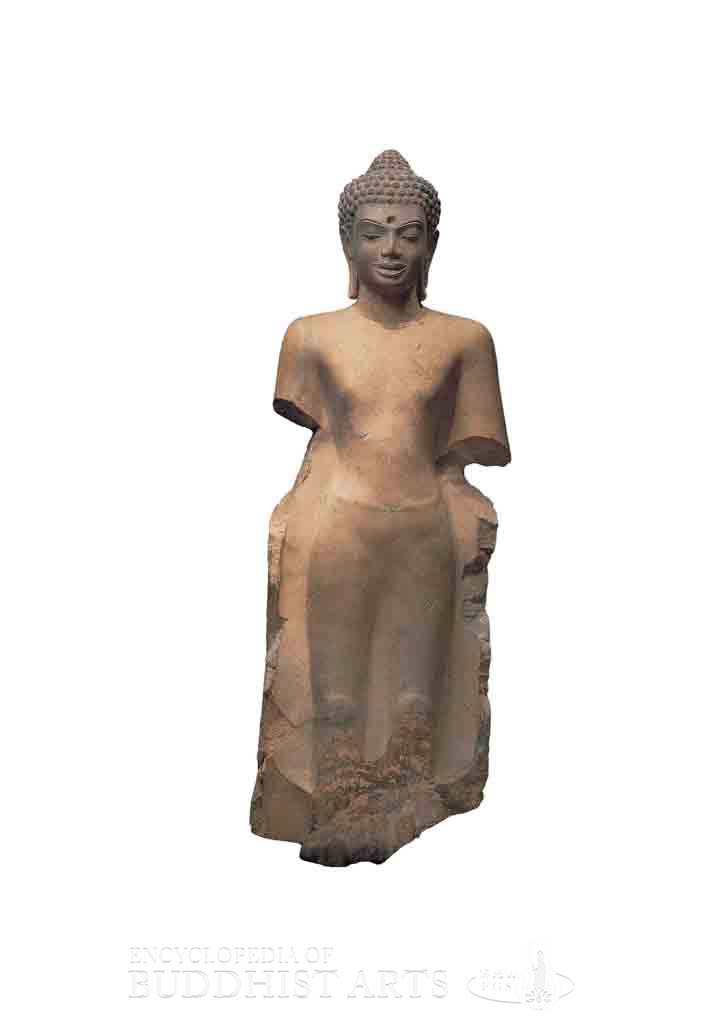
Sakyamuni Buddha
Sandstone

Sakyamuni Buddha (hand)
Sakyamuni Buddha
THAILAND; Dvaravati Kingdom
The sculpture may originally have been around 3 m high before the legs were broken. The place of origin is unknown but most scholars believe it is from the Sri Thep region. The fragment of the right palm discovered with the sculpture was marked with the Dharma wheel.
The Buddha’s usnisa is cone-shaped and the heavy curls fall low on the forehead. Elongated earlobes reach almost to the shoulders. The eyebrows are mere incisions and the eyes are downcast. The nose is straight and the full lips are further emphasized by outlining. A gemstone was originally embedded to represent the urna and the eyes were also inlaid. The Buddha’s robe is plain and so thin the outline of the body shows through.
For more details, go to the Encyclopedia of Buddhist Arts: Sculpture N-Sr, page 929.
Cite this article:
author = Hsingyun and Youheng and Lovelock, Yann and Chou, Yuan and Huntington, Susan and Edson, Gary and Neather, Robert,
booktitle = {Encyclopedia of Buddhist Arts: Sculpture N-Sr},
pages = 929,
title = {{Sakyamuni Buddha}},
volume = 12,
year = {2016}}