
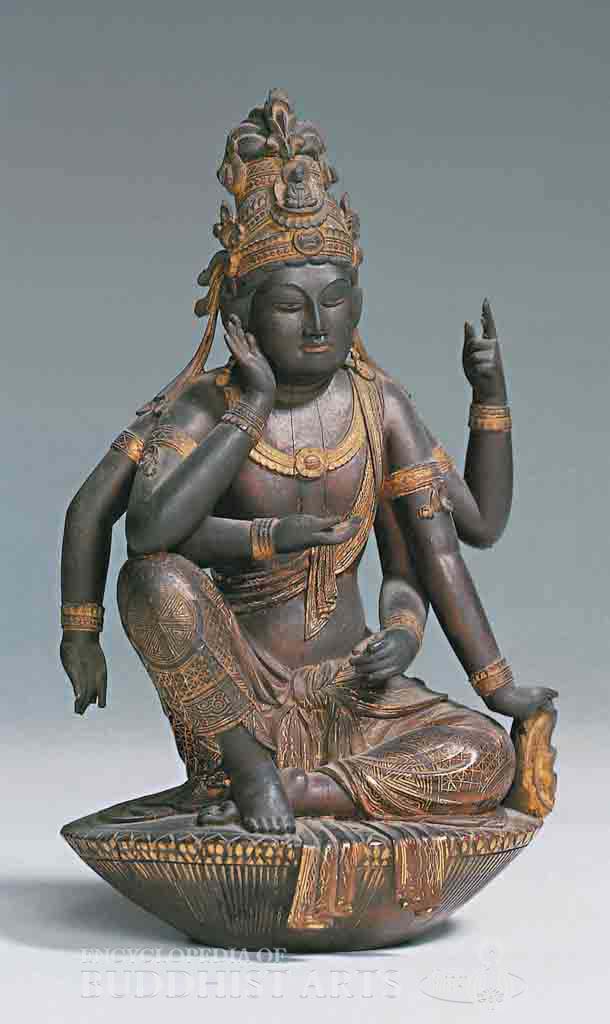
Cintamanicakra Avalokitesvara
Sandalwood
Cintamanicakra Avalokitesvara
CHINA; Tang dynasty
The statue was probably made between the 8th to 9th centuries of the Tang dynasty and subsequently taken to Japan. It was donated to Horyuji Temple and enshrined in the Shoryoin Hall in 1256 by the monk Eizon. The figure was listed as an Important Cultural Property of Japan in 1906.
The figure is depicted with six arms and is seated in the royal ease posture. The figure’s hair is swept up and held in place by an elaborate headdress with a Buddha image in the center. Ribbons hang down to the shoulders. The Bodhisattva wears jewelry consisting of earrings, a collar necklace, armlets, and bracelets. A sash hangs from the left shoulder and across the body. The lower body is covered in a dhoti decorated with geometric patterns. A belt is tied around the waist with the ends falling over the edge of the throne.
For more details, go to the Encyclopedia of Buddhist Arts: Sculpture A-F, page 263.
Cite this article:
author = Hsingyun and Youheng and Lovelock, Yann and Chou, Yuan and Huntington, Susan and Edson, Gary and Neather, Robert,
booktitle = {Encyclopedia of Buddhist Arts: Sculpture A-F},
pages = 263,
title = {{Cintamanicakra Avalokitesvara}},
volume = 10,
year = {2016}}