
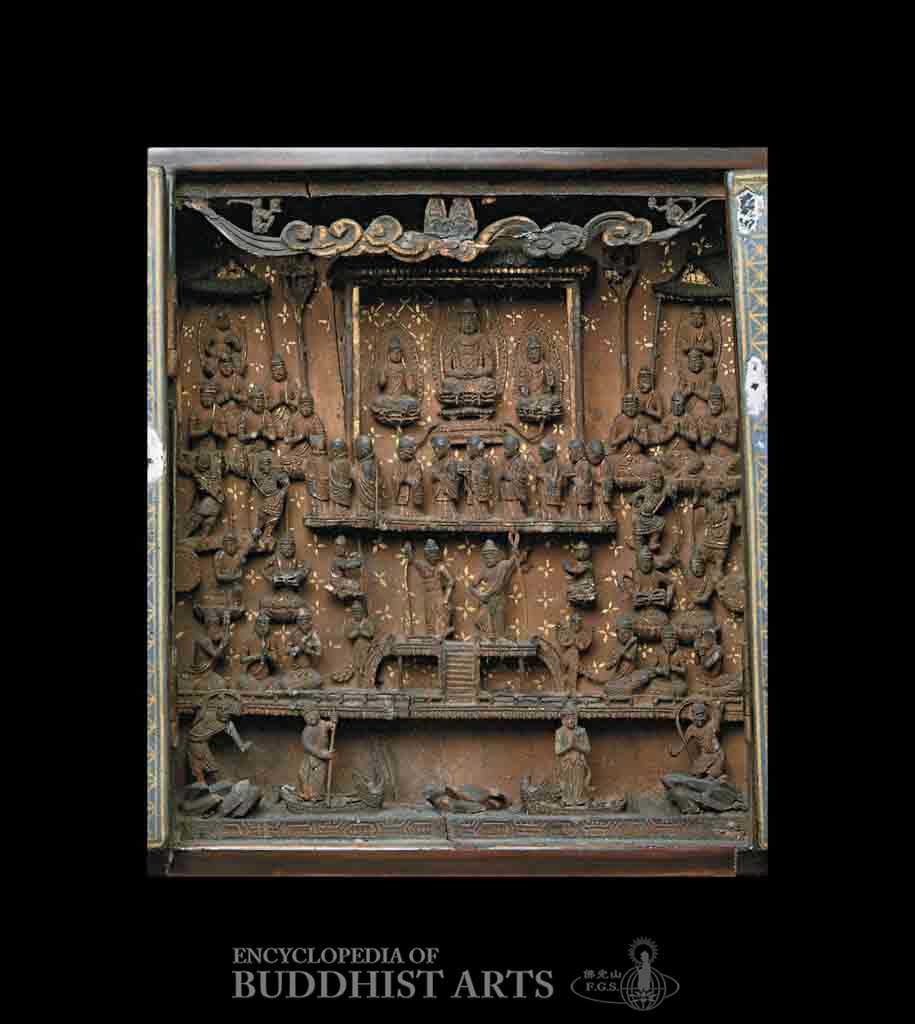
Kosanji Temple: Pure Land Mandala
Sandalwood
Kosanji Temple: Pure Land Mandala
JAPAN, Hiroshima, Onomichi; Heian period
The mandala dates from the 12th century and illustrates aspects of Amitabha Buddha’s Western Pure Land. It was listed as an Important Cultural Property in 1935.
The work is divided between three registers. At the center of the upper section is a palace in which the crowned Amitabha Buddha sits in meditation and is flanked by two attendant Bodhisattvas, all supported on lotus flowers. Below them are ten monks circumambulating as they chant the Buddha’s name. Trees act as partitions to separate the scene at the center and the two outer buildings. These side buildings hold a standing Buddha and five seated Bodhisattvas.
The middle section consists of dancing Bodhisattvas, kalavinkas, heavenly beings, the Four Heavenly Kings, and five Bodhisattvas playing musical instruments. In the lower section two beast-headed boats carry Bodhisattvas. One Bodhisattva has palms joined in reverence, the other steers the craft with a pole. Dharma protectors take their stance astride rocks at either side. Arching above the whole scene are rolling clouds, heavenly beings, and apsaras.
For more details, go to the Encyclopedia of Buddhist Arts: Sculpture G-M, page 563.
Cite this article:
author = Hsingyun and Youheng and Lovelock, Yann and Chou, Yuan and Huntington, Susan and Edson, Gary and Neather, Robert,
booktitle = {Encyclopedia of Buddhist Arts: Sculpture G-M},
pages = 563,
title = {{Kosanji Temple: Pure Land Mandala}},
volume = 11,
year = {2016}}