
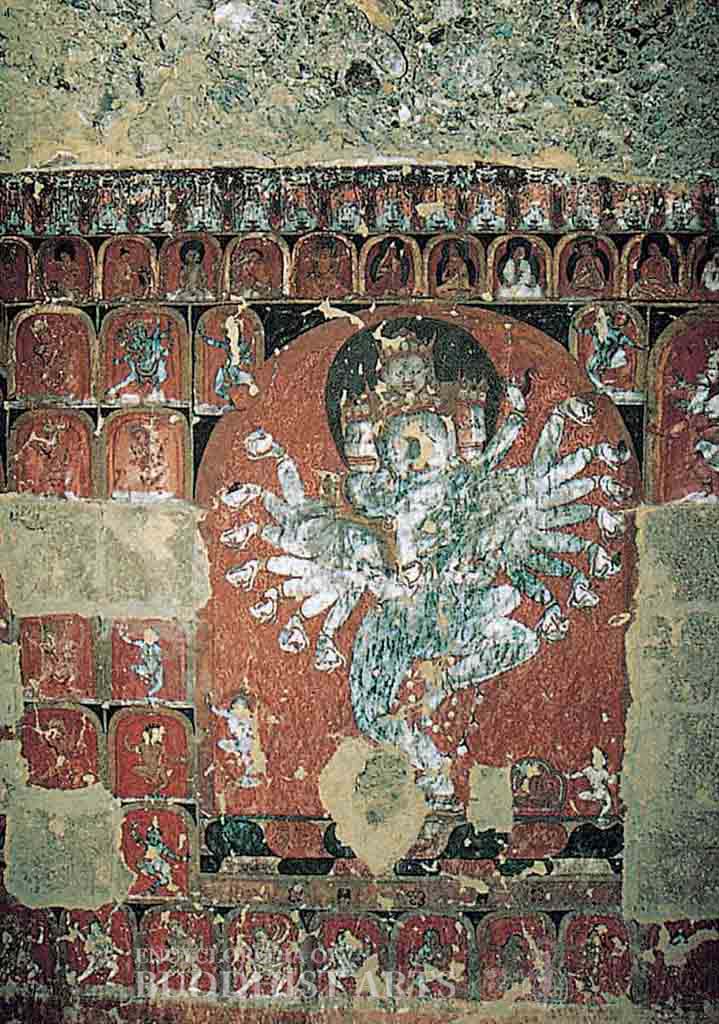
Xilingun Cave 1: East Wall
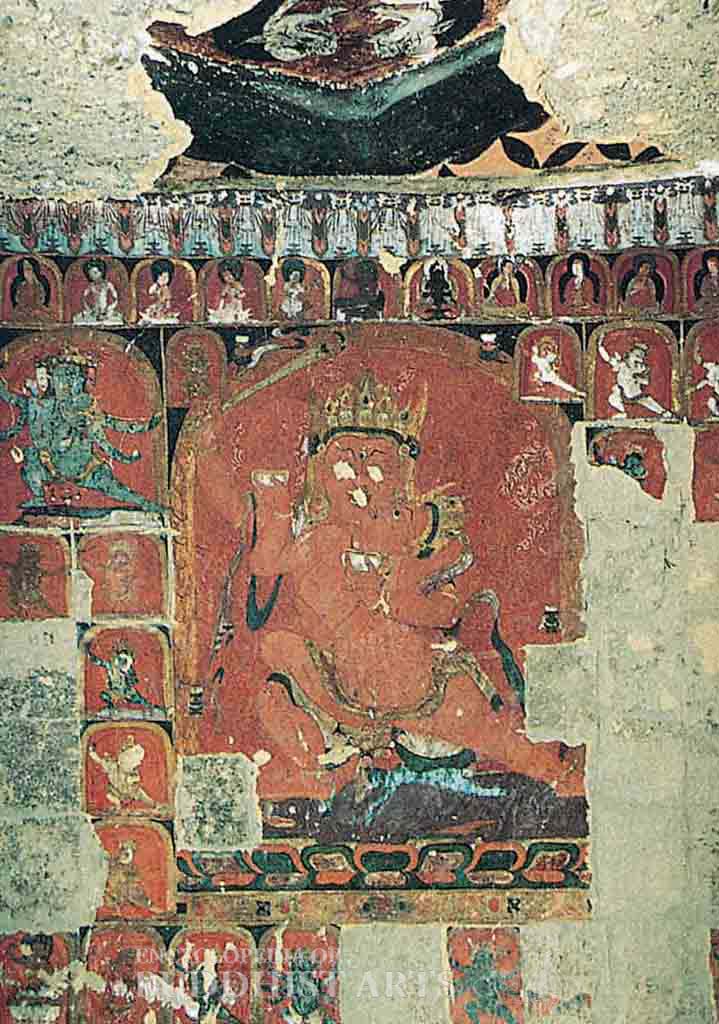
Xilingun Cave 1: West Wall
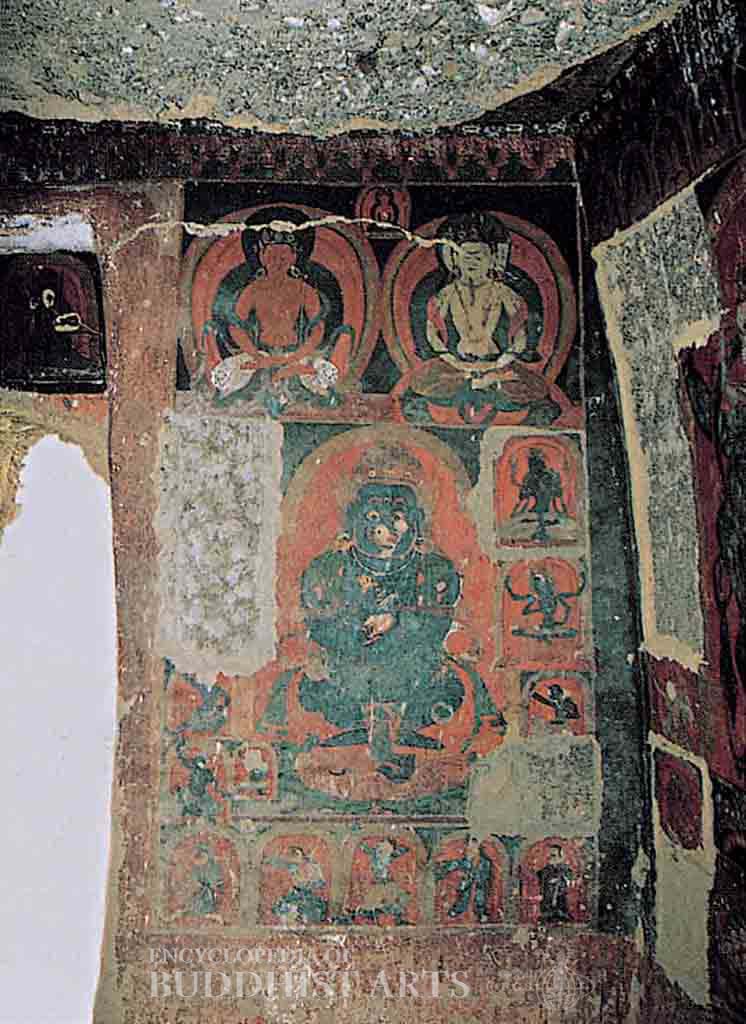
Xilingun Cave 1: Front Wall
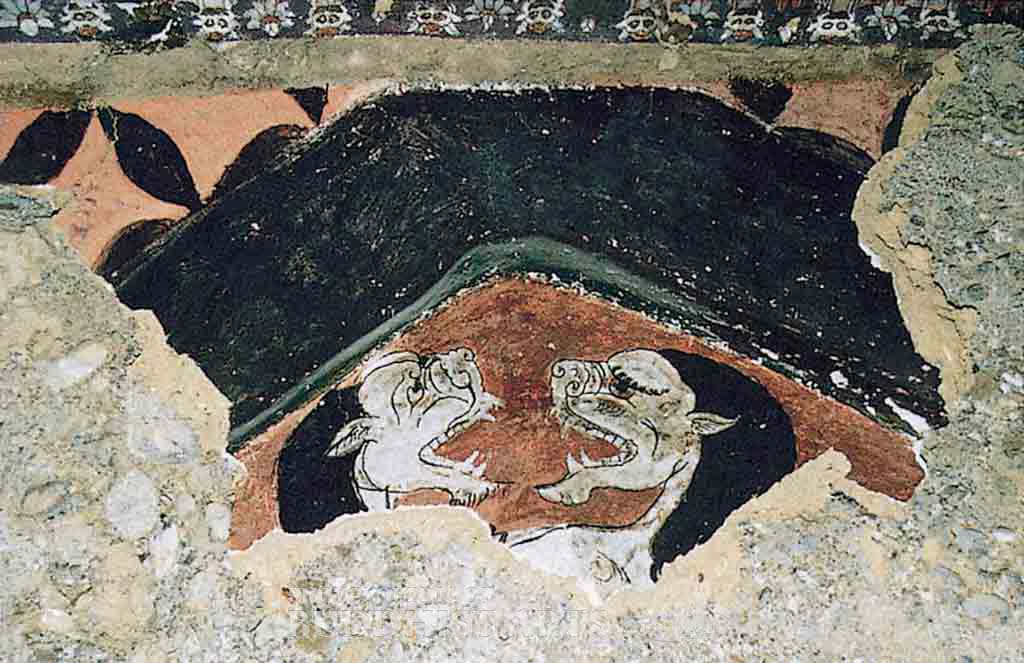
Xilingun Cave 1: Ceiling (detail)
Xilingun Cave 1
CHINA, Tibet, Ngari
Cave 1 is the easternmost of the Xilingun Caves and contains murals dating from the 15th to 17th century. Decorative images depicting animal heads with drapery hanging from their mouths are found at the top of the walls. The three main figures on the back (north) wall are all depictions of multi-headed, multi-armed figures. All three have three heads and ten arms, and are in yab-yum embrace with their consorts. They stand on lotus pedestals. The central figure, considered to be Guhyasamaja, is blue and the other two are red. All around them are 57 smaller images of people, including monks and founders of various schools.
The murals on the side walls are similar in layout to the back wall. The central figure on the west wall is a six-headed, sixteen-armed Hevajra, who is depicted stepping on a demon. The right figure is a four-headed, twelve-armed Cakrasamvara. The left figure has four heads and six arms, and also steps on a demon. These three images are surrounded by smaller figures.
The mural on the east wall features a red figure in the center holding a staff in the right hand and embracing a consort with the left, while holding a skull cup and standing upon on a black demon. The right figure stands on a lotus pedestal in the warrior stance. The left figure wears a crown with five prongs and has red hair, three heads, and six arms. Appearing wrathful, the figure wears a dhoti of tiger skin, while ribbons stream from the back and around the arms as it steps upon a demon. The three figures are surrounded by portraits of eminent monks, many of which have deteriorated.
Avalokitesvara and a wrathful deity with three heads and six arms are depicted in the upper left of the entrance on the south wall. The deity wears a tiger skin and holds various instruments, with the left leg extended in the warrior stance. A figure with four arms and a five-leaf crown is found below holding two skull cups in front of the chest, as well as a sword and vajra in the right and left hands respectively. Surrounding this figure are smaller portraits, thirteen of which are intact. Two similar rows of portraits are found to the upper right of the entrance, with the upper row composed of peaceful deities and the lower one of wrathful deities.
For more details, go to the Encyclopedia of Buddhist Arts: Caves T-Z, page 1523.
Cite this article:
author = Hsingyun and Youheng and Johnson, Peter and Mankuang and Huntington, Susan and Edson, Gary and Neather, Robert,
booktitle = {Encyclopedia of Buddhist Arts: Caves T-Z},
pages = 1523,
title = {{Xilingun Cave 1}},
volume = 9,
year = {2016}}