
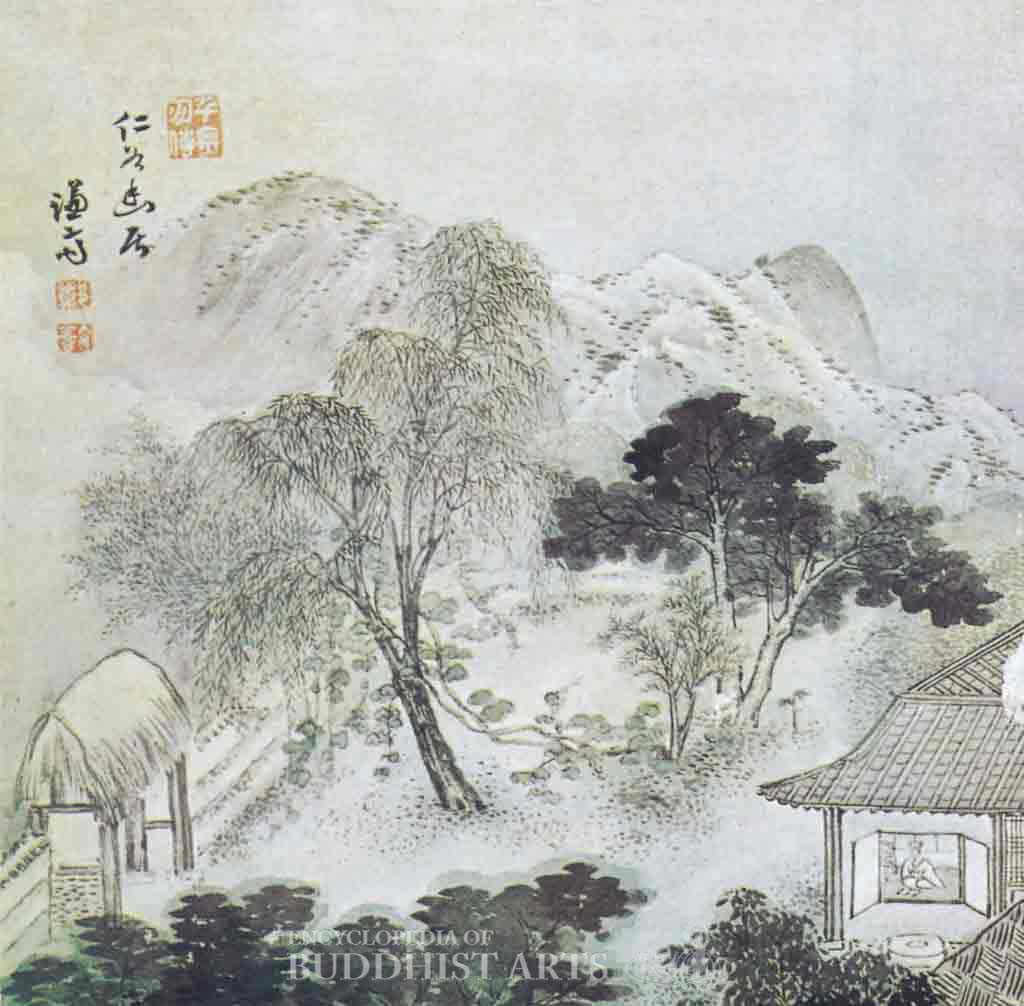
A Secluded House Near a Valley in Inwangsan by Jeong Seon; Joseon dynasty
Ink and color on paper
Jeong Seon
SOUTH KOREA, Gwangju; Joseon dynasty
Jeong Seon was also known as Wonbaek or Gyeomcho. He was a government official and painter who pioneered landscape painting in Korea. Exhibiting talent at a young age, Jeong was influenced by the literary paintings of the early Qing (1644–1911) dynasty of China. In his thirties, he traveled to Kumgangsan and other renowned mountains and scenic areas in Korea to paint the landscapes.
He was influenced by the painting style of the Southern school, as well as the development of O-pa landscape paintings, which incorporated poetry and calligraphy, and was a form of art popular among the literary class. Common themes in his paintings were the mountains and rivers of Korea, including the scenic spots of Kumgangsan and Gwadong, and the views of Hanyang and Namhangang. He also illustrated the temples in Hanyang, in addition to painting the streams, valleys, and hills he saw around northeast Inwangsan.
Jeong’s painting style imparted great influence on many subsequent Korean painters including his grandson, Jeong Hwang, eventually forming the Geunjae school of painting. Gang Heuiyeon, Kim Yungyeom, Choi Buk, Gim Eunghwan, Gim Hongdo, and Jeong Suyeong were all painters who produced works in this style.
Several well-known works by him include Kumgansan, kept at the Ho-Am Art Museum in Gyeonggi, and A Secluded House Near a Valley in Inwangsan, kept at the Gansong Art Museum in Seoul. Other paintings include Bakyeon Waterfalls, Manpokdong, and Sajik Nosong.
For more details, go to the Encyclopedia of Buddhist Arts: People, page 113.
Cite this article:
author = Hsingyun and Youheng and Youlu and Pokorski, Stefanie and Yichao and Mankuang and Miaohsi,
booktitle = {Encyclopedia of Buddhist Arts: People },
pages = 113,
title = {{Jeong Seon}},
volume = 19,
year = {2016}}