
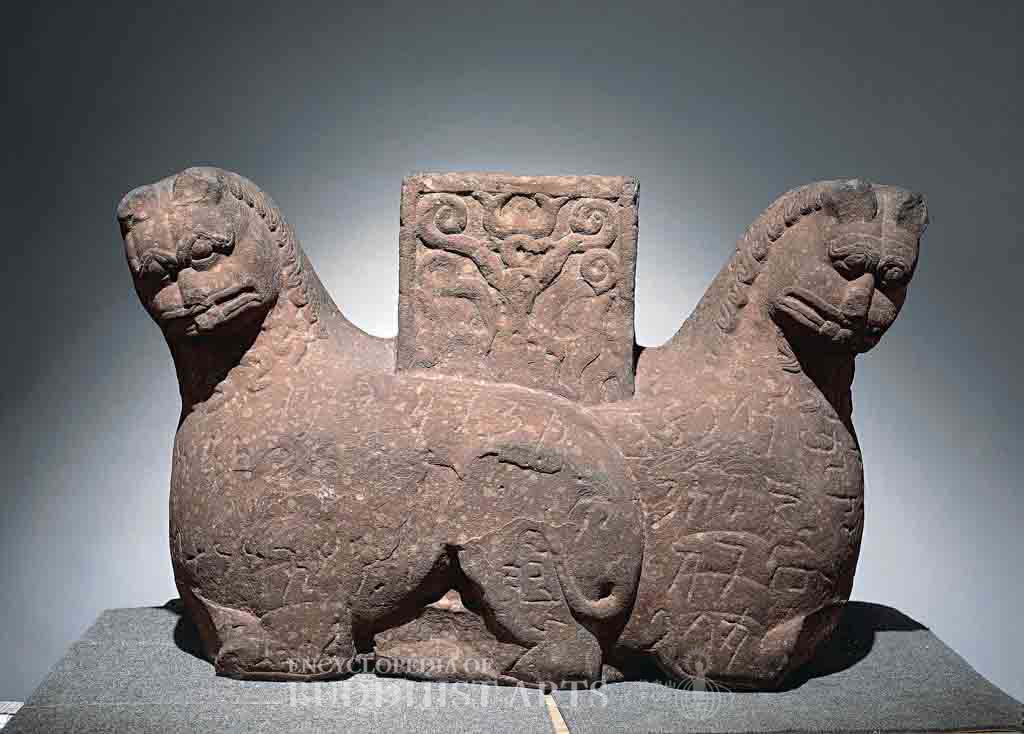
Mathura: Lion Capital
Sandstone
Mathura: Lion Capital
INDIA, Uttar Pradesh, Mathura
Unearthed from Mathura, the work once served as the capital of a column. A hole at the bottom was used to fix it to the column. Inscriptions cover the entire piece apart from the head and the square tablet, stating the name of the donor and its purpose as an offering to the Triple Gem: Buddha, Dharma, and Sangha. The sculpture consists of two stylized lions joined back-to-back. A rectangular stone block decorated with tendrils divides the lion’s backs. It has been suggested that the design owes something to ancient Persia, since a capital with twin bulls joined back to back was discovered from an excavated palace. The twin bulls were dated to early 8th century BCE.
For more details, go to the Encyclopedia of Buddhist Arts: Sculpture G-M, page 702.
Cite this article:
author = Hsingyun and Youheng and Lovelock, Yann and Chou, Yuan and Huntington, Susan and Edson, Gary and Neather, Robert,
booktitle = {Encyclopedia of Buddhist Arts: Sculpture G-M},
pages = 702,
title = {{Mathura: Lion Capital}},
volume = 11,
year = {2016}}