
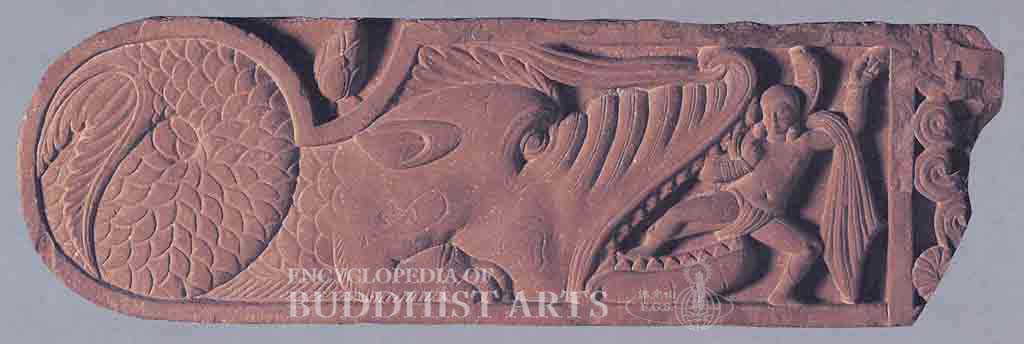
Mathura: Makara and Naga King
Sandstone
Mathura: Makara and Naga King
INDIA, Uttar Pradesh, Mathura
The relief depicts a makara out of whose mouth a naga king emerges. It was discovered in Sonkh, Mathura, and may have belonged on the lintel of a doorway into a stupa. The mythological makara has the head of a whale, an elephant’s trunk, crocodile’s jaws, lion’s paws, and the tail of a fish. It symbolizes vitality and for a while, the creature was popularly featured in Mathura sculpture. The naga king, identified by a snake’s head behind a human head, has one foot still inside the creature’s jaws. The naga kings derived from cobra gods and represent life and wealth. The deities are demons that inhabit the earliest folk beliefs in India and were later interpreted in Buddhism as auspicious creatures and guardian deities.
For more details, go to the Encyclopedia of Buddhist Arts: Sculpture G-M, page 702.
Cite this article:
author = Hsingyun and Youheng and Lovelock, Yann and Chou, Yuan and Huntington, Susan and Edson, Gary and Neather, Robert,
booktitle = {Encyclopedia of Buddhist Arts: Sculpture G-M},
pages = 702,
title = {{Mathura: Makara and Naga King}},
volume = 11,
year = {2016}}