
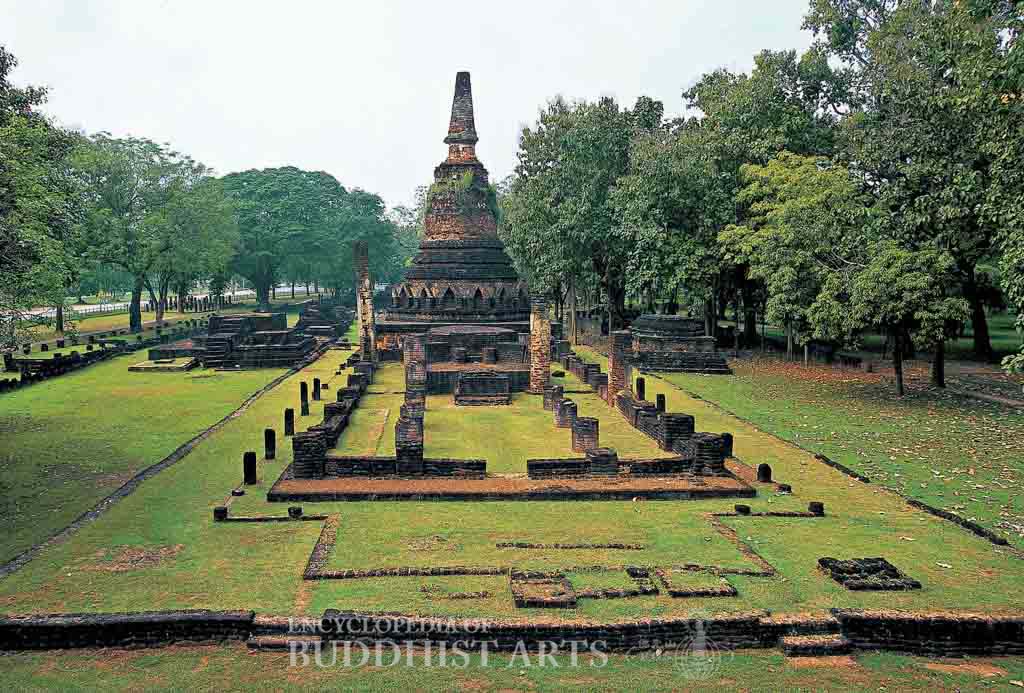
Wat Phra Kaeo
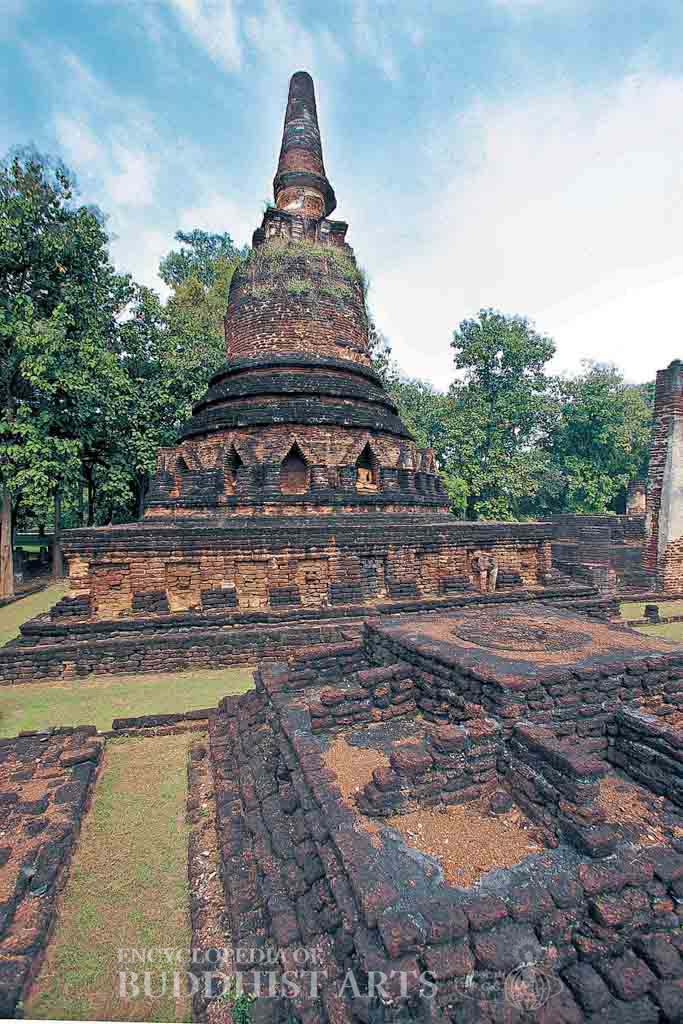
Wat Phra Kaeo: Main Stupa
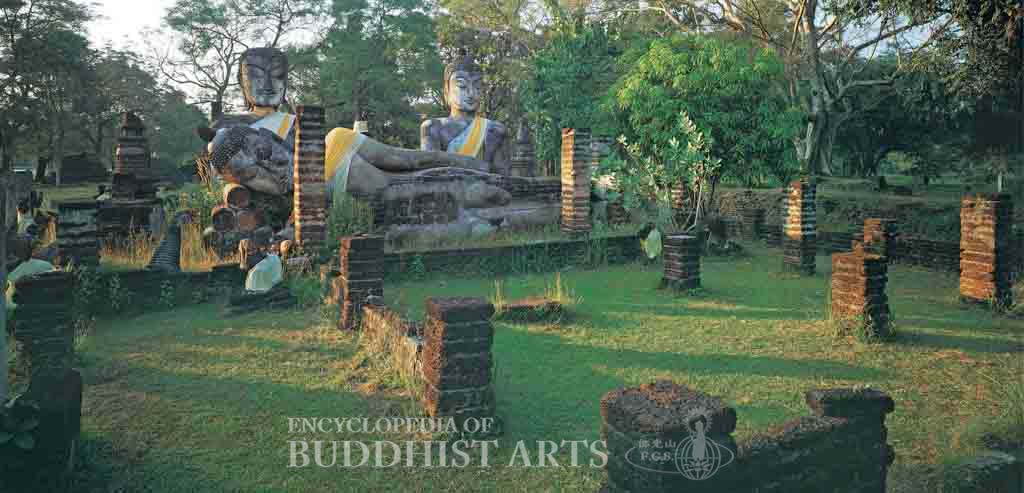
Wat Phra Kaeo: Buddha Hall - Reclining and Seated Buddhas
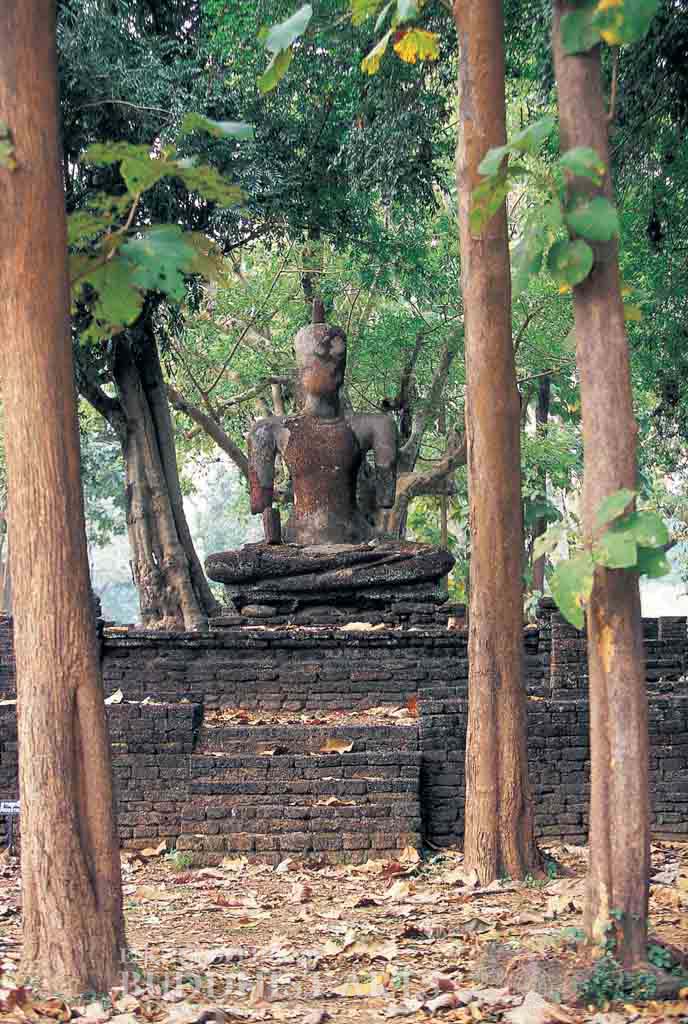
Wat Phra Kaeo: Seated Buddha
Wat Phra Kaeo
THAILAND, Kamphaeng Phet
Wat Phra Kaeo means the Temple of the Emerald Buddha. It is believed the temple formerly enshrined an emerald Buddha statue, and it was a royal temple during its prime. The year of its construction is unknown but it was likely built during the late Sukhothai period (circa 1238–1438) and renovated in the Ayutthaya Kingdom (circa 1350–1767). As part of the Historic Town of Sukhothai and Associated Historic Towns, it was listed as a UNESCO World Heritage Site in 1991.
The large temple complex consists of the remains of an ordination hall, assembly hall, Thai-style stupas, Khmer-style stupas, and Buddha statues from different periods. The temple faces east and the main buildings were built along an east-west axis. The site is surrounded by a laterite boundary wall. The ordination hall at the front no longer exists but the boundary stones that surrounded it can still be seen. Behind the ordination hall there is a three-tier square base with multiple corners, and it is believed to be the stupa base on which the Emerald Buddha image was once placed. To the west of the ordination hall there is the main stupa made of laterite and brick. It has a square base platform measuring 15 m on each side and has 32 niches, each of which once held a lion statue. An octagonal base stands on the base platform and there are two niches on each side, with a total of 16 niches. These niches were originally enshrined with seated Buddha statues. Above the octagonal base there are three circular tiers, on top of which rests the bell-shaped stupa body. Above that there is a square harmika with niches on the four sides, each containing a standing Buddha statue. At the very top, the spire takes the form of stacked rings.
Behind the main stupa there is the elevated base of the Buddha hall, within which there are three large Buddha statues, now out in the open. In the front there is the reclining Buddha, resting on the right side with a peaceful and gentle expression. Behind the reclining Buddha there are two seated Buddhas, both with rounded cheeks and broad chests. From their artistic style, these statues are believed to be works from the early Ayutthaya period. Numerous other stupas and outdoor Buddha statues of various sizes can be found around the temple.
For more details, go to the Encyclopedia of Buddhist Arts: Architecture T-Z, page 1225.
Cite this article:
author = Hsingyun and Youheng and Johnson, Peter and Mankuang and Lancaster, Lewis,
booktitle = {Encyclopedia of Buddhist Arts: Architecture T-Z},
pages = 1225,
title = {{Wat Phra Kaeo}},
volume = 4,
year = {2016}}