
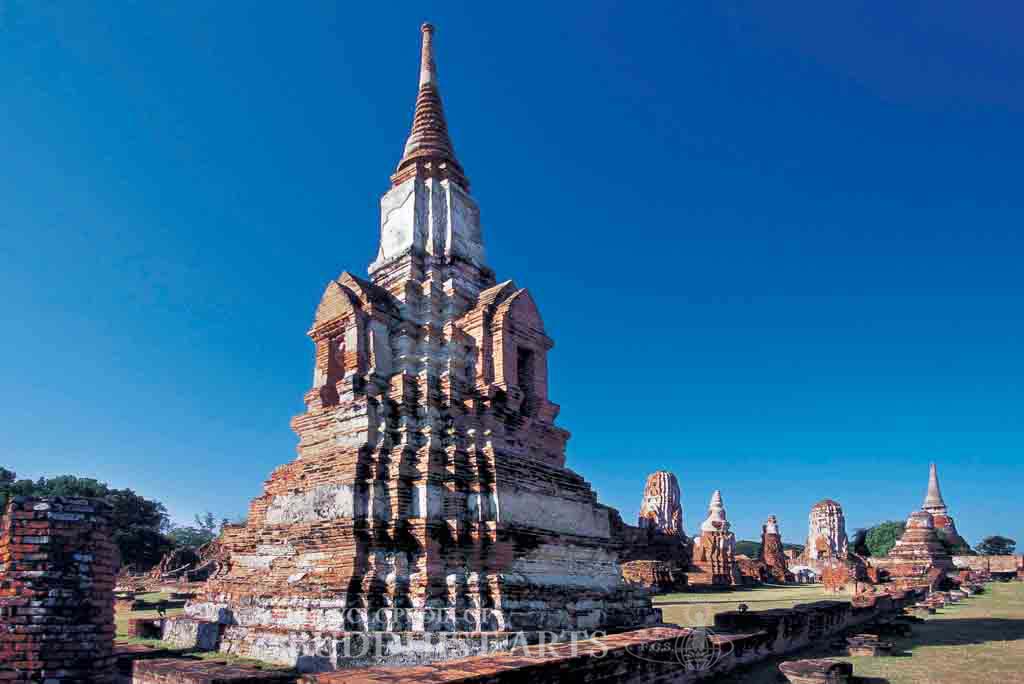
Wat Mahathat: Thai-Style Stupa
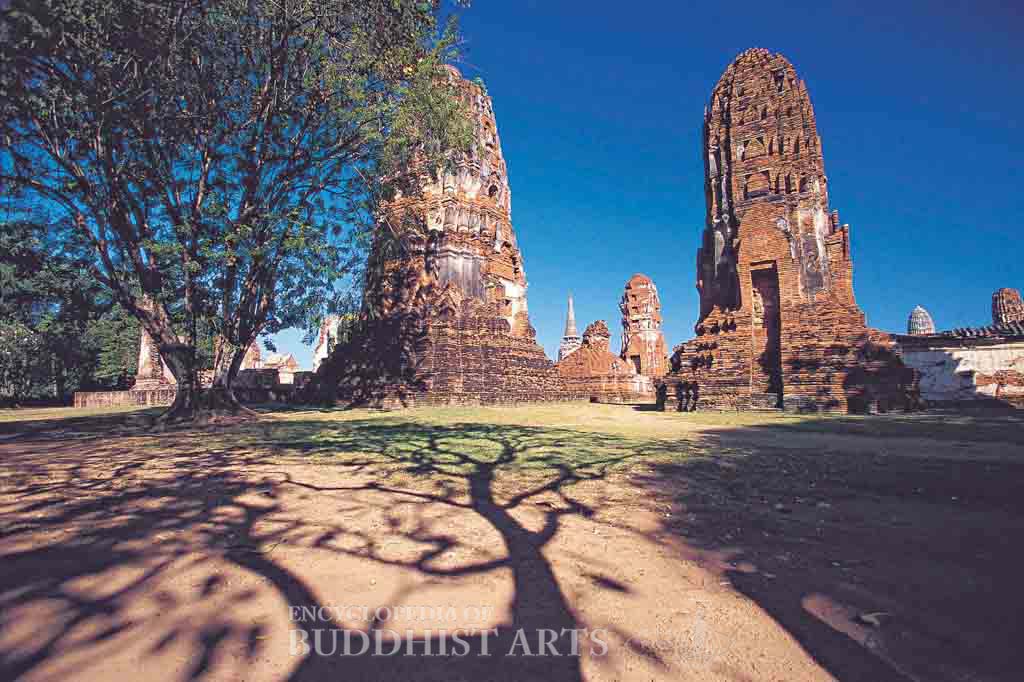
Wat Mahathat: Khmer-Style Stupas

Wat Mahathat: Thai-Style Stupa

Wat Mahathat
Wat Mahathat
THAILAND, Ayutthaya
Wat Mahathat means the Temple of the Great Relics. It is located in the center of the ancient city of Ayutthaya. It was one of the largest and most important royal temples during the Ayutthaya period (circa 1350–1767), and it was where the Sangharaja resided. It was built in 1374 by King Borommaracha I (reigned 1370–1388) and was expanded under King Ramesuan (reigned 1369–1370, 1388–1395), who named the temple Wat Mahathat. It subsequently underwent several expansions. In 1767 the Burmese army invaded Ayutthaya and the temple was severely damaged along with the entire city. As part of the Historic City of Ayutthaya, it was listed as a UNESCO World Heritage Site in 1991.
Only the ruins of the base platform and the base of the Khmer-style stupa still remain. It is located in the center of the temple and it is estimated to have a height of 50 m. It was constructed in laterite and later restored in brick, while the spire was cast in metal. The stupa collapsed during the reign of King Songtham (reigned 1610–1628) and was later restored. It collapsed again in 1911 during the time of King Rama VI (reigned 1910–1925) and has not been restored. In 1956 the Fine Arts Department of Thailand began excavation at the site of the main stupa and retrieved a set of seven nesting reliquaries containing relics of the Buddha.
For four centuries Wat Mahathat was one of the most important Buddhist centers at Ayutthaya and many architectural styles were evident during this time. Such differing styles can be seen in the extant stupas found within the temple compound. One Thai-style stupa has a high multi-tier base platform with multiple corners. On the body there are four porticos, above which there were formerly decorated tympana. The base of the spire is in the shape of a bell, which is surmounted by stacked rings, followed by the finial. Another Thai-style stupa has a similar but higher base surmounted by a square harmika with multiple corners. The spire consists of stacked rings followed by a finial. A third stupa is Sri Lankan in style with a low square base platform and a round base with multiple layers. The body of the stupa is in the shape of a bell, above which there is a square harmika. The spire of stacked rings is supported by short round columns. Within the temple there are numerous Khmer-style stupas with tapered curved shapes.
The remains of the foundation of a Buddha hall can still be seen surrounded by boundary walls in the form of a square. There are Buddha statues of various sizes but they are mostly damaged. Antiquities such as votive tablets, golden plaques, and decorated boxes were discovered during excavation. These objects, as well as the set of seven nesting reliquaries, are now in the collection of the Chao Sam Phraya National Museum.
For more details, go to the Encyclopedia of Buddhist Arts: Architecture T-Z, page 1201.
Cite this article:
author = Hsingyun and Youheng and Johnson, Peter and Mankuang and Lancaster, Lewis,
booktitle = {Encyclopedia of Buddhist Arts: Architecture T-Z},
pages = 1201,
title = {{Wat Mahathat}},
volume = 4,
year = {2016}}