

Taxila Jaulian Temple
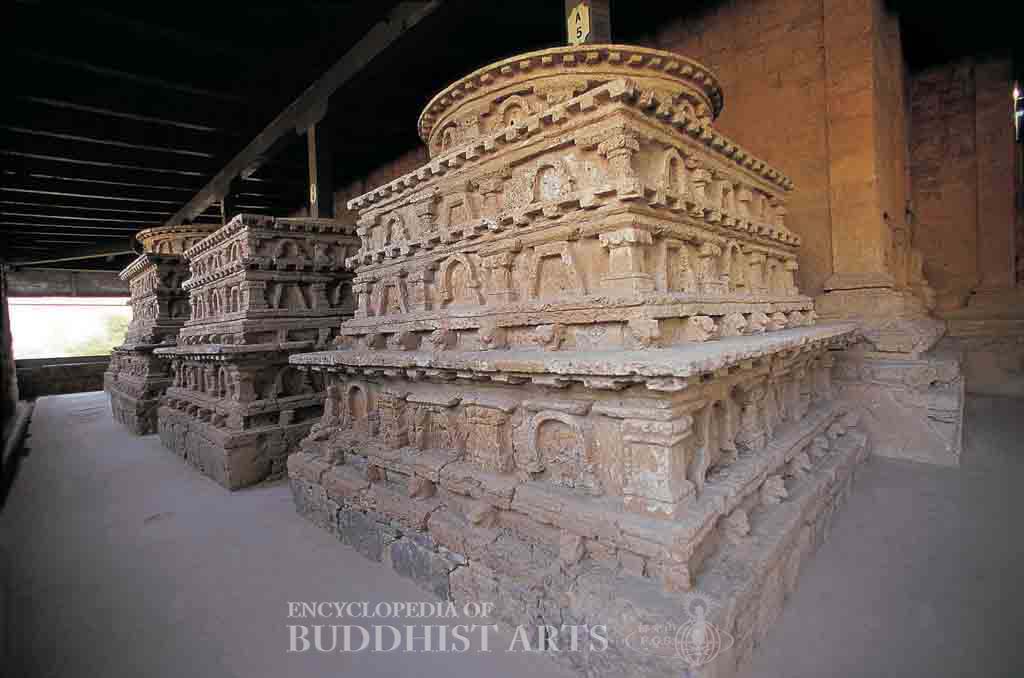
Taxila Jaulian Temple: Small Stupas

Taxila Jaulian Temple: Seated Buddha
Taxila Jaulian Temple
PAKISTAN, Punjab, Taxila
It is known locally as Jay Waliyan or the Seat of Saints, and is one of the best-preserved buildings at Taxila. The temple was built on a 92 m high hill during the 2nd century, when Taxila was under the Kushan Empire (circa 1st–3rd century). In 455 it was destroyed by the Hephthalites. As part of Taxila, it was listed as a UNESCO World Heritage Site in 1980.
The complex is composed of two compounds, with the stupa in the west and the monastery in the east. There are three entrances to the site: two are located in the stupa compound at the northwest and southeast corners, and one is on the east side of the monastery compound. The monastery is rectangular and aligned on an east-west axis. Towards the west there is a spacious square courtyard surrounded by two-story monastic quarters, of which the upper story has mostly collapsed. Every room has a small window and a lamp holder. Only the structural framework and stairs remain. There is an assembly hall in the northeast and a dining hall in the southeast.
The stupa compound can be divided into north and south courtyards. The south courtyard, which contains the main stupa, is built on elevated land. All that remains is part of the stupa base. The base platform is square and in the center of the north wall there are protrusions which are the remains of a stairway. There is a relief of the seated Medicine Buddha on the wall on the left-hand side of this stairway. Twenty-one elaborately carved small stupas surround the main stupa.
The sides of the north courtyard in the stupa compound are lined with small shrines, which once housed Buddha statues. Within the courtyard there are five small stupas. All that is left of these stupas is their high base platforms. The reliefs on the walls of these bases are fairly well preserved. The bases can be separated into upper and lower sections. Both sections are similarly divided into upper and lower reliefs. The upper row is filled with niches containing seated Buddha and Bodhisattva statues. Each niche is flanked by Bodhisattvas. The lower row consists of vivid carvings of elephants, lions and warriors.
There is another small shrine near the southeast entrance where several clay Buddha statues can be found. These statues are in a better condition than the other sculptures.
For more details, go to the Encyclopedia of Buddhist Arts: Architecture T-Z, page 1097.
Cite this article:
author = Hsingyun and Youheng and Johnson, Peter and Mankuang and Lancaster, Lewis,
booktitle = {Encyclopedia of Buddhist Arts: Architecture T-Z},
pages = 1097,
title = {{Taxila Jaulian Temple}},
volume = 4,
year = {2016}}