
Amitayus Buddha
Color on cloth
Amitayus Buddha
CHINA
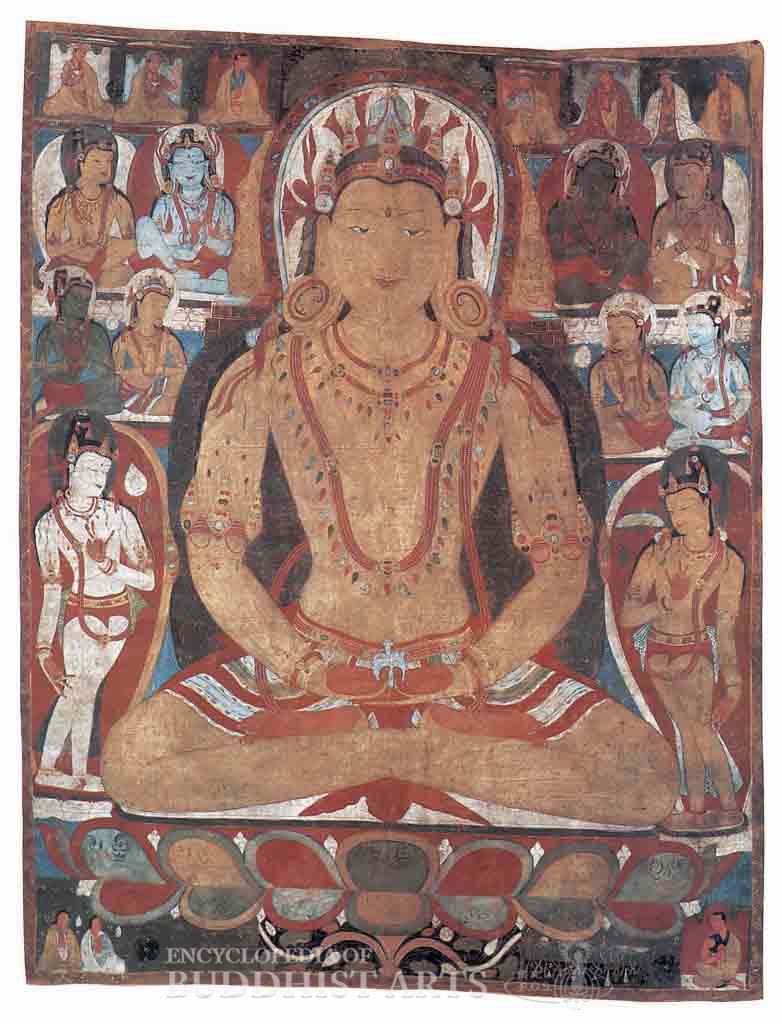
In this image, the yellow Amitayus Buddha wears a headdress decorated with five flowers and floating ribbons, a dhoti secured with a waistband, a necklace, armlets, and earrings. The Buddha sits in full lotus position and holds a vase containing the elixir of longevity.
Attendant Bodhisattvas, one yellow and the other white, stand in tribhanga posture facing the Buddha. Two groups of four seated Bodhisattvas are depicted above the attendants. At the top of the painting, there is a row of seven figures, six of whom wear flat hats. At the bottom of the painting, a monk sits in the right corner, and the two sponsors of the thangka are depicted on the left.
Like many of the other thangkas made in U-Tsang, Tibet between the 11th and 13th centuries, this image was influenced by the art of the Pala period (circa 8th–12th century) of India. The thangkas of this period feature Buddha images with large faces, curled upper eyelids, colored lower lips, and red coloring on the hands and feet. The lotus thrones have decorative, multi-colored petals, and the aureole is niche-like, all features of Pala period artworks.
For more details, go to the Encyclopedia of Buddhist Arts: Painting A-H, page 41.
Cite this article:
author = Hsingyun and Youheng and Youlu and Wilson, Graham and Manho and Mankuang and Huntington, Susan,
booktitle = {Encyclopedia of Buddhist Arts: Painting A-H},
pages = 41,
title = {{Amitayus Buddha}},
volume = 14,
year = {2016}}