
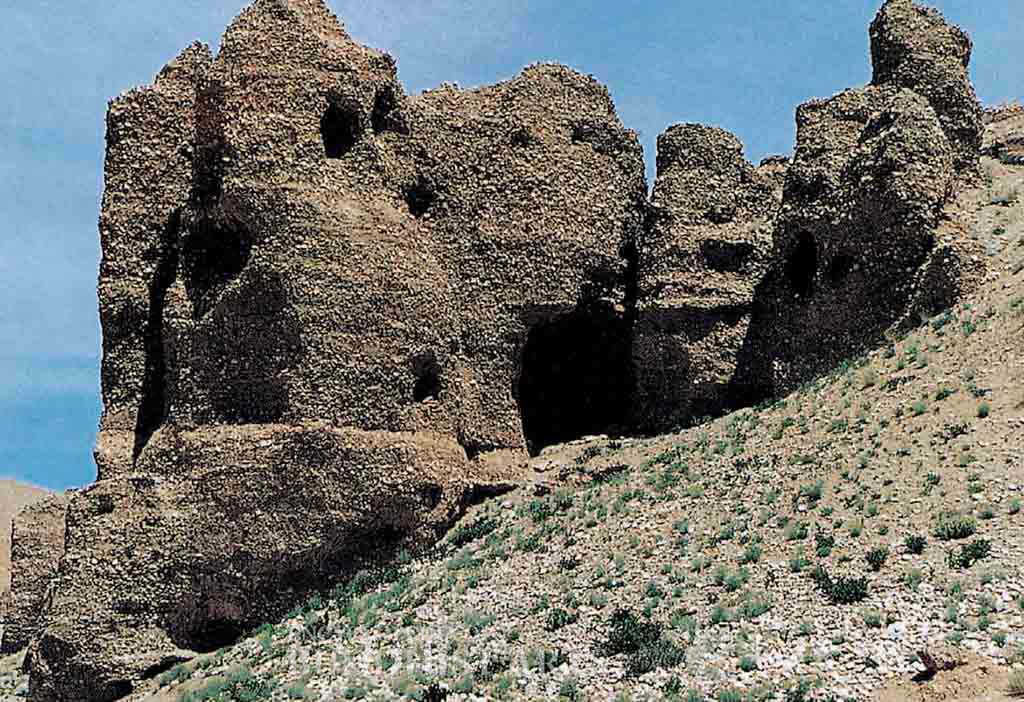
Kaepu Caves: Shrine Cave
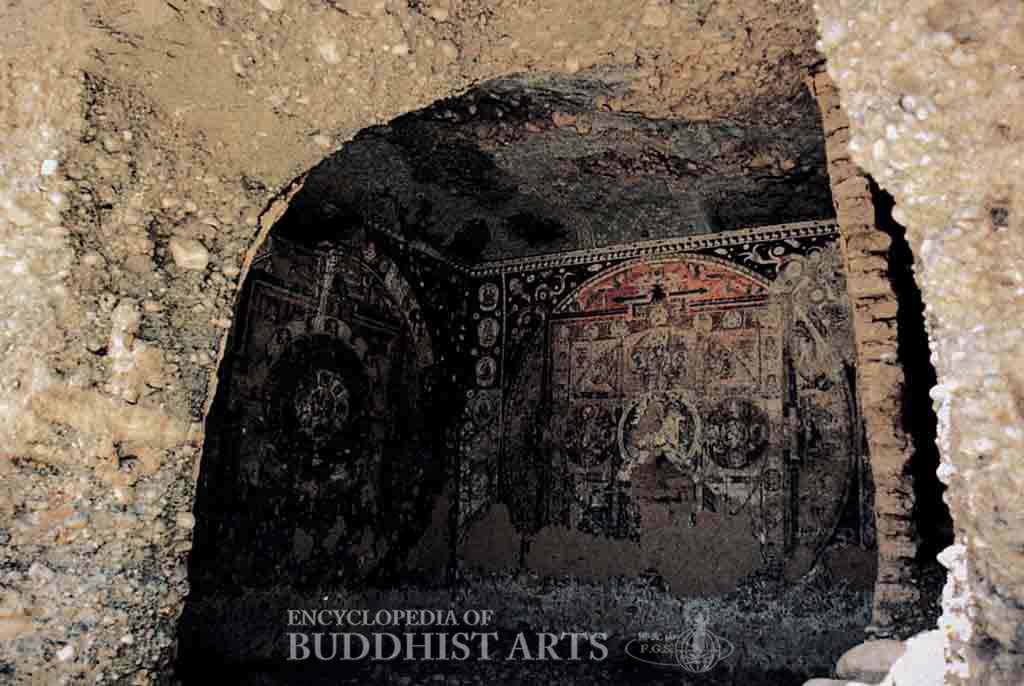
Kaepu Caves: Shrine Cave
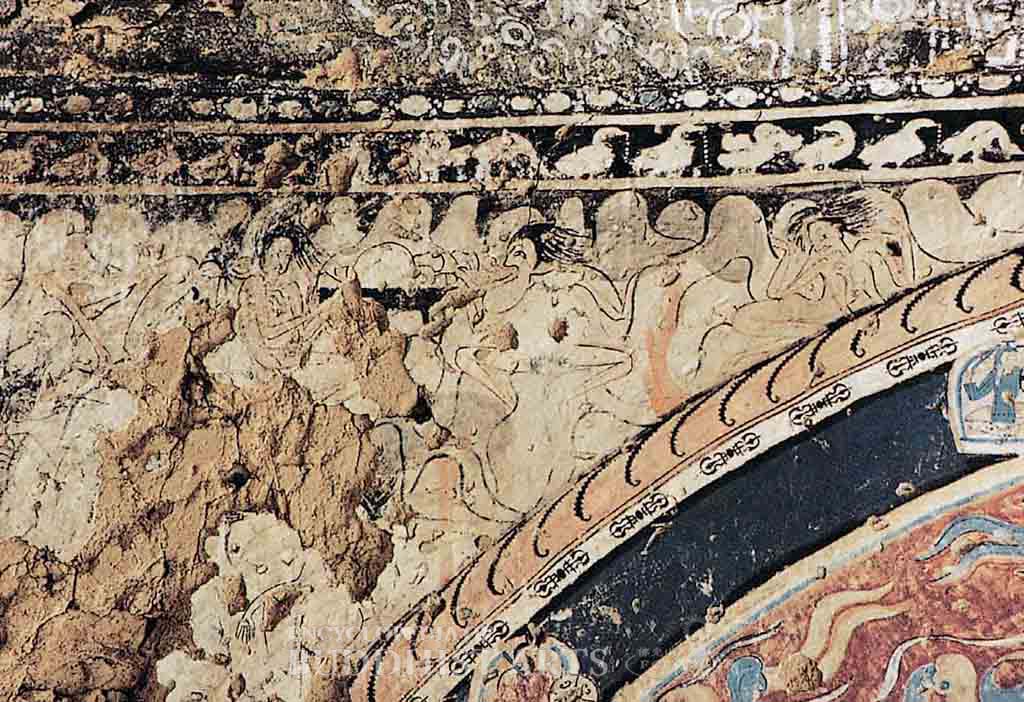
Kaepu Caves: Shrine Cave - Hungry Ghost (east wall)
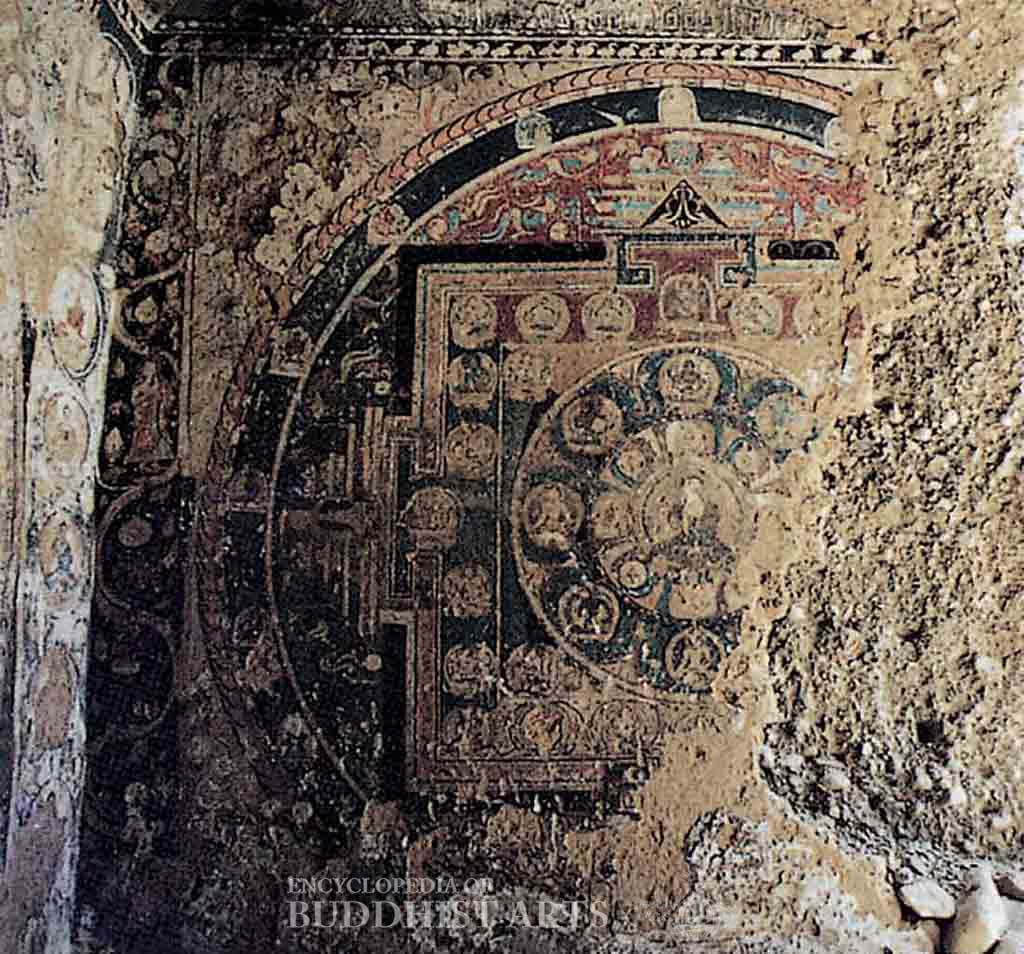
Kaepu Caves: Shrine Cave - Womb Realm Mandala (east wall)
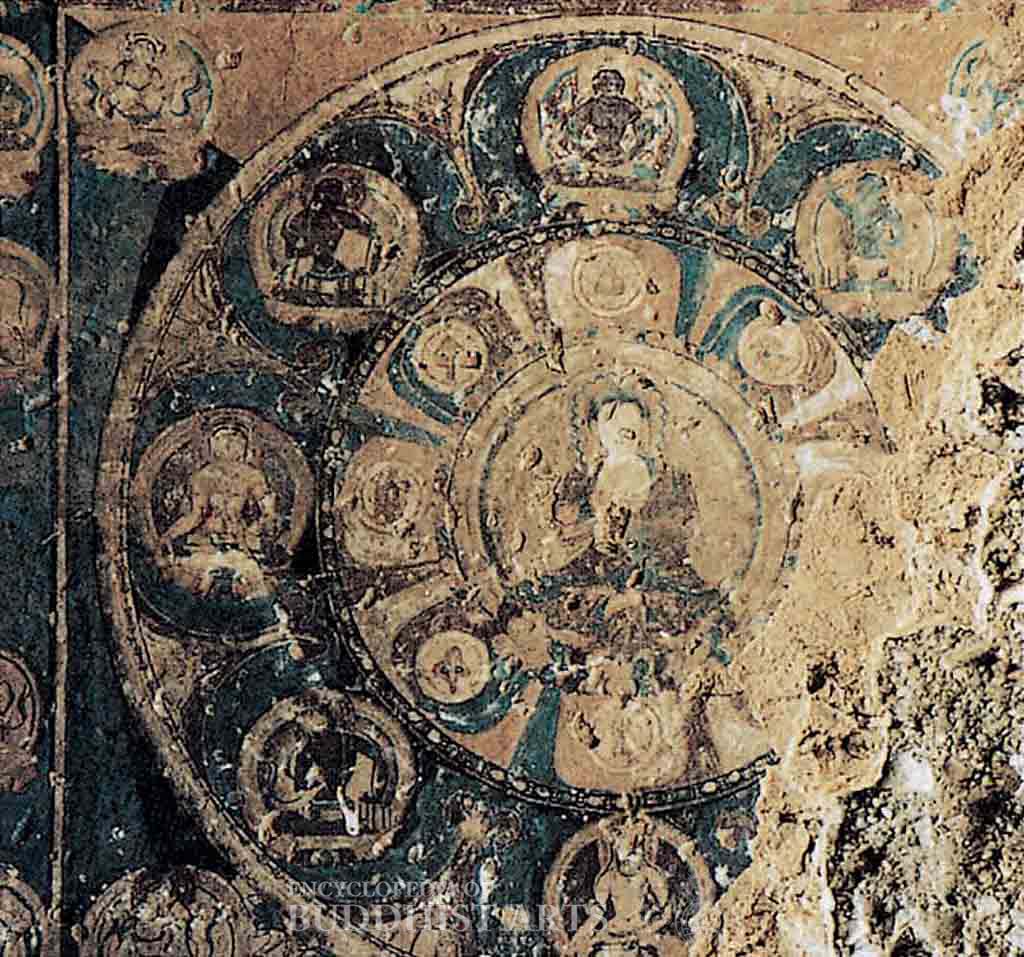
Kaepu Caves: Kaepu Caves: Shrine Cave - Womb Realm Mandala (detail) (east wall)
Kaepu Caves: Shrine Cave
CHINA, Tibet, Ngari
This shrine cave, with murals dated to between the 11th and 13th centuries, is located on the left side of the mountain ridge and faces south. The cave is square in shape with a flat ceiling and measures 4.1 m wide, 4.2 m high, and 4.2 m deep.
Several murals decorate the ceiling of the cave, although they are mostly damaged. The mural on the upper register of the north wall is painted with a pattern of water birds carrying ribbons in their mouths. There is a Diamond Realm Mandala in the center of the mural, in which the inner circle is divided into nine equal segments separated by vajras. The center of the mandala is slightly damaged, but the figure inside is discernibly Vairocana Buddha, painted white and has a simple mandorla. The Buddha is seated with ankles crossed on a lotus throne and forms the bodhyangi (wisdom fist) mudra. Vairocana is surrounded by a combination of four Bodhisattvas and four Buddhas. The square outside the inner circles of the mandala contains Dharma protectors.
The west wall displays a Womb Realm Mandala with an eight-petaled lotus at the center. There is a Dharma protector on each of the petal. At the center is a blue Buddha with eight arms, each holding a different instrument. The outer mandala features a gate and a pavilion on every side, each of which houses a Dharma protector. Surrounding the mandala are various animals, trees, birds, monks, and stupas.
The east wall features an almost identical Womb Realm Mandala. Small differences can be observed in the central Buddha, who has two arms, instead of eight, and wears a monastic robe covering both shoulders. This Buddha forms the vitarka (teaching) mudra. Two of the eight petals of the central lotus have been damaged, but the petals are adorned with images of Buddhas and Bodhisattvas as opposed to the Dharma protectors found in the west wall. In the corner, above the mandala, there is a ghastly-looking image of a hungry ghost.
Murals on the south wall are divided into three registers. The upper register features a decorative pattern of white water birds. Depicted on the middle register is a Dharma protector, who has one hand raised holding a weapon, and the other resting down by his side. The Dharma protector wears a robe covering both shoulders and his waist is wrapped in a white band. There are three rows of small figures on the lower register, though there is damage to the bottom row. Eleven figures are seated in the top row, the first five of which are monks and the remaining six being lay people making offerings. The middle row depicts 12 noblemen, who are thought to be the donors.
For more details, go to the Encyclopedia of Buddhist Arts: Caves R-L, page 447.
Cite this article:
author = Hsingyun and Youheng and Johnson, Peter and Mankuang and Huntington, Susan and Edson, Gary and Neather, Robert,
booktitle = {Encyclopedia of Buddhist Arts: Caves R-L},
pages = 447,
title = {{Kaepu Caves: Shrine Cave}},
volume = 6,
year = {2016}}