
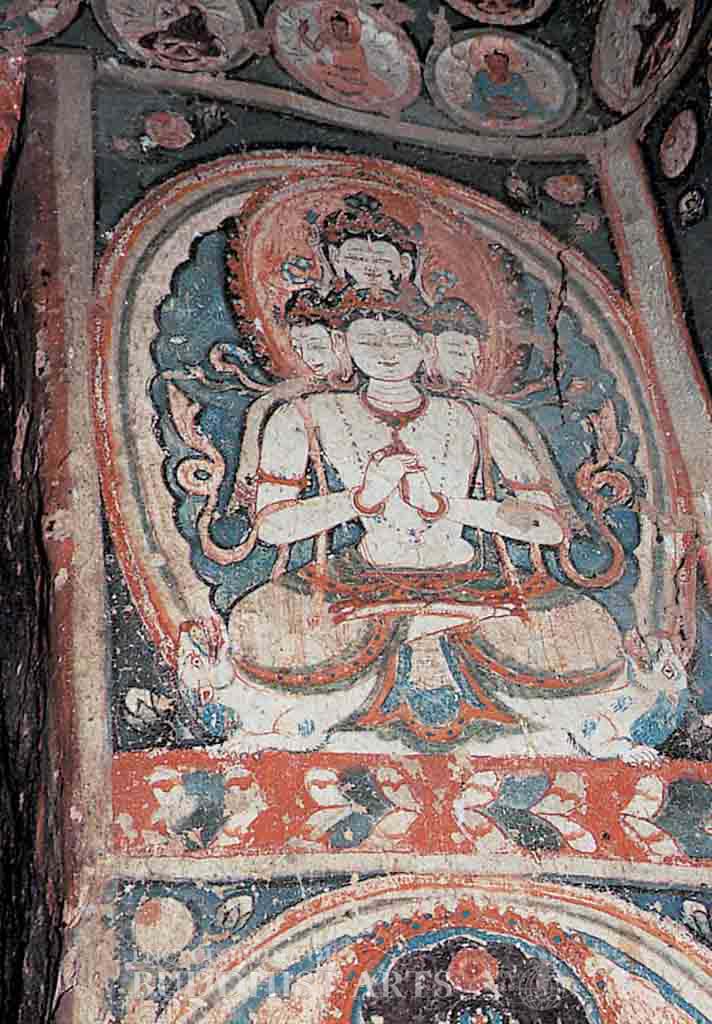
Mangyu Gateway Stupa: Five Dhyani Buddhas - Vairocana Buddha (north wall)
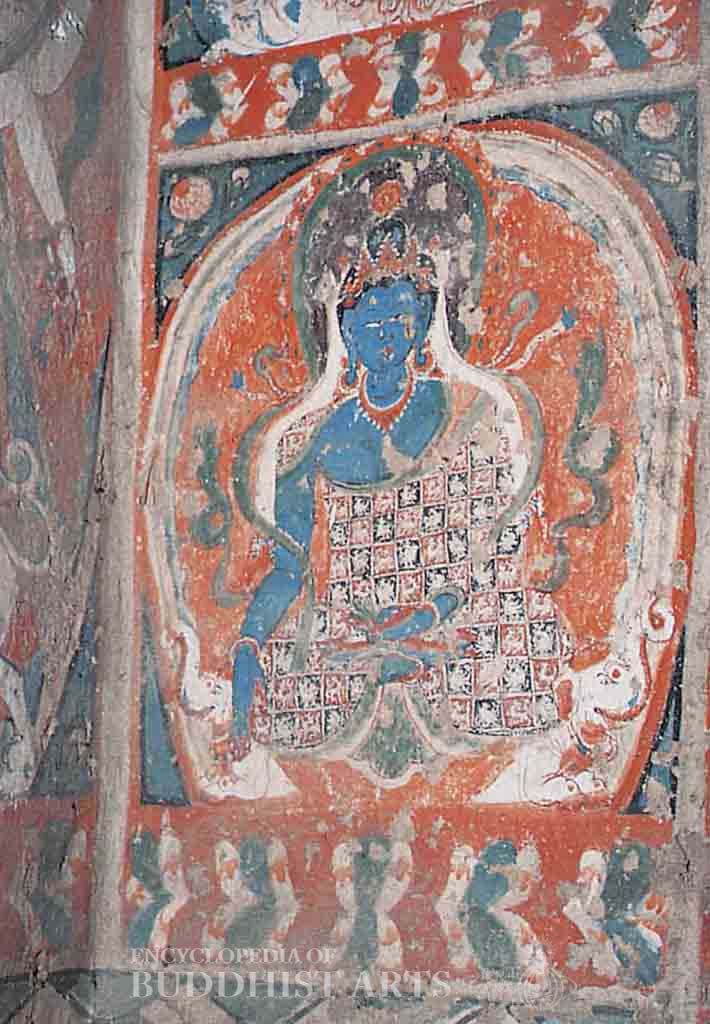
Mangyu Gateway Stupa: Five Dhyani Buddhas - Aksobhya Buddha (south wall)
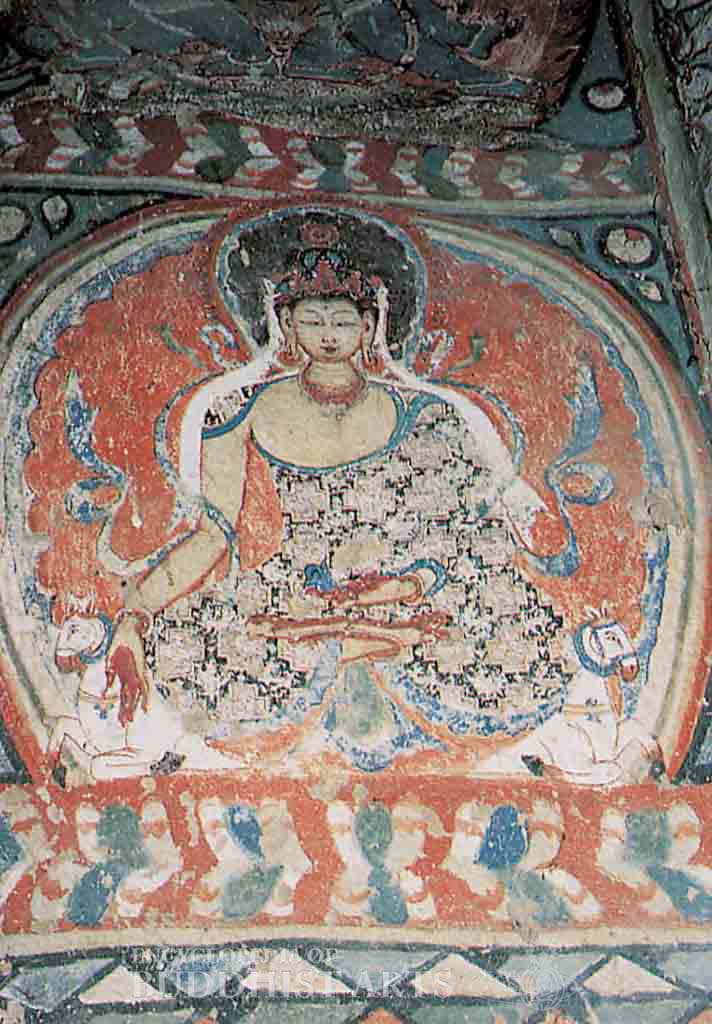
Mangyu Gateway Stupa: Five Dhyani Buddhas - Ratnasambhava Buddha (south wall)
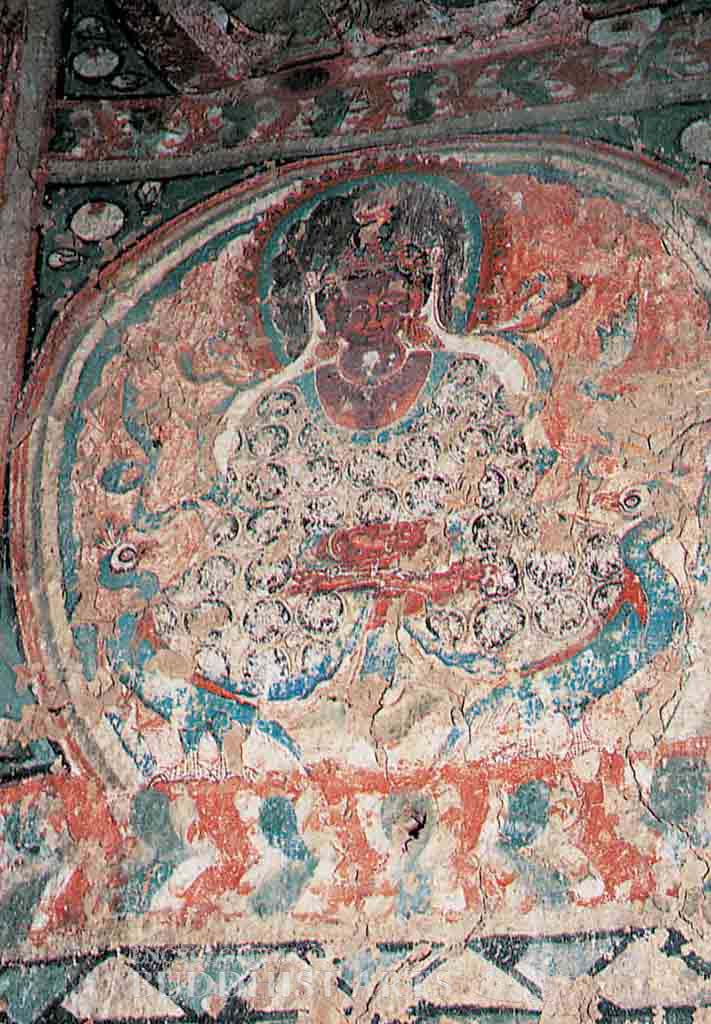
Mangyu Gateway Stupa: Five Dhyani Buddhas - Amitabha Buddha (north wall)
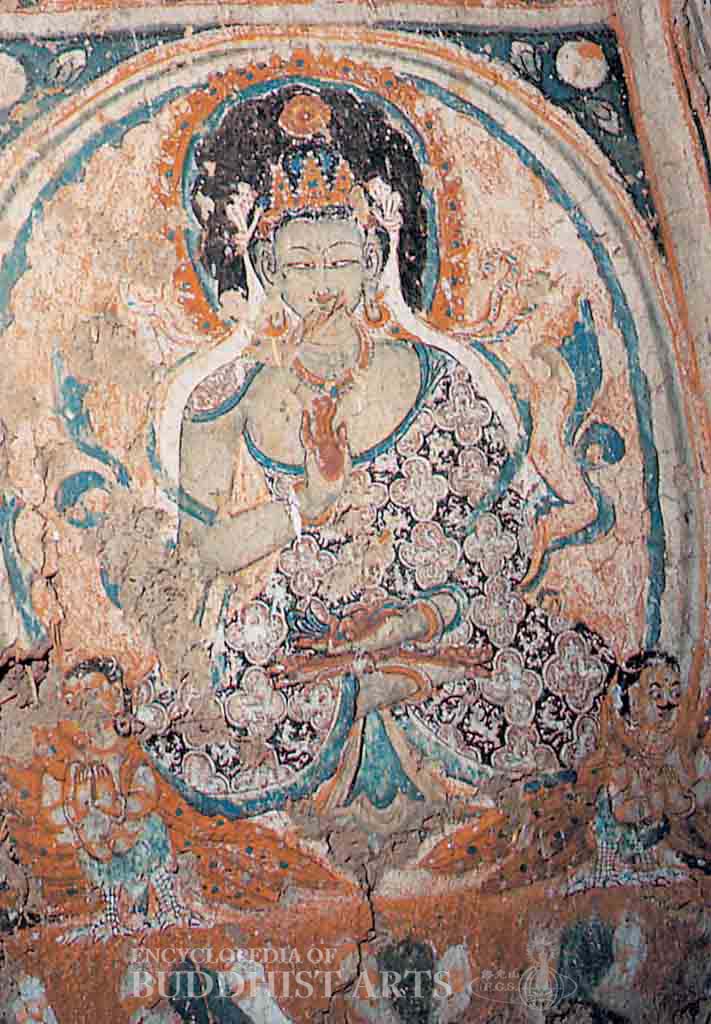
Mangyu Gateway Stupa: Five Dhyani Buddhas - Amoghasiddhi Buddha (north wall)
Mangyu Gateway Stupa: Five Dhyani Buddhas
INDIA, Jammu and Kashmir, Ladakh
The Five Dhyani Buddhas are painted beside the niches on the north and south walls of the Mangyu Gateway Stupa. Vairocana Buddha, Amoghasiddhi Buddha, and Amitabha Buddha are painted on the north wall, while Aksobhya Buddha and Ratnasambhava Buddha are shown on the south wall.
The Four-Headed Vairocana Buddha is often featured in the illustrations of the Diamond Realm Mandala. The white-bodied Buddha has a nimbus and a colorful aureole, and wears a crown with fluttering ribbons on the sides. Draped in a stole and adorned with beaded ornaments, Vairocana forms the bodhyangi (wisdom fist) mudra while sitting in full lotus position on the backs of two snow lions who lie on an inverted lotus throne. The heads of the snow lions are raised as they turn backward to look at the Buddha.
Aksobhya Buddha wears a gold necklace and a monastic robe covered with red and black checkered patterns. The Buddha is seated in lotus position upon two elephants with their trunks raised. The right hand forms the bhumisparsa (earth-touching) mudra, while the left hand rests flat in front of the abdomen. Sitting on a pair of crouching white horses, Ratnasambhava Buddha is dressed in a monastic robe decorated with geometric patterns. The right hand forms the varada (wish-granting) mudra.
The red-bodied Amitabha Buddha wears a monastic robe embellished with brightly colored floral patterns, and forms the dhyana (meditation) mudra with both hands. The Buddha is seated on two peacocks with turned heads. Amoghasiddhi Buddha, painted in green, dons a monastic robe covered with images of flowers. Forming the abhaya (fearlessness) mudra with the right hand, Amoghasiddhi sits on two garudas who stand with their palms joined in reverence. Though the murals have faded in places, their distinctive, detailed style and bright colors are still clear.
For more details, go to the Encyclopedia of Buddhist Arts: Painting I-O, page 505.
Cite this article:
author = Hsingyun and Youheng and Youlu and Wilson, Graham and Manho and Mankuang and Huntington, Susan,
booktitle = {Encyclopedia of Buddhist Arts: Painting I-O},
pages = 505,
title = {{Mangyu Gateway Stupa: Five Dhyani Buddhas}},
volume = 15,
year = {2016}}