
Life of the Buddha
Pyrophyllite
Life of the Buddha
MYANMAR
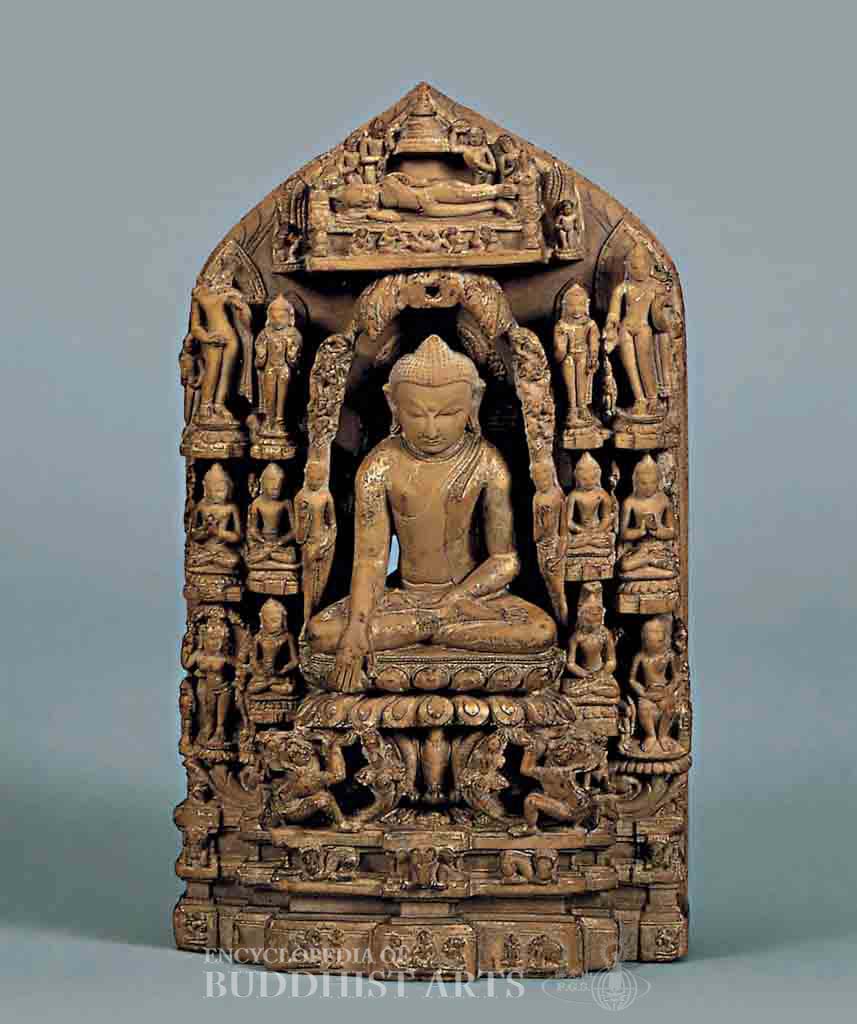
In the center of this composition the Buddha forms the bhumisparsa (earth-touching) mudra on a double lotus throne that is supported by two squatting naga kings. What appears to be an alcove in which the figure sits is made of two graceful figures on either side with a leafy canopy representing the Bodhi tree above. Surrounding the petal-shaped mandorla about this, a double row of figures are seated or standing on lotus outgrowths. On the sculpture’s reverse, the character “Om” is inscribed.
On both sides of the niche, there are Buddha images that resemble different contemplative postures and mudras in the seven weeks after his enlightenment. The engravings on the base depict others among the main episodes in the Buddha’s life, including birth, first teaching, subduing the intoxicated elephant, teaching his deceased mother in Trayastrimsa Heaven, and the monkey’s offering of honey. This style of narrative object was being pioneered in the region during the later Bagan Empire (10th–11th century).
For more details, go to the Encyclopedia of Buddhist Arts: Sculpture G-M, page 581.
Cite this article:
author = Hsingyun and Youheng and Lovelock, Yann and Chou, Yuan and Huntington, Susan and Edson, Gary and Neather, Robert,
booktitle = {Encyclopedia of Buddhist Arts: Sculpture G-M},
pages = 581,
title = {{Life of the Buddha}},
volume = 11,
year = {2016}}