
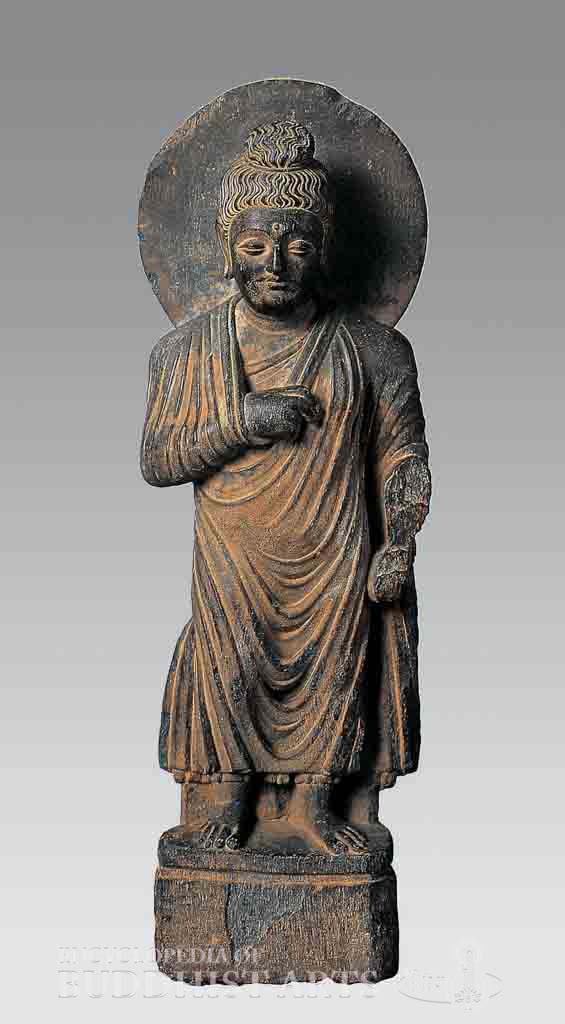
Standing Buddha
Schist
Standing Buddha
PAKISTAN
The body of this Gandharan figure is solid, rugged, and has a sense of mass. The vase in the damaged left hand is practically the only exceptional characteristic.
This figure wears a monastic robe wound tightly around the arms. The position of the right arm resembles that of the Roman statue Sophokles, reflecting western influence on Gandharan artworks. The hair is tied simply into an unornamented topknot and there is an urna mid-forehead. Other signs of Buddhahood are enlarged ears and the three lines on the neck.
For more details, go to the Encyclopedia of Buddhist Arts: Sculpture St-Z, page 1150.
Cite this article:
Hsingyun, et al. "Standing Buddha." Encyclopedia of Buddhist Arts: Sculpture St-Z, vol. 13, 2016, pp. 1150.
Hsingyun, Youheng, Yann Lovelock, Yuan Chou, Susan Huntington, Gary Edson, and Robert Neather. 2016. "Standing Buddha" In Encyclopedia of Buddhist Arts: Sculpture St-Z, 13:1150.
Hsingyun, Youheng, Lovelock, Y., Chou, Y., Huntington, S., Edson, G., & Neather, R.. (2016). Standing Buddha. In Encyclopedia of Buddhist Arts: Sculpture St-Z (Vol. 13, pp. 1150).
@misc{Hsingyun2016,
author = Hsingyun and Youheng and Lovelock, Yann and Chou, Yuan and Huntington, Susan and Edson, Gary and Neather, Robert,
booktitle = {Encyclopedia of Buddhist Arts: Sculpture St-Z},
pages = 1150,
title = {{Standing Buddha}},
volume = 13,
year = {2016}}
author = Hsingyun and Youheng and Lovelock, Yann and Chou, Yuan and Huntington, Susan and Edson, Gary and Neather, Robert,
booktitle = {Encyclopedia of Buddhist Arts: Sculpture St-Z},
pages = 1150,
title = {{Standing Buddha}},
volume = 13,
year = {2016}}