
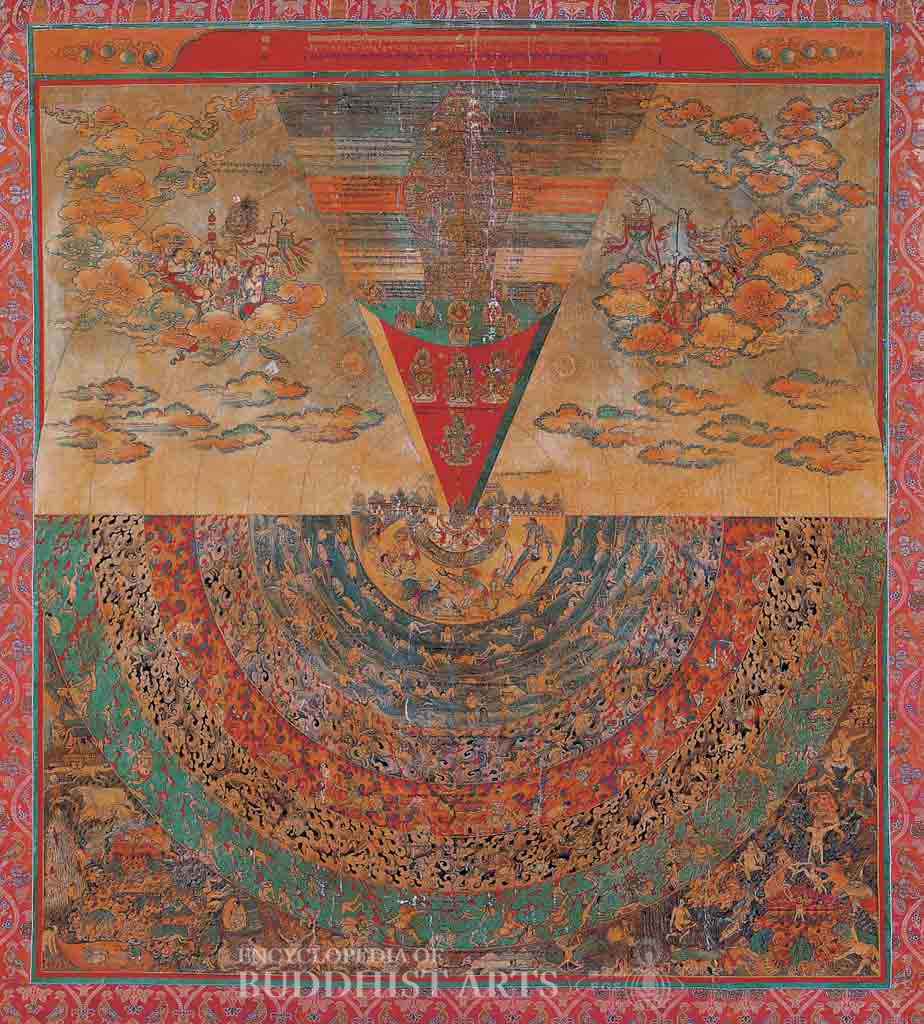
Buddhist Cosmology - Mount Sumeru
Color on cloth
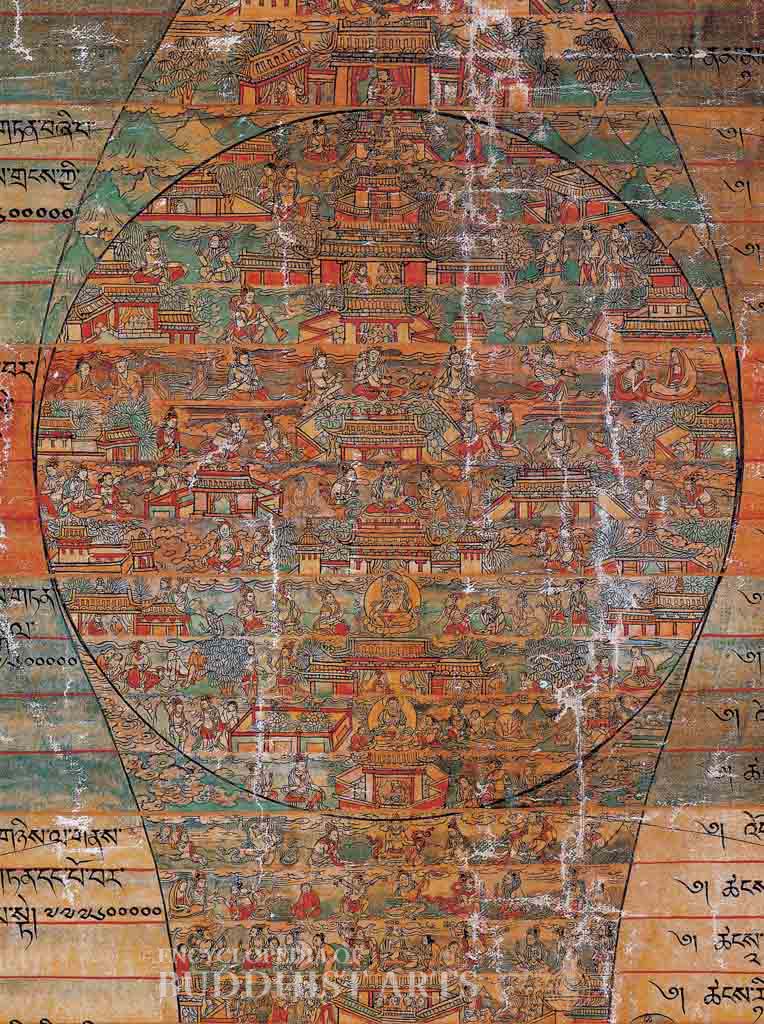
Buddhist Cosmology - Mount Sumeru (detail)
Buddhist Cosmology
CHINA, Tibet
Mount Sumeru was first described in ancient Indian myths and was later incorporated into Buddhist cosmology, where it represents the center of the universe. According to the “Chapter on Jambudvipa” in the Dirgha Agama, Mount Sumeru rises 84,000 yojanas above sea level, and its base rests 84,000 yojanas beneath the sea. It is surrounded by eight mountain ranges and eight seas encircled by a great ocean. There are four large continents beside Mount Sumeru: Jambudvipa to the south, Avaragodaniya to the west, Uttarakuru to the north, and Purvavideha to the east. The sun, moon, and stars orbit the middle of the mountain, and the heavenly realms are at the top.
The upper half of this thangka depicts Mount Sumeru, the sun, the moon, the continents, the palaces of the Four Heavenly Kings, the Trayastrimsa Heaven, the form realm, and the formless realm. In the lower half, there are images of the hell realms, where beings are shown burning in flames and undergoing tortures within concentric semicircular rings.
For more details, go to the Encyclopedia of Buddhist Arts: Painting A-H, page 130.
Cite this article:
author = Hsingyun and Youheng and Youlu and Wilson, Graham and Manho and Mankuang and Huntington, Susan,
booktitle = {Encyclopedia of Buddhist Arts: Painting A-H},
pages = 130,
title = {{Buddhist Cosmology}},
volume = 14,
year = {2016}}