
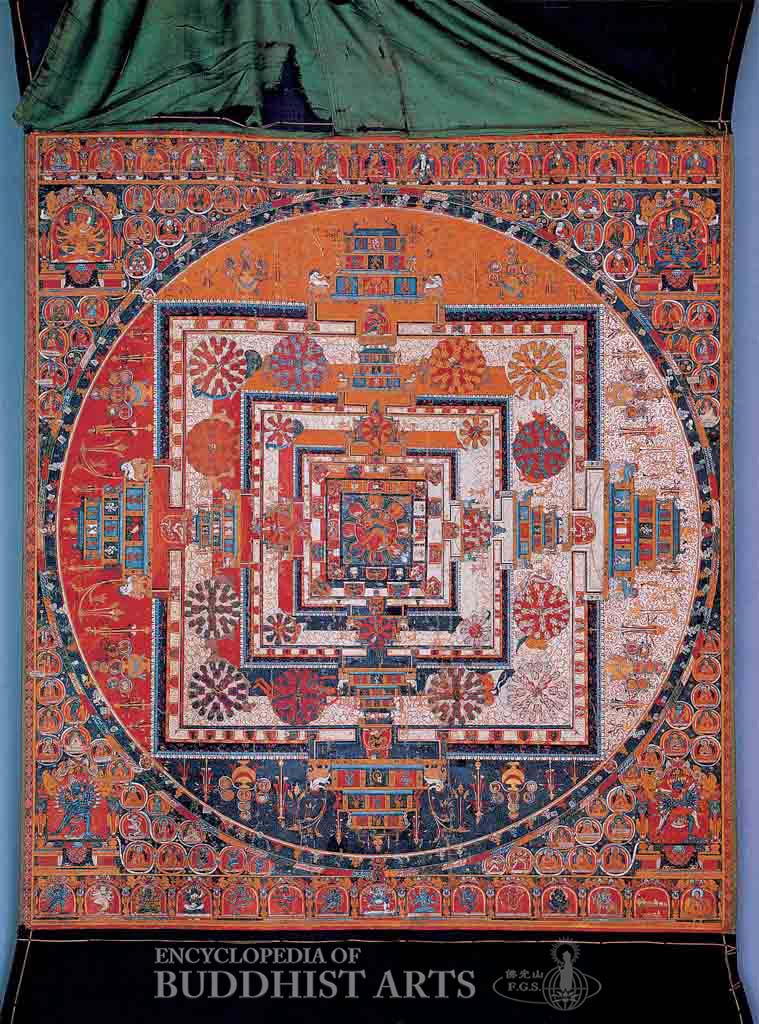
Kalacakra Mandala
Color on cotton
Kalacakra Mandala
CHINA; Ming dynasty
This intricate mandala was painted in the 14th or 15th century. The central figure, Kalacakra, or “Time-Wheel,” is symbolic of time and cycles, from the movements of the planets to the cycles of our breath. According to the Chronicle of the Ruling Families in Tibet, King Suchandra of Shambhala asked Sakyamuni Buddha to teach him the Kalacakra teachings, and it was transmitted to Tibet around the 11th century.
Kalacakra is in the center of the mandala, within the wheel of great bliss, embracing his consort Vishvamata. Eight lotus petals surround Kalacakra and Vishvamata. On each petal there is a Shakti goddess, who symbolize the compassionate energies of the enlightened heart. The palace surrounding the central wheel is made up of four smaller mandalas contained within each other: the mind mandala, the speech mandala, the body mandala, and the exalted wisdom mandala. Palace walls, gates, and towers are also portrayed. Outside the circle, there are numerous small images of lamas and lineage holders with circular mandorlas. In the corners, Manjuvajra, Guhyasamaja, Cakrasamvara, and Hevajra are depicted standing within niches and embracing their consorts. There are sitting Buddhas along the top of the image, with Sakyamuni Buddha in the center. At the bottom of the mandala, there is a row of deities and Dharma protectors.
For more details, go to the Encyclopedia of Buddhist Arts: Painting I-O, page 409.
Cite this article:
author = Hsingyun and Youheng and Youlu and Wilson, Graham and Manho and Mankuang and Huntington, Susan,
booktitle = {Encyclopedia of Buddhist Arts: Painting I-O},
pages = 409,
title = {{Kalacakra Mandala}},
volume = 15,
year = {2016}}