
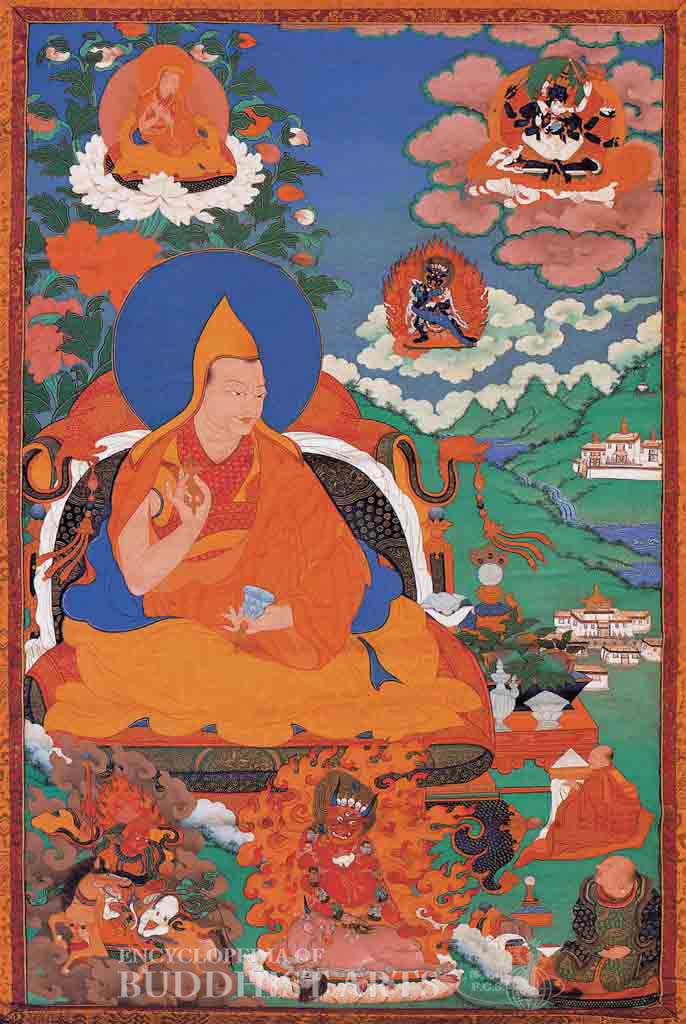
Third Dalai Lama
Color on cloth
Third Dalai Lama
CHINA, Tibet; Qing dynasty
In 1577, at the invitation of Altan Khan (reigned 1531–1582), Sonam Gyatso, the abbot of Drepung Monastery, traveled to Mongolia. He propagated Gelug school teachings and established Buddhism as the state religion. Altan Khan gave him the title “Dalai Lama,” and it was retrospectively bestowed on his two predecessors. Part of a series of paintings of the Dalai Lamas, this artwork was given as a tribute from Tibet to the Chinese imperial court in 1761 during the Qing dynasty.
The Third Dalai Lama sits on a cushioned throne, wearing an orange robe and hat. He holds a vajra in his right hand and a bell in his left, symbols of Vajradhara, the Dharmakaya Buddha of complete realization in Gelug school Buddhism. Wrathful Dharma protectors surrounded by flames are painted below the throne. The two small monasteries on the right side of the painting represent Yanghua Temple, the location of the first meeting between Altan Khan and Sonam Gyatso, and Shiretu Juu Temple, the first Gelug monastery in Mongolia. Altan Khan is shown kneeling in the lower right corner, looking up respectfully at Sonam Gyatso.
The thangka is representative of the Menri painting style, characterized by vibrant colors, gold highlights, and meticulous details. The patterns on the robe of the central figure are particularly elegant.
For more details, go to the Encyclopedia of Buddhist Arts: Painting P-Z, page 901.
Cite this article:
author = Hsingyun and Youheng and Youlu and Wilson, Graham and Manho and Mankuang and Huntington, Susan,
booktitle = {Encyclopedia of Buddhist Arts: Painting P-Z},
pages = 901,
title = {{Third Dalai Lama}},
volume = 16,
year = {2016}}