
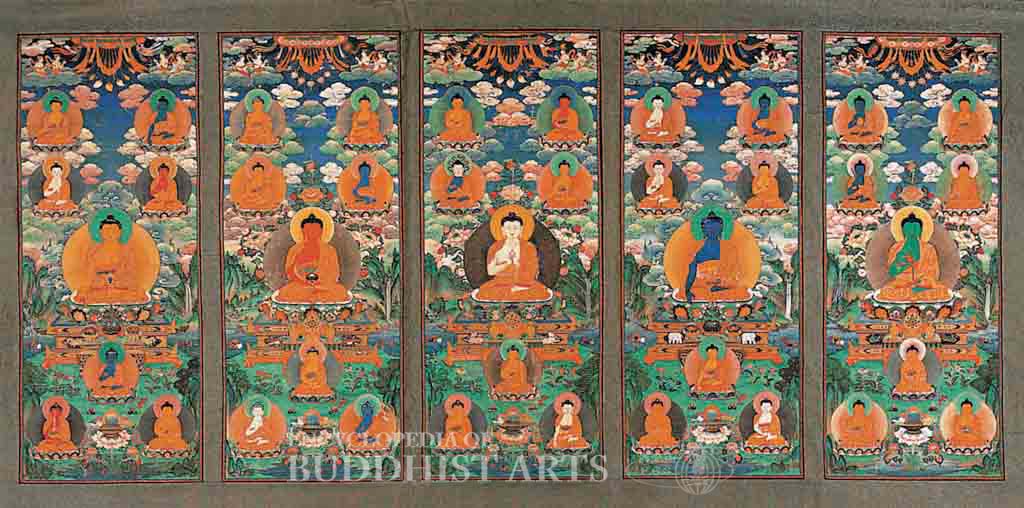
Five Dhyani Buddhas
Color on cloth
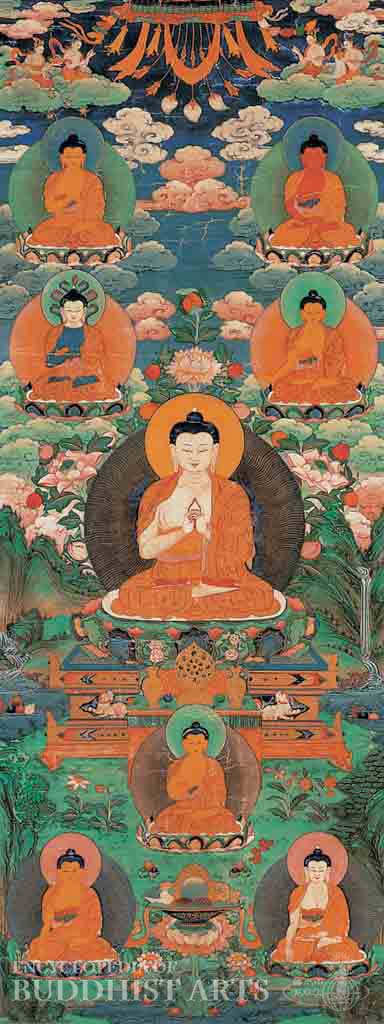
Five Dhyani Buddhas - Vairocana Buddha
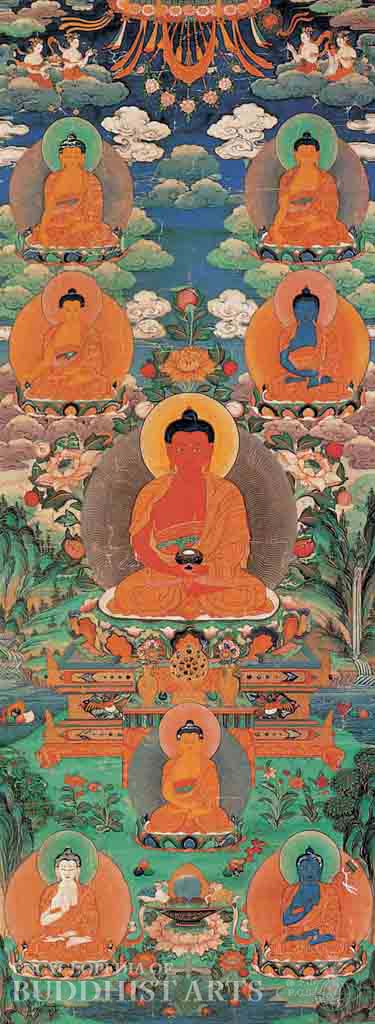
Five Dhyani Buddhas - Amitabha Buddha
Five Dhyani Buddhas
CHINA; Qing dynasty
In the Vajrayana tradition, the Five Dhyani Buddhas represent the wisdom of enlightenment. This thangka dates from the Qing dynasty (1644–1911), and was created specifically to fit the wall of the shrine within the Imperial Palace. It consists of five individual images, all with a similar layout and measuring 140 cm high and 54.5 cm wide.
The central figures in the images, moving from left to right, are the yellow Ratnasambhava Buddha, the red Amitabha Buddha, the white Vairocana Buddha, the blue Aksobhya Buddha, and the green Amoghasiddhi Buddha. Surrounding the five central figures are the 35 Buddhas from the Great Repentance Prayers. All of the Buddhas have colorful nimbuses and aureoles, and sit in lotus position on lotus thrones. Green grass, flowers, and altars topped with a flaming jewel are painted in the foregrounds. There are ponds behind the thrones, and colorful clouds in the sky above. Canopies flanked by heavenly beings are painted at the top of the images.
For more details, go to the Encyclopedia of Buddhist Arts: Painting A-H, page 240.
Cite this article:
author = Hsingyun and Youheng and Youlu and Wilson, Graham and Manho and Mankuang and Huntington, Susan,
booktitle = {Encyclopedia of Buddhist Arts: Painting A-H},
pages = 240,
title = {{Five Dhyani Buddhas}},
volume = 14,
year = {2016}}