
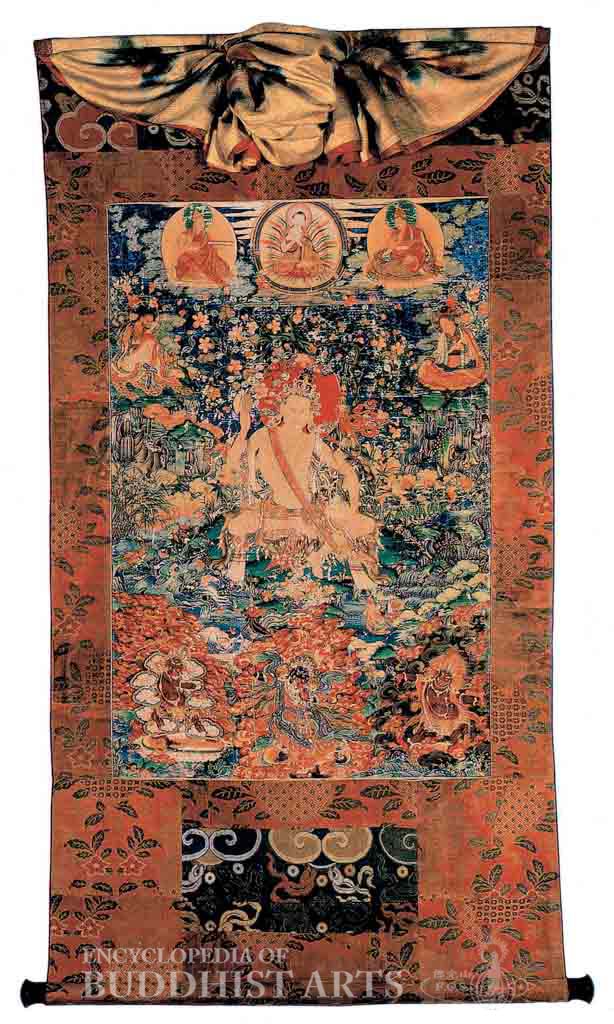
Guru
Color on cloth
Guru
CHINA, Tibet
An artwork of the Menri school, this thangka dates from the 17th or 18th century. Although the guru in the center of the thangka does not appear to be female, it is possibly a depiction of Machig Labdron, a Tibetan woman who started the Chod lineage during the late 11th or early 12th century. The guru wears a crown and a stole that drapes diagonally across the body. Seated in a relaxed posture on a rock covered with an animal pelt, the guru holds a hand drum in the raised right hand, and the left hand is placed on the left leg. At the bottom of the thangka, there are images of Mahalaka, who holds a trident, and the single-eyed Ekajati, who holds a heart in her hand. In the center of the top register, there is an image of the First Patriarch of the Nyingma school, Garab Dorje, who most likely forms the Dharmacakra (Dharma wheel) mudra. The figure with a ceremonial hat on the left is translator Vairotsana, and the figure below Vairotsana who holds a vajra is thought to be Palgyi Wangchug, a disciple of Padmasambhava. On the right, a monk wearing the ritual hood of the Nyingma school and a lay devotee are shown. There is a forest in the background painted with dark colors, flowing lines, and naturally styled foliage, integrating features of Chinese landscape painting.
For more details, go to the Encyclopedia of Buddhist Arts: Painting A-H, page 317.
Cite this article:
author = Hsingyun and Youheng and Youlu and Wilson, Graham and Manho and Mankuang and Huntington, Susan,
booktitle = {Encyclopedia of Buddhist Arts: Painting A-H},
pages = 317,
title = {{Guru}},
volume = 14,
year = {2016}}