
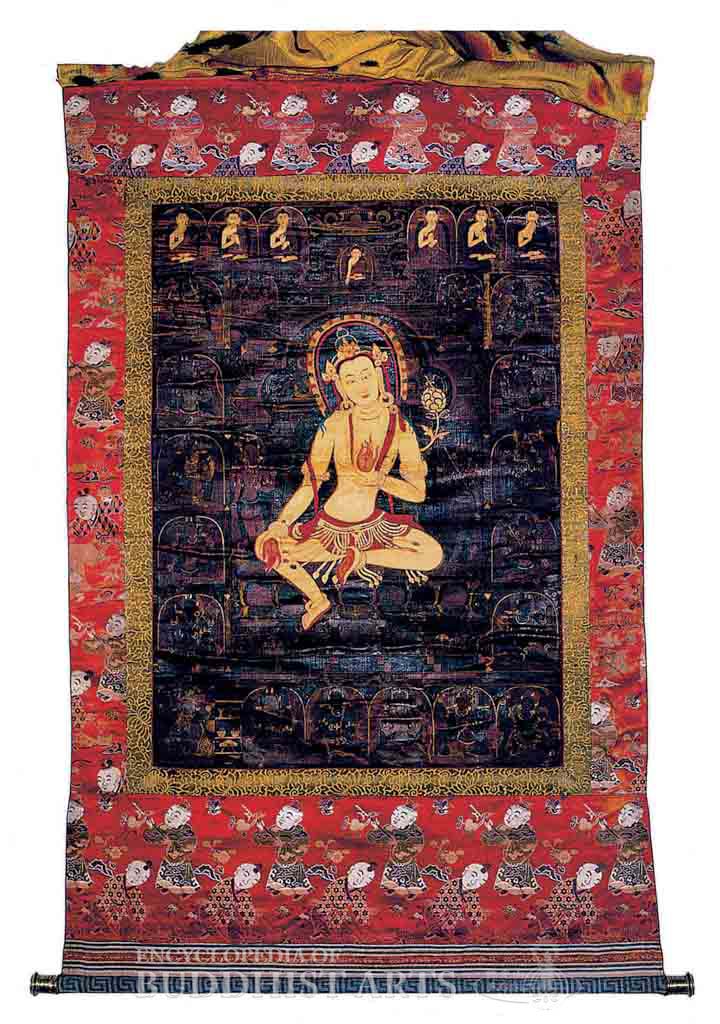
Green Tara
Color on cloth
Green Tara
CHINA, Tibet; 14th–17th century
Though the central figure in this black thangka has a golden skin color, the sitting posture and the lotus held in the left hand indicate that it is a depiction of Green Tara. Black thangkas, or “Nakthang” in Tibetan, became popular in the 17th century. Black paint made from a mixture of black oil and indigo dye was first applied to the whole canvas as the base color before the images were outlined in gold. Various mineral pigments were then applied to accentuate the details.
Green Tara has a high topknot and wears a golden crown. Colored lines decorate the border of the petal-shaped nimbus. The palms of the hands and soles of the feet are red. The right hand forms the varada (wish-granting) mudra while holding a lotus stem. Tara sits on a lotus throne with her left leg bent and right leg partially extended. The central figure is flanked by faint images of two attendants and surrounded by smaller Tara figures. Seven Buddhas are depicted along the top of the image. The thangka is bordered with gold patterning, and mounted against a red background decorated with childlike figures and floral patterns.
For more details, go to the Encyclopedia of Buddhist Arts: Painting A-H, page 287.
Cite this article:
author = Hsingyun and Youheng and Youlu and Wilson, Graham and Manho and Mankuang and Huntington, Susan,
booktitle = {Encyclopedia of Buddhist Arts: Painting A-H},
pages = 287,
title = {{Green Tara}},
volume = 14,
year = {2016}}