
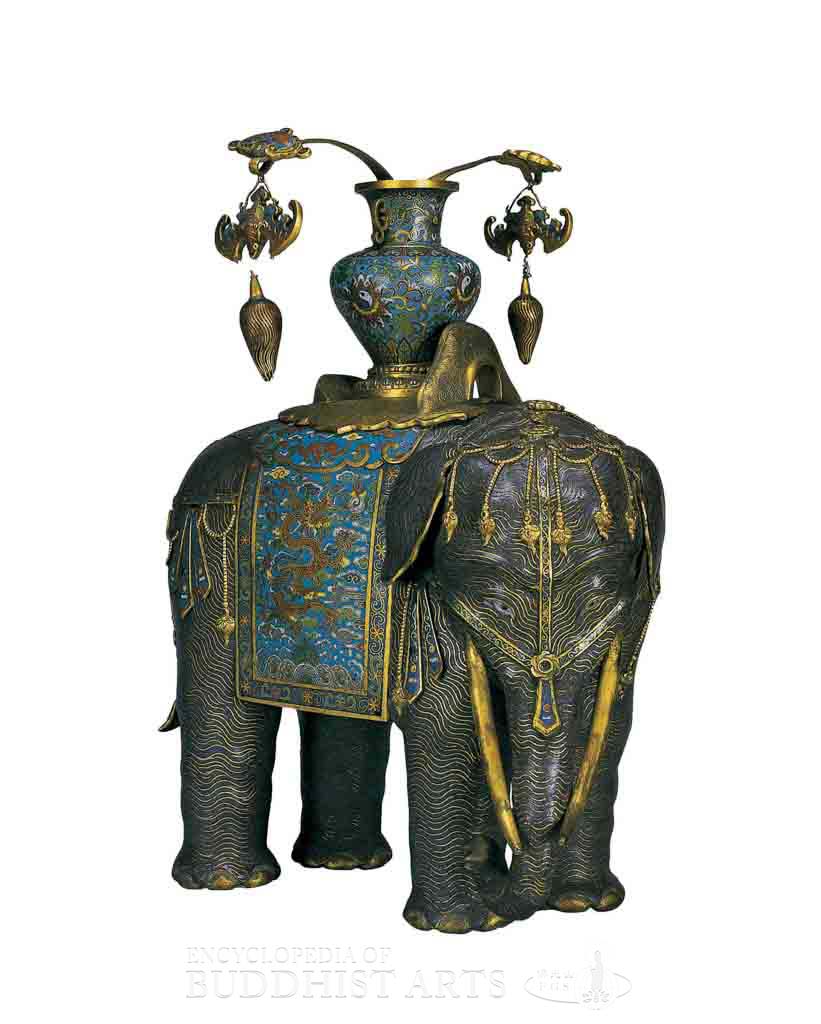
Elephant with Vase
Gilt copper and cloisonné
Elephant with Vase
CHINA; Qing dynasty
The elephant is one of the seven treasures of the cakravartin. The vase is known as “ping” in Chinese, a homophone with the word for peace. The combination of an elephant and vase is particularly auspicious. This elephant and vase was created during the time of Emperor Qianlong (reigned 1736–1795) of the Qing dynasty.
The elephant is covered in a ripple pattern with ornaments on its head. Both the vase and saddle are in cloisonné. The vase, which rests on the elephant’s saddle, is decorated with scroll leaf and taiji patterns. Multiple ruyis (wish-fulfilling talisman) hang from the vase with their respective ends decorated with bats and lotus buds. The saddle blanket has a lively upright dragon on a blue background with a floral border.
For more details, go to the Encyclopedia of Buddhist Arts: Artifacts, page 64.
Cite this article:
author = Hsingyun and Youheng and Youji and Pokorski, Stefanie and Mankuang and Fan, Wen,
booktitle = {Encyclopedia of Buddhist Arts: Artifacts },
pages = 64,
title = {{Elephant with Vase}},
volume = 18,
year = {2016}}