
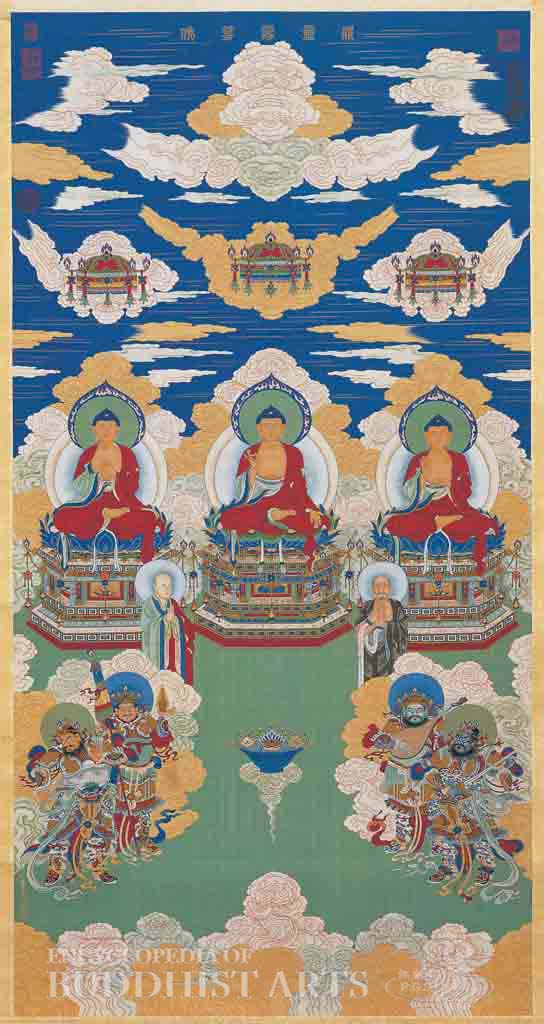
Qing Imperial Palace: Tapestry of Buddhas of the Past, Present, and Future
Silk
Qing Imperial Palace: Tapestry of Buddhas of the Past, Present, and Future
CHINA, Beijing; Qing dynasty
This tapestry was created during the rule of Emperor Qianlong (reigned 1736–1795) of the Qing dynasty. It was originally kept in the Qing Imperial Palace.
The Buddhas of the Past, Present, and Future sit in full lotus position on lotus thrones upon Sumeru platforms in the middle register. Above each Buddha, there is a canopy in a cloud. The three figures have similar features, with blue hair, a low usnisa, and a two-layer lotus petal shaped nimbus and a mandorla behind. They wear robes covering both shoulders, leaving the chest bare. The only difference lies in the mudra each Buddha performs. Between the thrones, there is an image of Mahakasyapa and Ananda. There are depictions of the Four Heavenly Kings in the lower register, and the Chinese characters for “Amitayus” run across the top of the upper register.
For more details, go to the Encyclopedia of Buddhist Arts: Artifacts, page 261.
Cite this article:
author = Hsingyun and Youheng and Youji and Pokorski, Stefanie and Mankuang and Fan, Wen,
booktitle = {Encyclopedia of Buddhist Arts: Artifacts },
pages = 261,
title = {{Qing Imperial Palace: Tapestry of Buddhas of the Past, Present, and Future}},
volume = 18,
year = {2016}}