
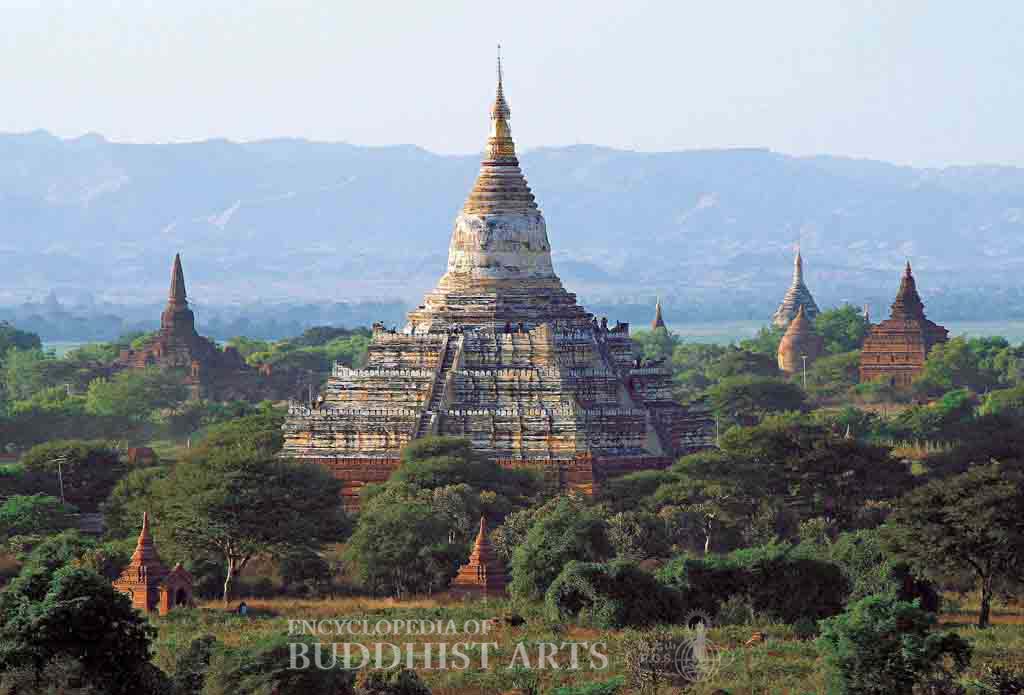
Shwesandaw Pagoda
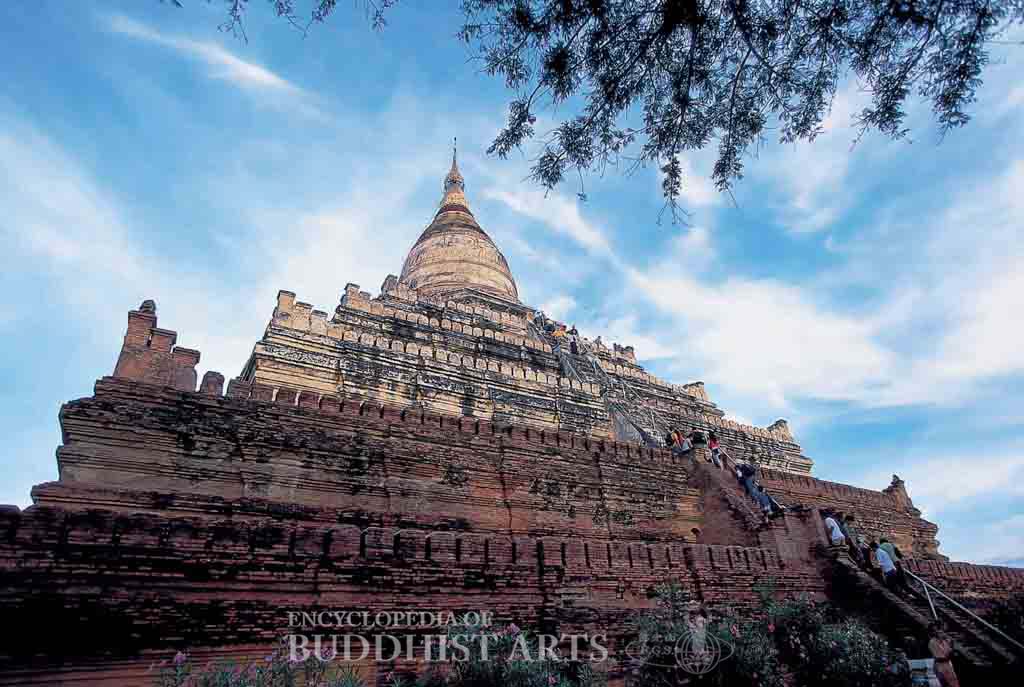
Shwesandaw Pagoda
Shwesandaw Pagoda
MYANMAR, Mandalay, Bagan
Shwesandaw means Golden Hair Relic and it is believed that the pagoda was built to enshrine the hair relic of the Buddha. It was built by King Anawrahta (reigned 1044–1077) of Bagan in 1057 and was renovated by subsequent kings.
The pagoda has a base made of five square Sumeru terraces. There is a steep stone staircase at the center of each side of the base. The walls of the terraces used to contain terracotta tiles decorated with reliefs depicting scenes from the Jataka tales and other stories, but they were covered up during later renovation work. On top of the base there is a two-layer octagonal base which supports the bell-shaped body of the pagoda. At the top there are stacked rings in the form of a truncated cone, surmounted by the golden spire consisting of a decorated round base, a parabolic cone, an open-work canopy, and a finial.
This was the first pagoda to have a staircase that provided access to the pagoda body, providing a vantage point for people to view the whole city of Bagan.
For more details, go to the Encyclopedia of Buddhist Arts: Architecture M-S, page 1015.
Cite this article:
author = Hsingyun and Youheng and Johnson, Peter and Mankuang and Lancaster, Lewis,
booktitle = {Encyclopedia of Buddhist Arts: Architecture M-S},
pages = 1015,
title = {{Shwesandaw Pagoda}},
volume = 3,
year = {2016}}