
Gandan Monastery Avalokitesvara Hall: Avalokitesvara Bodhisattva
Copper alloy
Gandan Monastery Avalokitesvara Hall: Avalokitesvara Bodhisattva
Gandan Monastery Avalokitesvara Hall: Avalokitesvara Bodhisattva
MONGOLIA, Ulaanbaatar
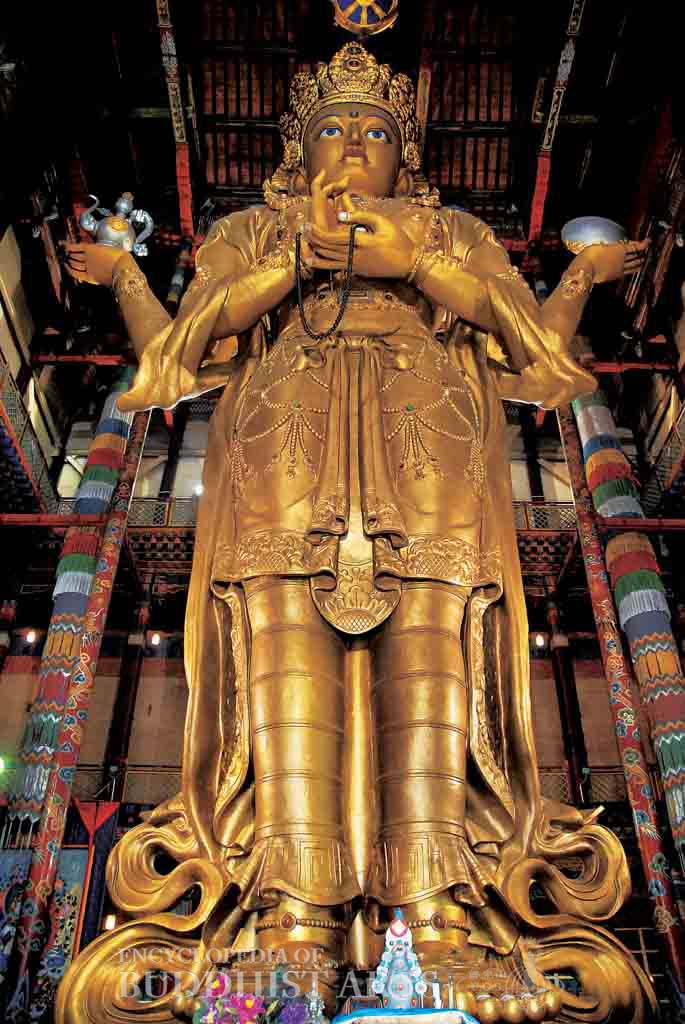
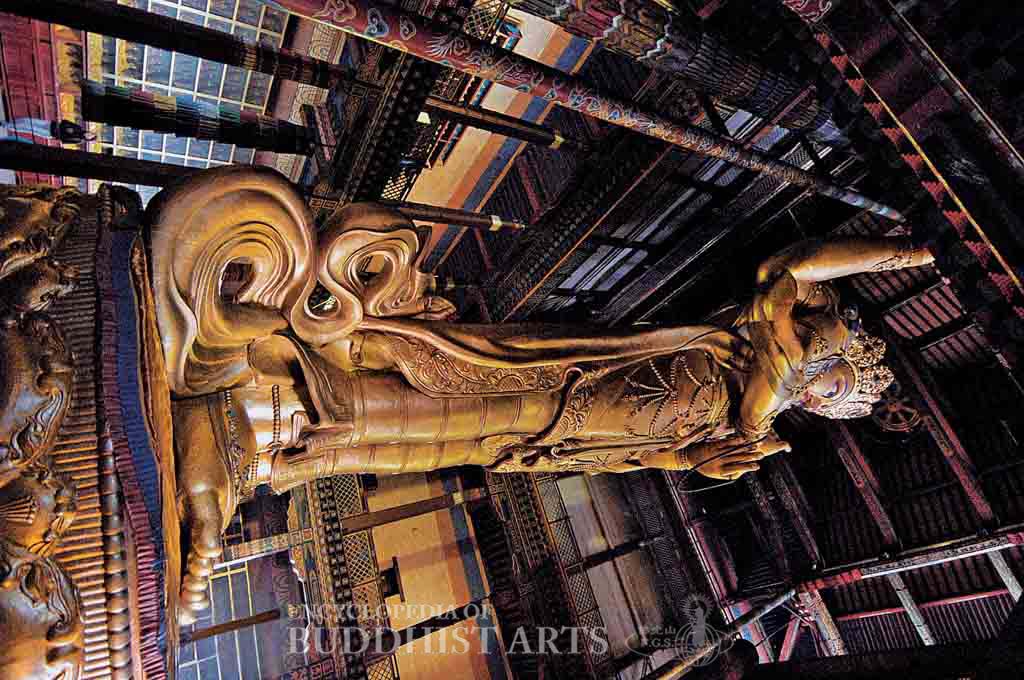
Bogd Khan (reigned 1869–1924) ordered for the construction of this statue in 1913 as the main focus of the monastery’s main hall after Mongolia gained its independence. The original statue was 32 m high. During the persecution of Buddhism in the late 1930s, the Buddha statue was destroyed, though the monastery escaped unscathed. After the restoration, a new statue was reconstructed in 1996 and measured 26.4 m high. This was achieved by donations and assistance from Nepal and Japan, and is now considered the nation’s most revered national treasure.
Weighing 20 t, the statue represents the Bodhisattva’s four-armed version. The lower hand of those raised at the chest holds some prayer beads while the right hand is in lotus mudra. The hands lifted to the side hold a vase and an offering bowl. The figure towers above the lotus pedestal, wearing an ornate crown and other jewelry set with gems and gilded with over two thousand leaves of gold. The Bodhisattva is wrapped with brocade woven out of gold threads and 500 m of silk. Precious stones, medicinal herbs weighing 27 t, 300 sutra scrolls and two million rolled mantras are all stored inside. The statue is a statement of the nation’s long Buddhist history and independent status.
For more details, go to the Encyclopedia of Buddhist Arts: Sculpture G-M, page 367.
Cite this article:
author = Hsingyun and Youheng and Lovelock, Yann and Chou, Yuan and Huntington, Susan and Edson, Gary and Neather, Robert,
booktitle = {Encyclopedia of Buddhist Arts: Sculpture G-M},
pages = 367,
title = {{Gandan Monastery Avalokitesvara Hall: Avalokitesvara Bodhisattva}},
volume = 11,
year = {2016}}