
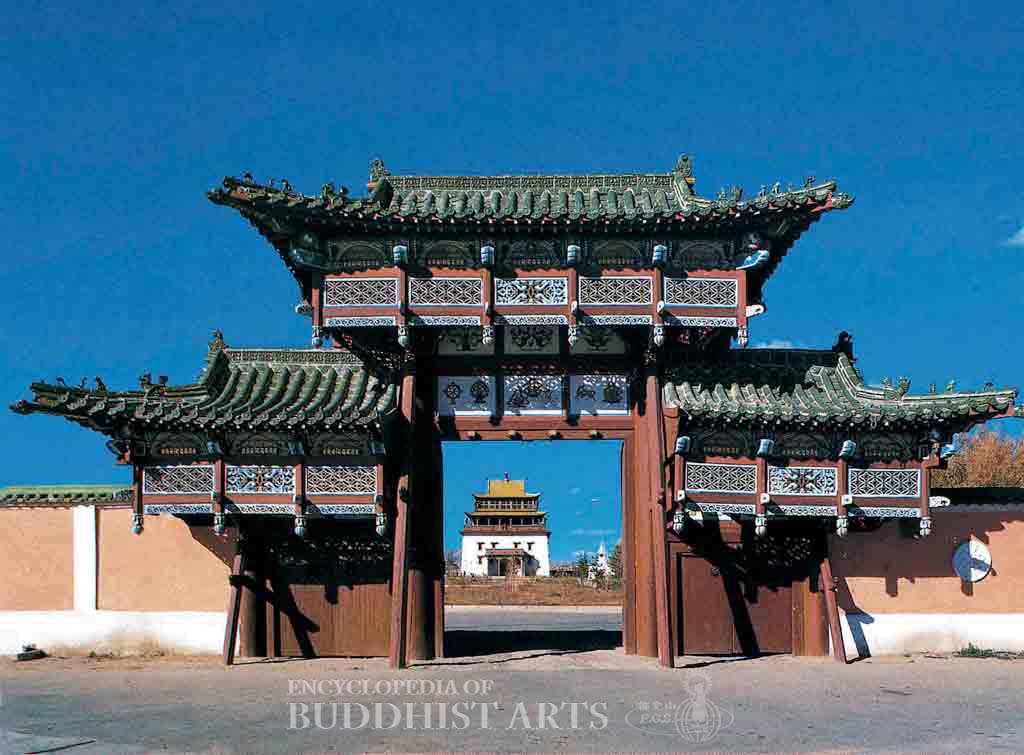
Gandan Monastery: Main Temple Gate
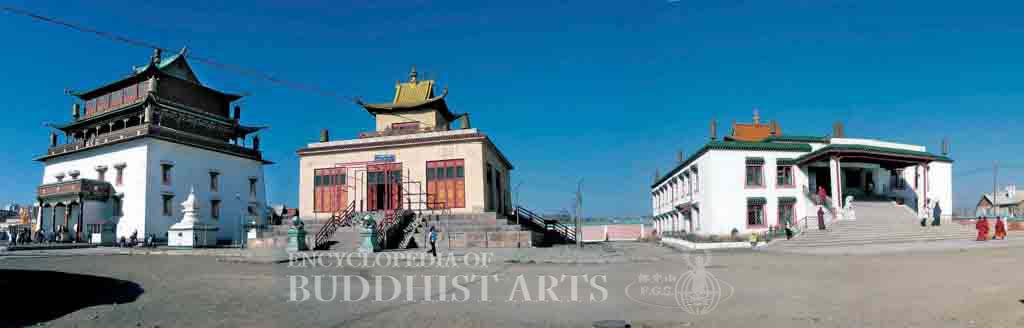
Gandan Monastery
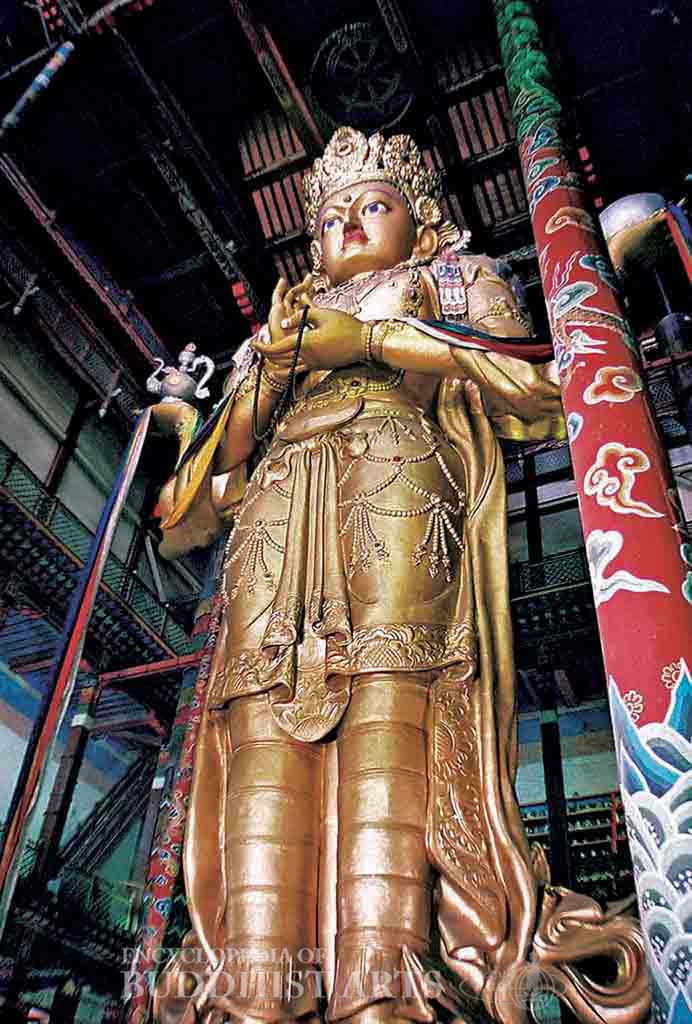
Gandan Monastery: Avalokitesvara Hall - Migjid Janraisig
Gandan Monastery
MONGOLIA, Ulaanbaatar
The full name of the monastery is Gandantegchinlen, which means Great Place of Complete Joy. The monastery complex includes a university with a number of colleges and a center for Buddhist research. The 5th Jebtsundamba Khutughtu established this monastery for the purpose of sutra research in 1838 and it was subsequently expanded to form a large monastery complex. It managed to survive the persecution of Buddhism in the late 1930s and was re-opened to the public in 1944. The monastery not only continues to hold traditional Dharma services, it became a Buddhist educational and cultural center after 1990.
The main buildings include the Gandan Temple, Vajrapani Hall, Avalokitesvara Hall, and Zanabazar Buddhist University. The Gandan Temple is the oldest building and is used to hold large-scale Dharma services. Regular Dharma services and the monks’ day-to-day chanting practice are carried out in the Vajrapani Hall. The Avalokitesvara Hall houses a 26.5 m high gold-plated bronze statue of Avalokitesvara Bodhisattva, known as Migjid Janraisig. It is an important religious symbol of Mongolia. The Zanabazar Buddhist University was founded in 1970 and houses a number of colleges. It undertakes the translation, editing, and publication of Buddhist sutras, and sponsors repair work on Buddhist sites. Its sutra repository contains over 50,000 volumes of sutras in Mongolian, Tibetan, Sanskrit, and other languages. It is one of the most important Buddhist research organizations in the world.
For more details, go to the Encyclopedia of Buddhist Arts: Architecture G-L, page 353.
Cite this article:
author = Hsingyun and Youheng and Johnson, Peter and Mankuang and Lancaster, Lewis,
booktitle = {Encyclopedia of Buddhist Arts: Architecture G-L},
pages = 353,
title = {{Gandan Monastery}},
volume = 2,
year = {2016}}