

Kizil Cave 17: Right Corridor
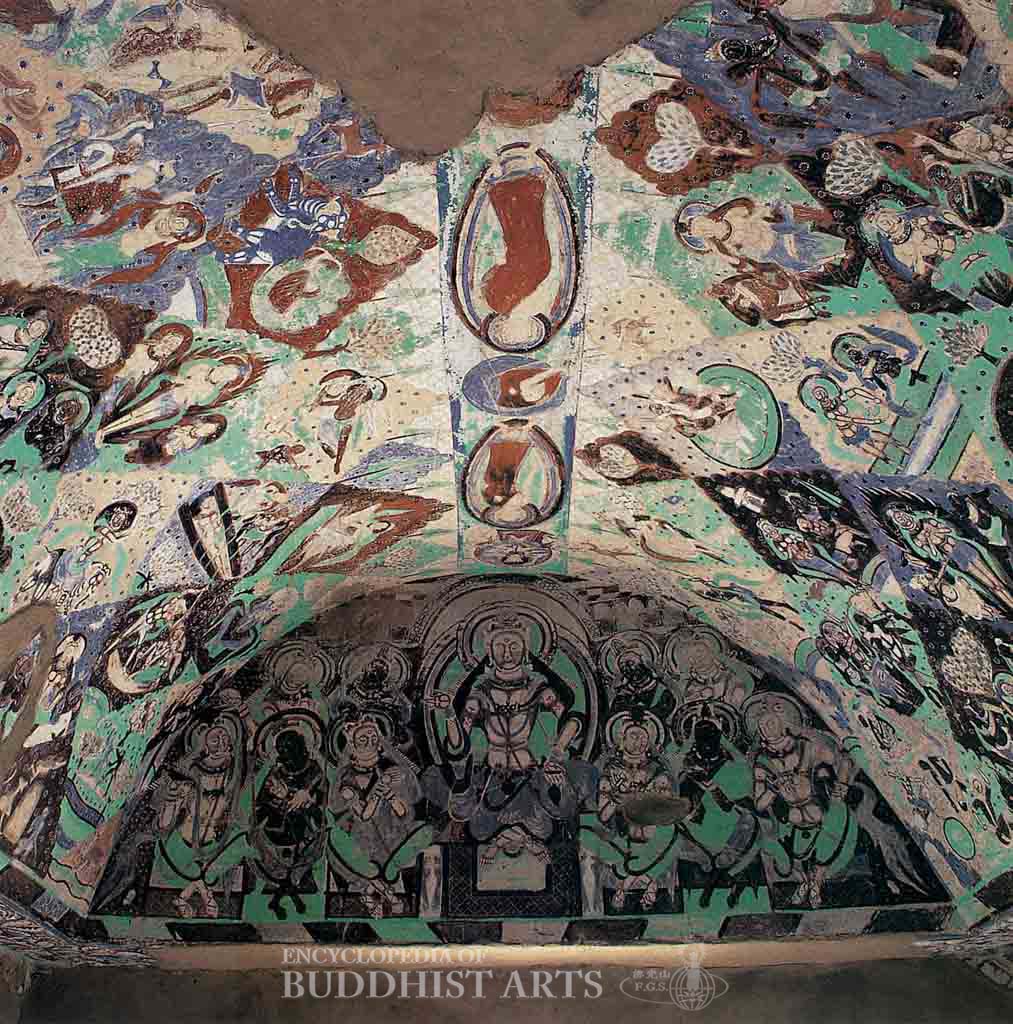
Kizil Cave 171: Main Chamber - Ceiling and Front Wall
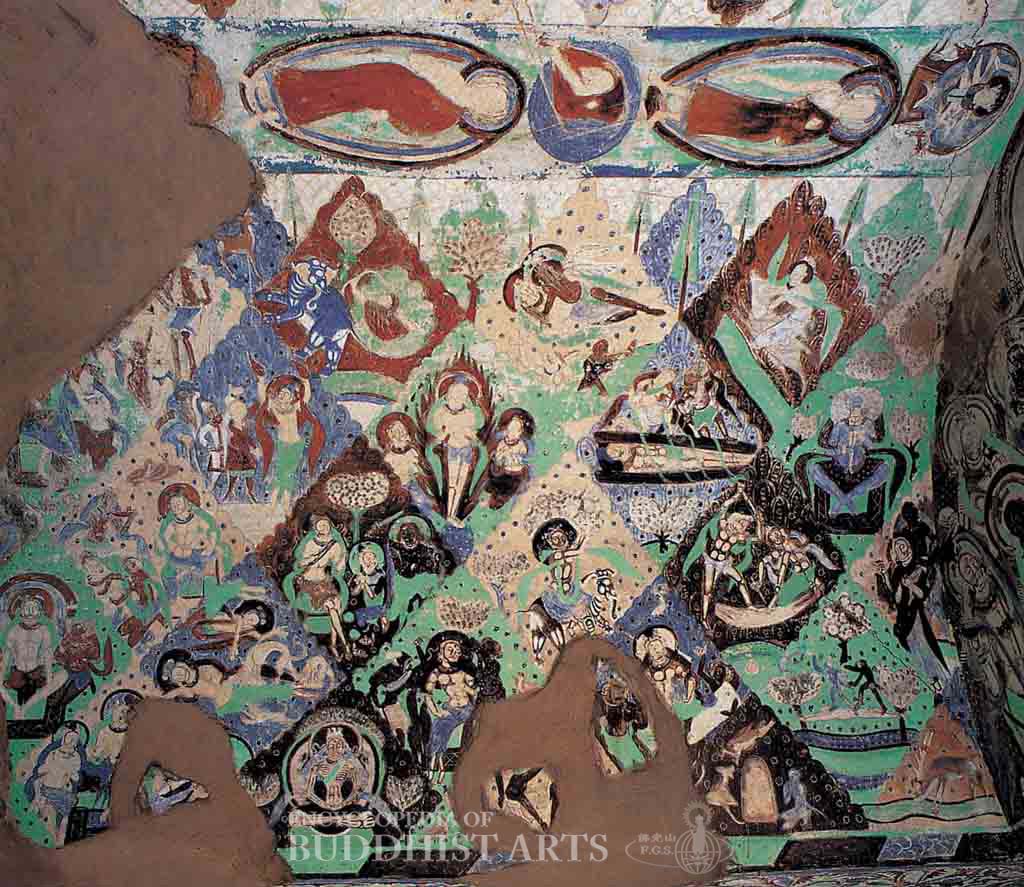
Kizil Cave 17: Main Chamber - Ceiling (right side)
Kizil Cave 17
CHINA, Xinjiang, Aksu
This central pillar cave is situated in the west valley and was excavated in the 6th century. The cave has a main chamber with a barrel-vaulted ceiling and three corridors, which form a central pillar. The main chamber measures 3.65 m wide, 3.45 m high, and 3.7 m deep. The murals in the cave are well preserved due to its location high in the cliff.
An arched niche is found in the center of the back wall in the main chamber, though the statues are missing. Rows of Jataka illustrations are located on the side walls, and between the rows are honeysuckle and other decorative motifs. The entrance in the center of the front wall of the main chamber is partially collapsed and only a few murals remain. A semicircular mural above the entrance illustrates Maitreya Bodhisattva teaching the Dharma in Tusita Heaven.
Paintings of astrological symbols are located along the center ridge of the barrel-vaulted ceiling, a portion of which near the back wall is damaged. Rows of diamond-shaped illustrations depicting Jataka tales are located on both sides of the ceiling, with six scenes on each row in fairly good condition. There are 45 Jataka illustrations in total. The images are simple, with only the key scenes portrayed to symbolize the stories. The colors have changed over time, consisting mainly of black, white, mineral green, and blue. Additionally, on both sides of the ceiling are rows of small diamonds illustrated with animals or plants.
Painted on both the left and right corridors are two rows of stupas, and in the right corridor is a mural of a standing Vairocana Buddha. The rear corridor which has a barrel-vaulted ceiling and niches along the left and right walls. The illustration of the Buddha’s Parinirvana is found on the back wall of the rear corridor.
For more details, go to the Encyclopedia of Buddhist Arts: Caves R-L, page 480.
Cite this article:
author = Hsingyun and Youheng and Johnson, Peter and Mankuang and Huntington, Susan and Edson, Gary and Neather, Robert,
booktitle = {Encyclopedia of Buddhist Arts: Caves R-L},
pages = 480,
title = {{Kizil Cave 17}},
volume = 6,
year = {2016}}