
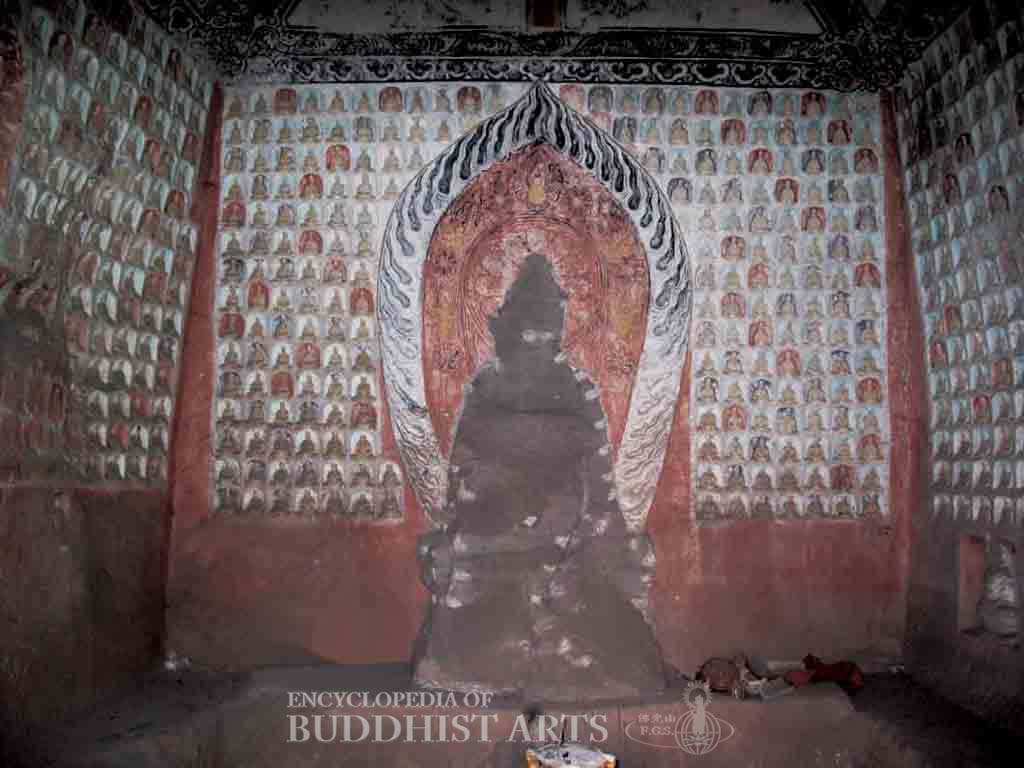
Xiangtang Temple Caves: Cave 1 - Back Wall
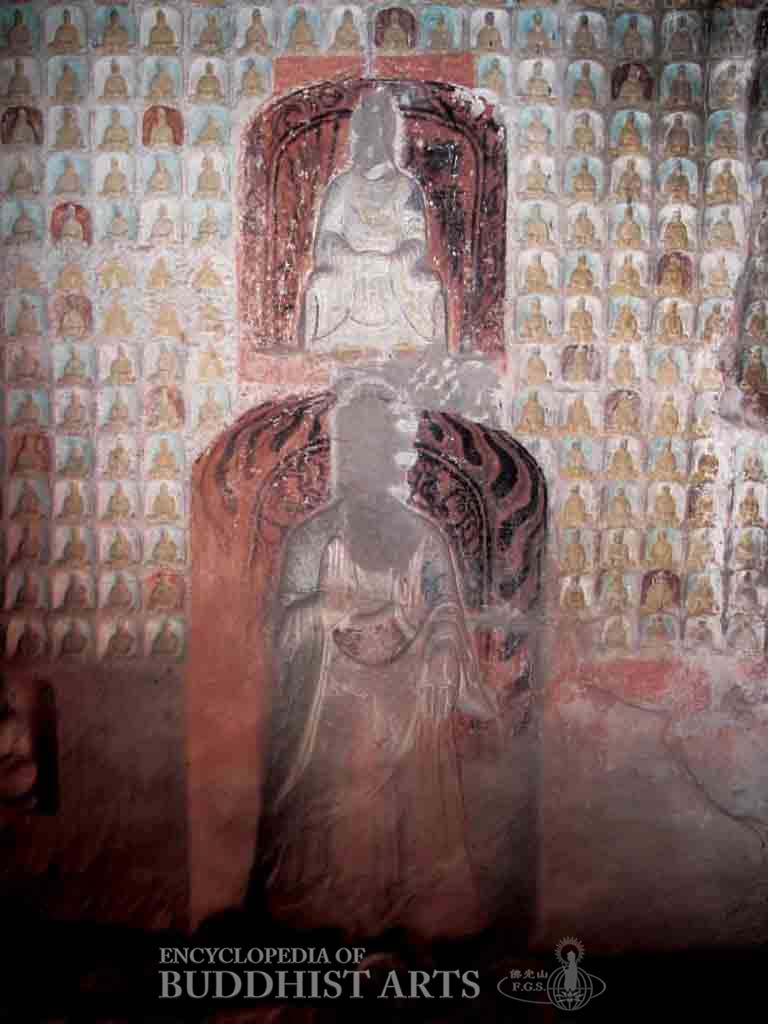
Xiangtang Temple Caves: Cave 1 - East Wall
Xiangtang Temple Caves
CHINA, Shanxi, Jinzhong
The Xiangtang Temple Caves are situated on the side of Miaolingshan (Temple Ridge Mountain), 5 km southwest of Yushe, Jinzhung. The site has partially collapsed but, based on the remaining structure, it can be inferred that the main hall of the temple was three bays wide, and the back wall was constructed to align with the mountain. The main hall contains a statue of the Buddha that is carved into the mountainside. The caves were excavated during the late Northern Wei (386–534) and Eastern Wei (534–550) dynasties. The Xiangtang Temple Caves are listed as a Provincial Cultural Heritage Site.
Cave 1 has a square layout and measures 2.36 m to 2.73 m wide, 1.08 m high, and 2.37 m deep. It has a square pyramidal ceiling with a large lotus sculpted at the apex. The four sides are painted with illustrations of flora and fauna from the Ming (1368–1644) and Qing (1644–1911) dynasties. Low platforms are set up on the back (north) and side walls. The platform on the back wall has a Buddha flanked by two semicircular depressions containing attendant Bodhisattvas. Only one of these Bodhisattva statues remains. Circular arched niches are carved on the upper and lower tiers of the east wall, with a seated Buddha in the upper niche and a standing Buddha in the lower niche. A small niche was added to the bottom right section of the wall in 683. The layout of the sculptures on the west wall is similar to those on the east wall. Five small Buddha niches constructed during the Tang dynasty (618–907) are found to the bottom right of the front (south) wall. The four walls of the cave are covered with the Thousand Buddhas.
Cave 2 also has a square layout and a square pyramidal ceiling. The main sculpture of the Buddha is 2.6 m high and sits on a lotus throne, surrounded by a mandorla with flame patterns.
Caves with designs that are similar to these appeared in Shanxi as early as the late Northern Wei dynasty, in caves such as the Yangtoushan Caves and Kaihe Temple Caves. Such caves were rarely constructed after the Sui (581–618) and Tang dynasties.
For more details, go to the Encyclopedia of Buddhist Arts: Caves T-Z, page 1514.
Cite this article:
author = Hsingyun and Youheng and Johnson, Peter and Mankuang and Huntington, Susan and Edson, Gary and Neather, Robert,
booktitle = {Encyclopedia of Buddhist Arts: Caves T-Z},
pages = 1514,
title = {{Xiangtang Temple Caves}},
volume = 9,
year = {2016}}