
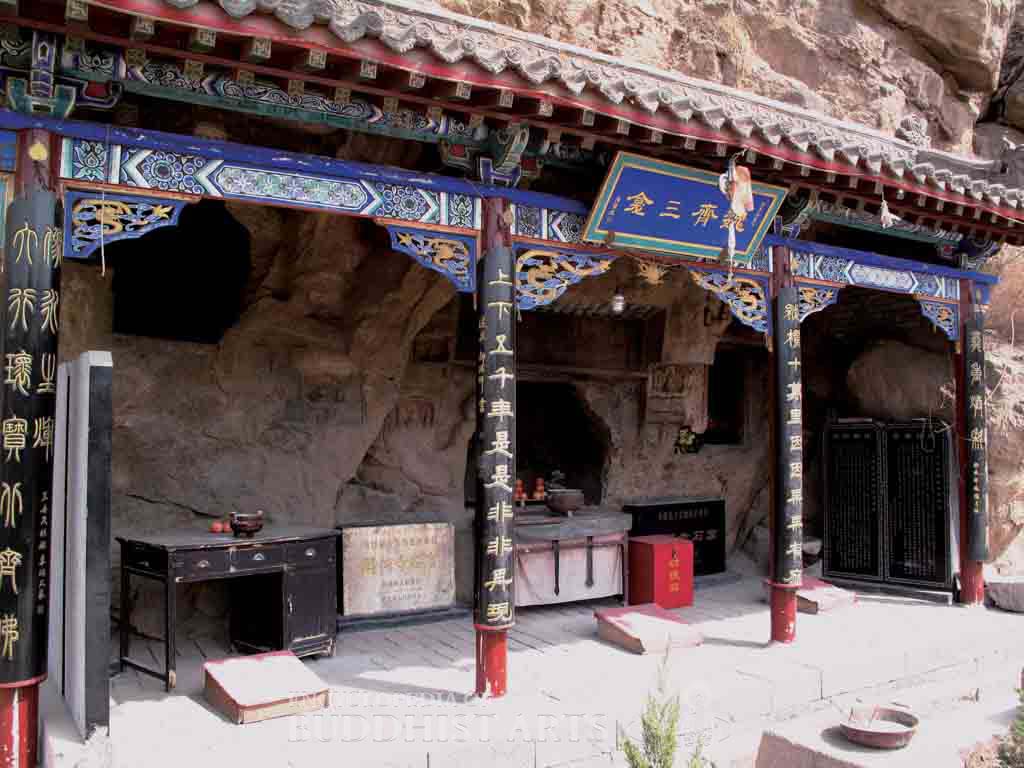
Kaihe Temple Caves
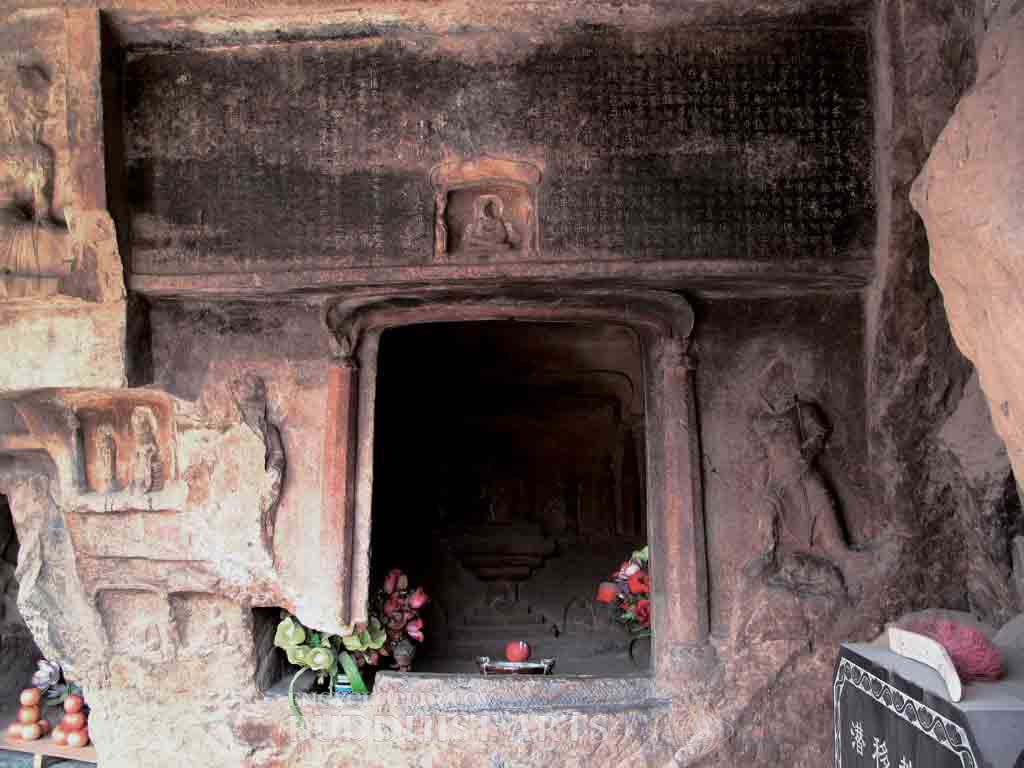
Kaihe Temple Caves: Cave 1
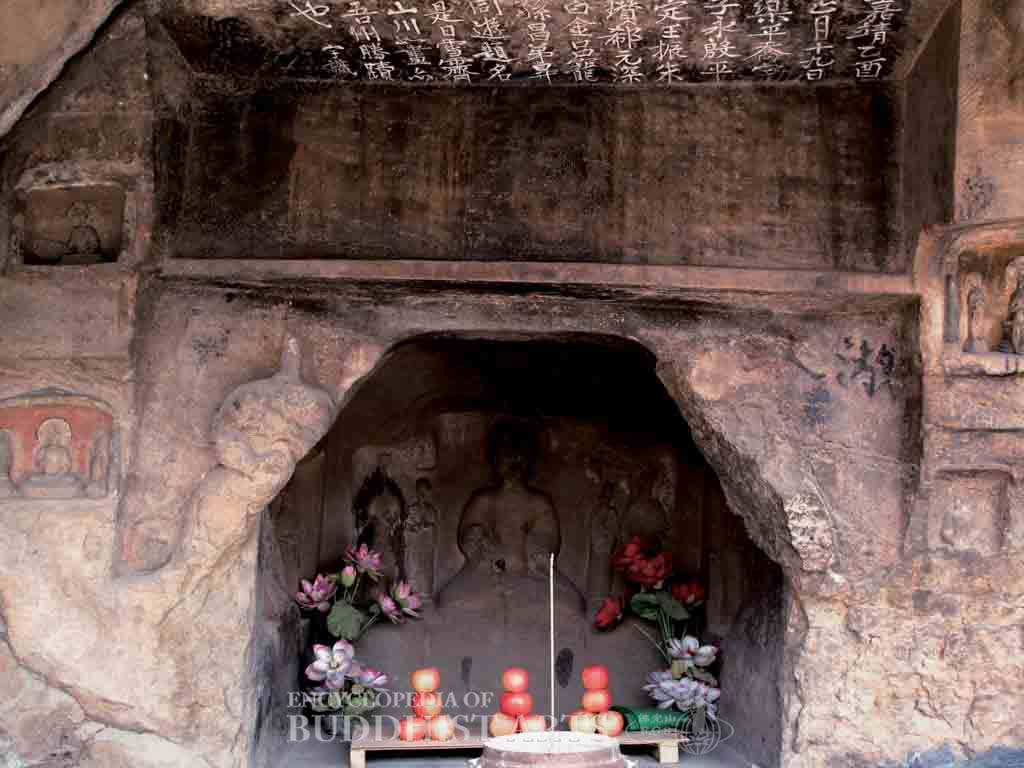
Kaihe Temple Caves: Cave 2
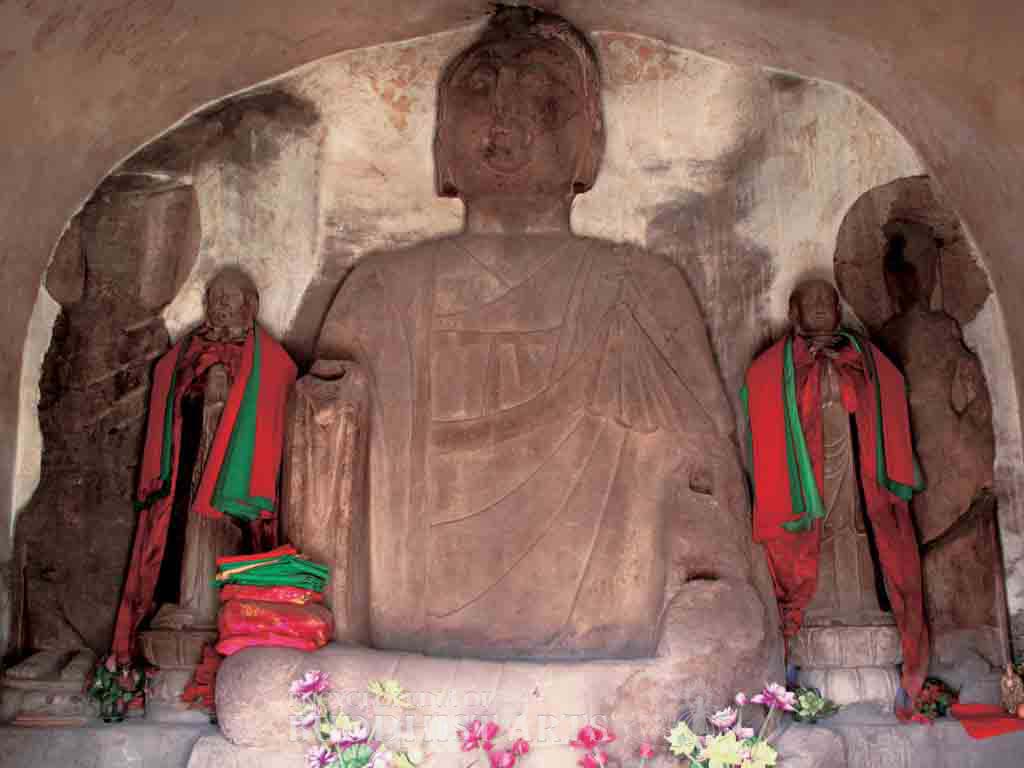
Kaihe Temple Caves: Cliff Sculpture
Kaihe Temple Caves
CHINA, Shanxi, Yangquan
The Kaihe Temple Caves are situated 1 km west of Luanliu village in Pingding county. The three small caves of this site were constructed on the southern cliff face north of the Tao River, along the 6 m wide ridge. Above the three caves are rectangular frames containing Buddha statues flanked with prayers for the construction, in addition to donor names. Caves 1 and 3 were constructed in 563 and 561, respectively, during the Northern Qi dynasty, while Cave 2 was constructed in 547 during the Eastern Wei dynasty. Engraved below an attendant Bodhisattva statue is an inscription dating to 581 during the Sui dynasty. A large sculpture is located over 10 m west of the caves, in front of where Kaihe Temple previously existed. The caves were listed as a Provincial Cultural Heritage Site in 2004.
The three caves have square floor plans, pyramidal roofs, and three walls sculpted with niches. The back walls of Caves 1 and 2 are each carved with a Buddha, two disciples, and two Bodhisattvas, while the side walls have a Buddha and two Bodhisattvas. Warrior statues flank the cave entrances. The back wall of Cave 3 is sculpted with a Buddha and two disciples, and the side walls are similar to that of Caves 1 and 2.
The lower levels of the walls in Caves 1 and 3 are carved with Heavenly King niches. The Eastern Wei (534–550) sculptures in Cave 2 show notable differences from those of the Northern Wei dynasty (386–534) sculptures, featuring figures with short necks, broad shoulders, and muscular builds. Sculptures found in Caves 1 and 3 are smaller, and possess the typical features of the Northern Qi dynasty (550–577). The Buddha is depicted as having broad shoulders and a heaved chest, and wears a monastic robe with a draping collar. Bodhisattvas are stronger in build, wear skirts, and don stoles across both shoulders, which drape the sides of the exposed upper body. The sculptures are similar in style to those of the Xiangtangshan Grottoes and Tianlongshan Caves.
A Buddha sits in full lotus position in the center among the cliff sculptures. The Buddha is shown wearing a monastic robe with wavy hair and a round face. Previously, there were round holes on either side of the Buddha for placing disciple statues, which were sculpted using freestanding methods. The present statues were set in place by later generations, along with two attendant Bodhisattvas positioned on both sides. As a whole, the arrangement is richly portrayed with stylistic features of the Northern Qi. According to inscriptions, the donor of the cliff sculpture was Dou Lutong, the governor of Dingzhou.
For more details, go to the Encyclopedia of Buddhist Arts: Caves R-L, page 449.
Cite this article:
author = Hsingyun and Youheng and Johnson, Peter and Mankuang and Huntington, Susan and Edson, Gary and Neather, Robert,
booktitle = {Encyclopedia of Buddhist Arts: Caves R-L},
pages = 449,
title = {{Kaihe Temple Caves}},
volume = 6,
year = {2016}}