
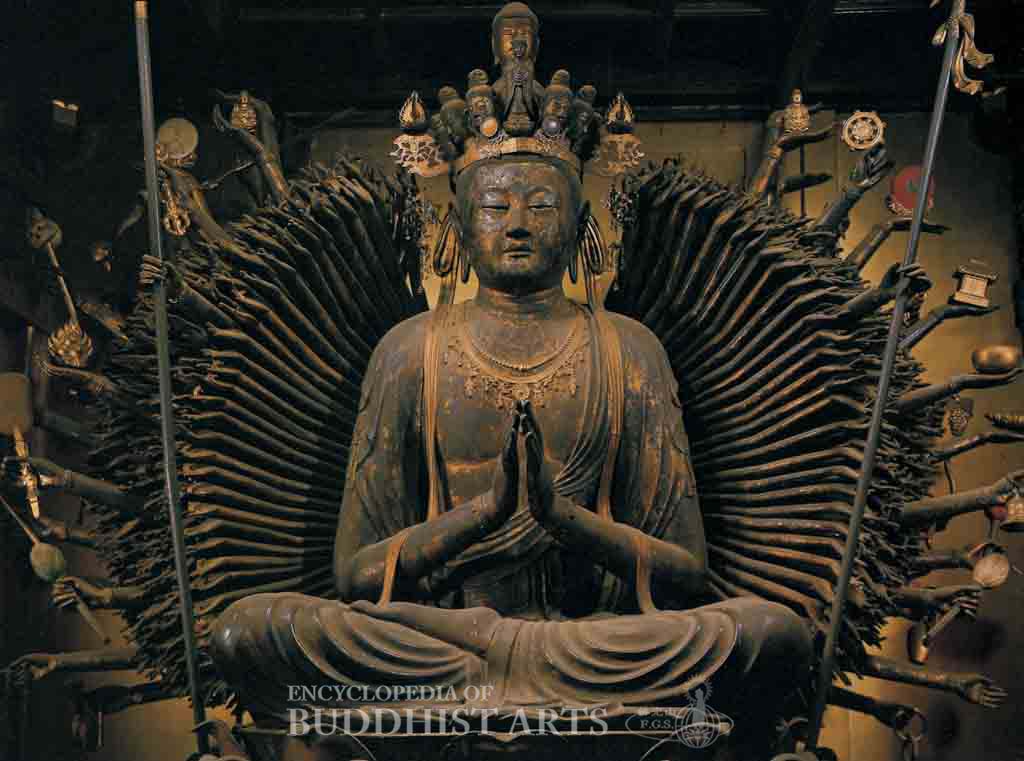
Fujiidera Temple Main Hall: Thousand-Armed Avalokitesvara
Dry lacquer
Fujiidera Temple Main Hall: Thousand-Armed Avalokitesvara
JAPAN, Osaka, Fujiidera; Nara period
Statues of the Thousand-Armed Avalokitesvara generally have a representative 42 arms, but this rare example actually has more than 1,000. The design, dry lacquer technique and polished gold appearance suggest that the statue was constructed by the Yaoguan workshop in the mid-8th century. It is the earliest Thousand-Armed statue of the Bodhisattva still in existence in Japan and was listed as a National Treasure in 1952.
The Bodhisattva sits in full lotus position on an octagonal, six-layered lotus pedestal. The figure is bare-chested but wears a large double necklace ornamented with pendants as well as a stole that crosses the chest and another which winds round the two principal arms. The front pair of hands are held in manidhara (jewel-holding) mudra; besides these, there are 38 more large arms and 1,001 smaller ones arrayed about the figure. Arranged uniformly, they double as a mandorla effect. The larger hands that protrude from the sides hold various religious implements, with meditating Buddhas at right and left in the top pair. An eye symbolizes the universal watchfulness of this compassionate figure.
The Bodhisattva’s eleven-headed form is represented by a crown surrounded by ten more heads, topped with a figure of Amitabha. Peacocks with spread golden tails are on either side of the crown. The eyes on the tail feathers are symbolic of the Bodhisattva’s watchfulness and the bird’s ability to absorb poison evokes Avalokitesvara’s protective function. The statue produces an impression of grandeur although it is not large.
For more details, go to the Encyclopedia of Buddhist Arts: Sculpture A-F, page 356.
Cite this article:
author = Hsingyun and Youheng and Lovelock, Yann and Chou, Yuan and Huntington, Susan and Edson, Gary and Neather, Robert,
booktitle = {Encyclopedia of Buddhist Arts: Sculpture A-F},
pages = 356,
title = {{Fujiidera Temple Main Hall: Thousand-Armed Avalokitesvara}},
volume = 10,
year = {2016}}