
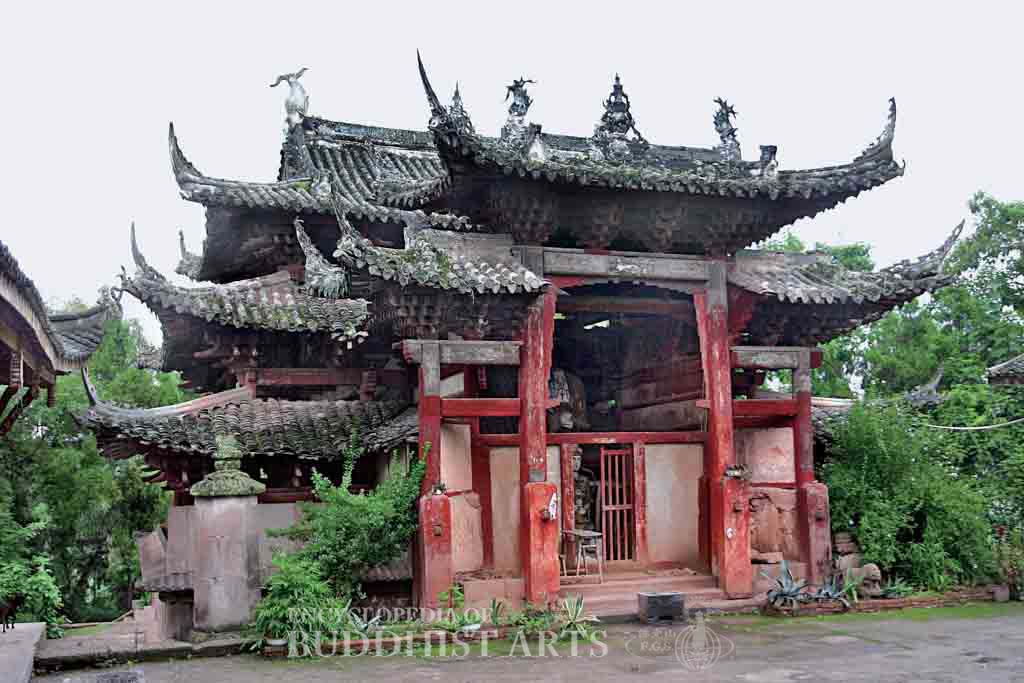
Mumen Temple: Patriarch Hall

Muman Temple: Pavilion of Chan Master Wuji Pagoda (detail)
Mumen Temple
CHINA, Sichuan, Ziyang
Mumen means Wooden Door. The temple was built during the rule of Emperor Yongle (reigned 1402–1424) of the Ming dynasty. The pavilion of Chan Master Wuji has two large wooden doors, and everything else is made from stone. The temple derives its name from these wooden doors. It was listed as a National Cultural Heritage Site in 2006.
The existing structures include the Patriarch Hall, Great Hero Hall, stone gateway, and wooden gateway. The Patriarch Hall has a double-eave hip-and-gable roof. It has a post-and-tie construction. Inside there is a pavilion, which houses the funerary pagoda of Chan Master Wuji. This type of arrangement is unusual in Chinese architecture. The 12 m high pavilion is constructed from stone and has a single-eave pyramidal roof. Carvings of sages, mythical creatures, and lotus buds can be found throughout the pavilion. The bracket sets are carved with a cloud pattern. There are 12 statues of Wuji’s disciples, which all face toward his funerary pagoda. The five-tier, octagonal, stone pagoda is 4.5 m high. It is has no decoration except for a seated image of Wuji carved onto the front side. On the roof, there are layers of clouds, plants, flowers, and lotus buds. On either side of the pavilion, there are two inscribed steles from the Ming dynasty, with anecdotes from Chan Master Wuji’s life as well as information about the pavilion.
For more details, go to the Encyclopedia of Buddhist Arts: Architecture M-S, page 751.
Cite this article:
author = Hsingyun and Youheng and Johnson, Peter and Mankuang and Lancaster, Lewis,
booktitle = {Encyclopedia of Buddhist Arts: Architecture M-S},
pages = 751,
title = {{Mumen Temple}},
volume = 3,
year = {2016}}