
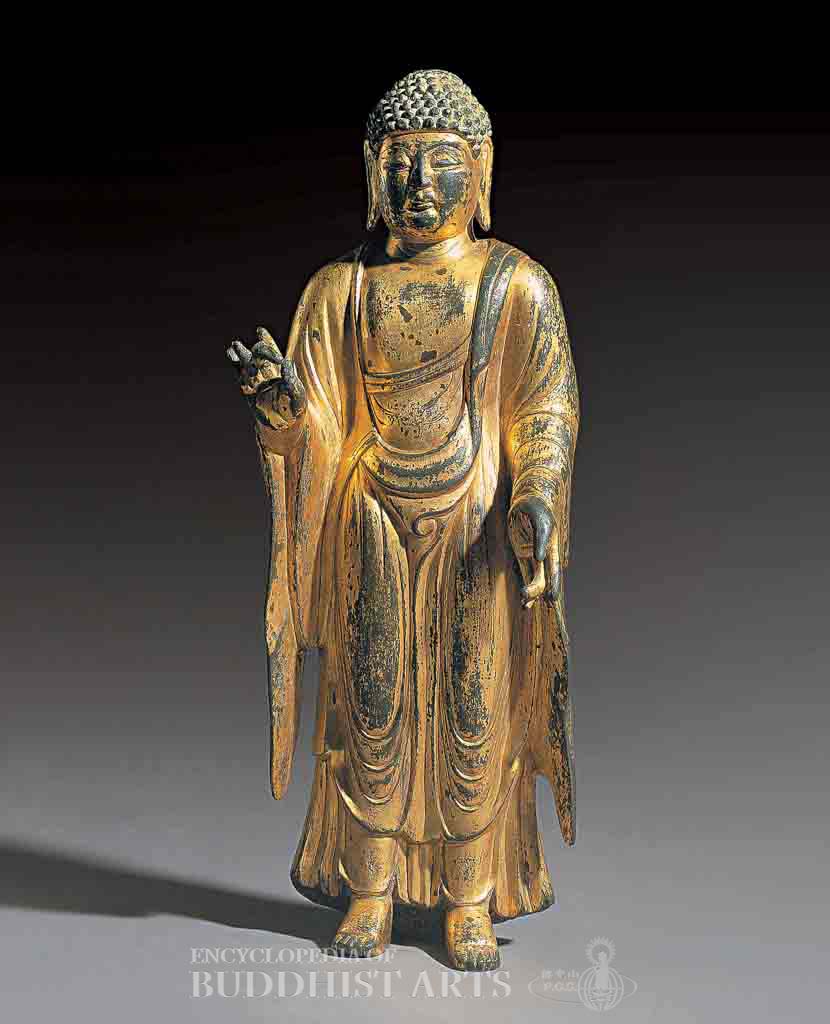
Standing Buddha
Gilt bronze
Standing Buddha
KOREA; Unified Silla dynasty
This statue shares similar traits with the one discovered in the 1970s at the Anapji Pond Banwolseong Palace, suggesting it may date from late 8th to early 9th century. The broad bodied Buddha stands with one arm raised and the other arm lowered. The cap-like hair rises steeply with no transition into a usnisa, a feature common on 8th century Korean statues. The figure wears an outer monastic robe over an inner robe with the material falling deeply from the arms. The material’s folds divide distinctively over the thighs and then ripple downwards. There are tenons on the back that once secured a mandorla.
For more details, go to the Encyclopedia of Buddhist Arts: Sculpture St-Z, page 1145.
Cite this article:
Hsingyun, et al. "Standing Buddha." Encyclopedia of Buddhist Arts: Sculpture St-Z, vol. 13, 2016, pp. 1145.
Hsingyun, Youheng, Yann Lovelock, Yuan Chou, Susan Huntington, Gary Edson, and Robert Neather. 2016. "Standing Buddha" In Encyclopedia of Buddhist Arts: Sculpture St-Z, 13:1145.
Hsingyun, Youheng, Lovelock, Y., Chou, Y., Huntington, S., Edson, G., & Neather, R.. (2016). Standing Buddha. In Encyclopedia of Buddhist Arts: Sculpture St-Z (Vol. 13, pp. 1145).
@misc{Hsingyun2016,
author = Hsingyun and Youheng and Lovelock, Yann and Chou, Yuan and Huntington, Susan and Edson, Gary and Neather, Robert,
booktitle = {Encyclopedia of Buddhist Arts: Sculpture St-Z},
pages = 1145,
title = {{Standing Buddha}},
volume = 13,
year = {2016}}
author = Hsingyun and Youheng and Lovelock, Yann and Chou, Yuan and Huntington, Susan and Edson, Gary and Neather, Robert,
booktitle = {Encyclopedia of Buddhist Arts: Sculpture St-Z},
pages = 1145,
title = {{Standing Buddha}},
volume = 13,
year = {2016}}