
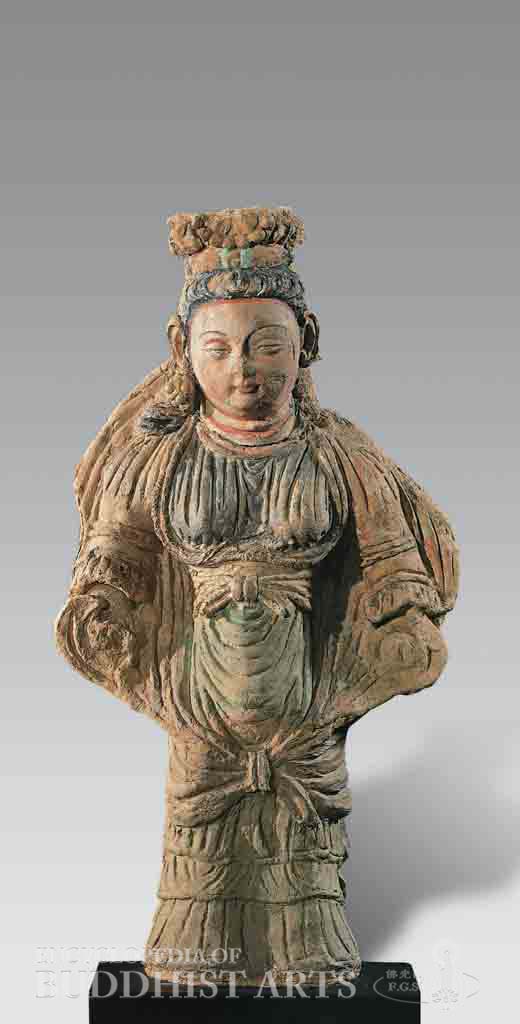
Qigxin: Standing Bodhisattva
Clay
Qigxin: Standing Bodhisattva
CHINA, Xinjiang, Bayingolin
This Bodhisattva statue was discovered by a German archaeological expedition at the start of the 20th century. It incorporates one of the broad, mold-produced heads used for these figures, in this case set slightly to the left and looking down. A floral crown is set above the standard wavy fringe. The Bodhisattva, in a better preserved state than most clay pieces found at Qigxin, is wearing an ornate robe tied at the waist and falling in layers to the feet. A shawl that billows behind the figure is knotted above the thighs.
For more details, go to the Encyclopedia of Buddhist Arts: Sculpture N-Sr, page 857.
Cite this article:
Hsingyun, et al. "Qigxin: Standing Bodhisattva." Encyclopedia of Buddhist Arts: Sculpture N-Sr, vol. 12, 2016, pp. 857.
Hsingyun, Youheng, Yann Lovelock, Yuan Chou, Susan Huntington, Gary Edson, and Robert Neather. 2016. "Qigxin: Standing Bodhisattva" In Encyclopedia of Buddhist Arts: Sculpture N-Sr, 12:857.
Hsingyun, Youheng, Lovelock, Y., Chou, Y., Huntington, S., Edson, G., & Neather, R.. (2016). Qigxin: Standing Bodhisattva. In Encyclopedia of Buddhist Arts: Sculpture N-Sr (Vol. 12, pp. 857).
@misc{Hsingyun2016,
author = Hsingyun and Youheng and Lovelock, Yann and Chou, Yuan and Huntington, Susan and Edson, Gary and Neather, Robert,
booktitle = {Encyclopedia of Buddhist Arts: Sculpture N-Sr},
pages = 857,
title = {{Qigxin: Standing Bodhisattva}},
volume = 12,
year = {2016}}
author = Hsingyun and Youheng and Lovelock, Yann and Chou, Yuan and Huntington, Susan and Edson, Gary and Neather, Robert,
booktitle = {Encyclopedia of Buddhist Arts: Sculpture N-Sr},
pages = 857,
title = {{Qigxin: Standing Bodhisattva}},
volume = 12,
year = {2016}}