
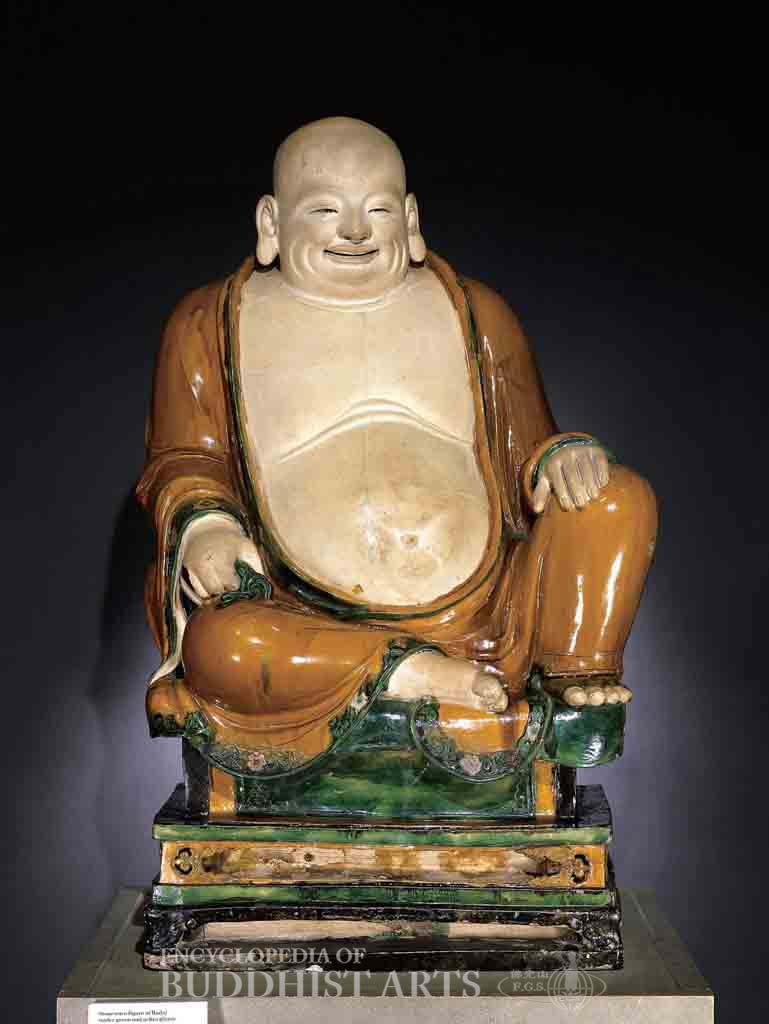
Budai
Stoneware
Budai
CHINA; Ming dynasty
There was a monk called Qici who lived during the Later Liang dynasty (907–923) and used to carry personal belongings in a cloth bag tied to a stick according to Fascicle 27 of the Records of the Transmission of the Lamp. Qici became known as Monk Budai or Cloth Sack, and legend claims the jovial monk as the incarnation of Maitreya. An inscription found on the base of the statue dates it to 1486.
The figure is in three colors and is seated in the posture of royal ease. The smiling face is so creased that the eyes are almost squeezed shut while the neck is hidden by the double chin. The monastic robe with a hem decorated with floral motifs does nothing to hide the rounded belly. The sack carried by the Bodhisattva is tucked under the right hand.
For more details, go to the Encyclopedia of Buddhist Arts: Sculpture A-F, page 190.
Cite this article:
author = Hsingyun and Youheng and Lovelock, Yann and Chou, Yuan and Huntington, Susan and Edson, Gary and Neather, Robert,
booktitle = {Encyclopedia of Buddhist Arts: Sculpture A-F},
pages = 190,
title = {{Budai}},
volume = 10,
year = {2016}}